
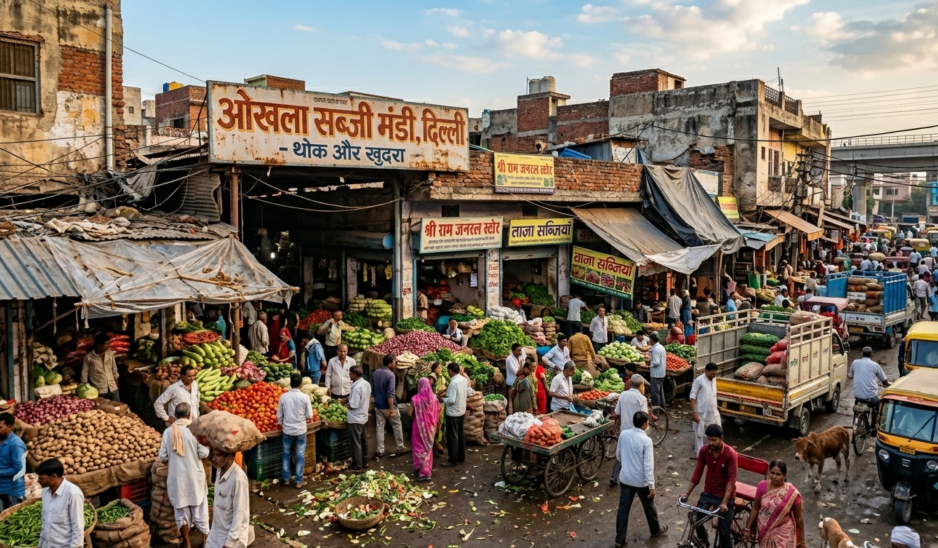
Okhla Mandi, Delhi :- The Relentless Wholesale Food Hub of the Capital
Detailed History
Okhla Mandi, situated adjacent to the high-density Okhla Industrial Area in South-East Delhi, is far more than a local marketplace; it operates as an irreplaceable lifespring that secures the daily dietary and food logistics of the entire Delhi-NCR. Ranking dynamically behind the massive Azadpur Market, Okhla holds the proud distinction of being the second-largest wholesale fruit and vegetable market in New Delhi.
The operational foundation of this mega market was laid in the late 1980s (specifically around 1987-88) by the Delhi Agricultural Marketing Board (DAMB). The core institutional vision was to decentralize the capital’s food distribution networks, establishing a dedicated regional center capable of supplying fresh agricultural produce directly to South and East Delhi, thereby bypassing the severe transit pressures of older northern markets. Over the past four decades, Okhla Mandi has grown into a massive commercial engine. Every single night, hundreds of commercial freight trucks from Haryana, Punjab, Uttar Pradesh, Rajasthan, Himachal Pradesh, Jammu & Kashmir, and distant agrarian states of South India converge here. It functions as the foundational raw material warehouse for thousands of regional sub-vendors, street cart pullers, and premium hospitality establishments across the metropolis.
Detailed Architecture :-
The overall structural layout of Okhla Mandi is configured based on high-utility industrial market blueprints, prioritizing vast space distribution, rapid material transit, and heavy cargo management.
- Wholesale Sheds and Platforms (Arhats) :– The expansive acreage of the market is structurally organized into parallel rows of massive concrete covered sheds and wide distribution bays. Within these spaces operate hundreds of certified ‘Arhats’ (licensed wholesale brokerages). These shops are built on elevated concrete plinths engineered to align perfectly with truck flatbeds, ensuring seamless non-stop unloading and loading of perishable goods. The wide aprons in front of these platforms host the energetic, high-decibel daily morning auctions.
- Specialized Commodity Categorization :– The inner geometry of the market features strict zoning based on the classification of the produce. A vast section is exclusively engineered for high-volume root crops like potatoes and onions; another sector is dedicated to delicate green leafy vegetables, while modern sheltered hangers are reserved for premium seasonal and imported exotic fruits.
- High-Volume Transit Network :– The internal avenues are planned with expansive widths to comfortably accommodate the simultaneous movement of heavy freight trucks, mid-sized commercial tempos, and manual hand-carts. The vertical spaces above the ground shop floors feature compact administrative cabins utilized by merchants for bookkeeping and real-time trade coordination.
- Photography Spots :– While Okhla Mandi does not possess classic architectural aestheticism, it is universally hailed as an absolute paradise for documentary and high-contrast street photography. The pre-dawn hours offer spectacular visual setups under heavy halogen spotlights, reflecting off towering pyramids of deep red tomatoes, emerald green chilies, and diverse multi-colored fruits. The grit of manual laborers navigating heavy wicker baskets overhead, the intense facial expressions of auctioneers, and the endless geometry of canvas sacks provide a magnificent, raw slice of urban human life.
Travel Guide & Routes :-
- Ticket :– As Okhla Mandi functions as an open public commercial yard for agricultural trade, there is absolutely no entry fee or ticket criteria. Access is completely free for everyone.
- Visiting Time :– The market framework remains active 24 hours a day, 7 days a week, but its true cultural essence peaks between 02:00 AM and 08:00 AM. This is the prime window for heavy truck arrivals, sorting, and wholesale bidding. For retail consumers or private buyers looking for optimal deals on minor bulk lots, the ideal timeframe is between 06:00 AM and 09:00 AM.
- How to Reach :–
- By Metro :– The complex enjoys exceptional transit links via the Delhi Metro network. The nearest stations are Okhla NSIC and Kalkaji Mandir on the Violet Line. Additionally, the Okhla Vihar Metro Station on the Magenta Line sits in close proximity. From any of these exits, local e-rickshaws and auto-rickshaws can drop you at the market gates within 5 to 10 minutes.
- By Bus :– The region is flanked by major public transit lanes. Any DTC bus heading towards Kalkaji, Nehru Place, or Okhla Phase-III offers convenient drop-off access points near the main market roundabout.
- By Road :– Nestled right off Captain Gaur Marg and the Outer Ring Road, the market is easily accessible via cabs or private vehicles. (Crucial Safety Note: The approach lanes face severe commercial traffic blocks during the pre-dawn hours; hence, if driving a private car, it is highly recommended to park a short distance away from the core market boundary).
- Nearby Attractions :– The Lotus Temple (Bahá’í House of Worship), the ancient Kalkaji Mata Mandir, the Nehru Place IT Hub, and the scenic Okhla Bird Sanctuary (situated down the river corridor along the Noida border).
- Local Flavors & Famous Markets :– The peripheral entry lanes of the market host legendary 24-hour food kiosks catering to overnight truck drivers and merchants. Visitors can enjoy incredibly robust street food including piping hot samosas, crisp kachoris, and classic Puri-Sabzi paired with strong masala tea. For shoppers, sourcing from Okhla Mandi guarantees access to daily harvested greens and premium fruits at pricing slabs that are 40% to 50% lower than standard neighborhood retail outlets.
Interesting Facts :-
- Okhla Mandi is rapidly converting into a model sustainable market in South Delhi, integrating heavy-duty waste management systems that systematically process tons of daily organic vegetable waste directly into rich agricultural compost and clean biogas.
- The entire commercial velocity of this market relies on instantaneous cash streams or real-time digital bank transfers, smoothly liquidating multi-million-rupee inventories within a highly compressed window of a few hours each morning.
- The market houses premium niche importers whose elite stocks of exotic items—such as high-grade broccoli, zucchini, Thai dragon fruit, and fresh berries—are directly routed to the kitchens of five-star hospitality chains and international embassies located in Lutyens’ Delhi.
Important Questions and Answer :-
Question 1:- Can general households purchase vegetables in minor retail quantities at Okhla Mandi?
Answer:- Okhla Mandi operates fundamentally as a bulk wholesale yard where goods are traded in standardized packing units like whole crates, sacks, or a minimum benchmark weight of 5 kilograms (locally known as a Dhari). However, post 07:00 AM, numerous retail vendors set up external tables near the boundaries to cater to individual domestic shoppers looking for standard family quantities.
Question 2:- What is the absolute best hour to explore the market for tourism and street photography?
Answer: To witness the peak energy, dramatic light beams, and maximum inventory volume, arriving between 04:30 AM and 06:00 AM is highly recommended.
Question 3:- Does Okhla Mandi observe a weekly holiday or day of closure?
Answer:- No. To ensure an uninterrupted food supply chain to the capital, Okhla Vegetable and Fruit Mandi operates non-stop, 365 days a year, with zero weekly closures.
Author’s Thoughts :-
Okhla Mandi is not merely a center for food commerce; it is an incredible testament to human endurance and raw industrious spirit. While the rest of the city rests in comfort, the farmers, brokers, and manual loaders here operate with untiring synchronicity through freezing winter nights and intense monsoons. They ensure that the moment the capital wakes up, fresh, nutritious food is ready for every household kitchen. The rustic smell of earth, the competitive bidding roars, and the absolute motion of this space reveal the true backbone of India’s agricultural trade. To appreciate the unfiltered, working-class pulse that fuels the life of New Delhi, an early morning journey into Okhla Mandi is an unforgettable revelation.
“Thriving dynamically from the dark hours of midnight to the first golden rays of dawn, the untiring rhythm of Okhla Mandi stands as the mighty pillar keeping the kitchens of millions across Delhi-NCR nourished and alive.”