
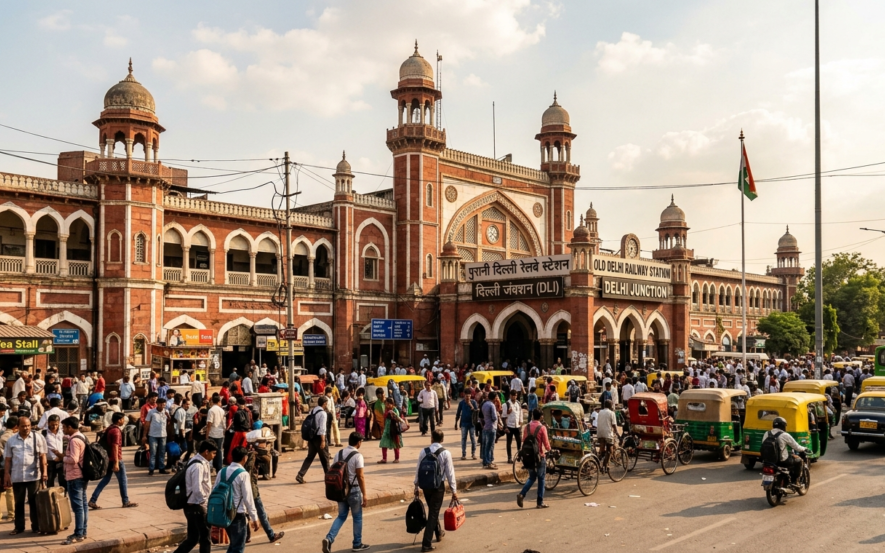
Historic and Colossal: Old Delhi Railway Station (Delhi Junction :- DLI)
Nestled in the heart of the walled city, the Old Delhi Railway Station, officially designated as Delhi Junction (DLI), is one of the oldest, most historic, and incredibly busy railway terminals in India. Far more than a mere transit point, this iconic station stands as a living testament to the glorious heritage of Indian Railways, the historic charm of Purani Dilli, and the collective memories of generations of travelers.
Detailed History :-
The historical timeline of Delhi Junction is deeply intertwined with the dawn of the railway revolution in the Indian subcontinent. This legendary station was first opened in the year 1864 during the British Raj, marking the historic completion of the railway line connecting Calcutta (now Kolkata) and Delhi.
- A Grand Rebirth :– Initially established as a modest station, the continuous growth of rail traffic necessitated a massive upgrade. Consequently, in the year 1903, the British administration remodeled and expanded the structure into a monumental junction, reopening it with unmatched architectural grandeur.
- Historical Significance :– The station has been a silent witness to crucial historical milestones, including the Indian Freedom Struggle, the poignant arrival of refugees during the Partition of 1947, and the shaping of modern India. Before the commissioning of New Delhi Railway Station (NDLS), Delhi Junction served as the primary gateway to the capital.
Detailed Architecture :-
The monumental facade of Delhi Junction instantly captivates visitors with its striking resemblance to the Mughal and British colonial architectural aesthetics.
- Fort-like Facade :– The defining architectural highlight of the station is its exterior, constructed entirely of deep red bricks designed to mimic an ancient fort or a majestic Mughal palace. Featuring detailed battlements, towering turrets, and elegant semi-circular arches, the building harmonizes beautifully with the nearby Red Fort.
- Platforms and Infrastructure :– Presently, the junction operates seamlessly with 16 massive platforms. The inner layout is brilliantly structured to handle high passenger volumes smoothly. While retaining its old-world heritage character, the interiors have been progressively upgraded with premium modern amenities, including escalators, smart digital signage, and air-conditioned passenger lounges.
Travel Guide & Routes :-
- Ticket :– Access to the active platform zones requires a mandatory Platform Ticket (available via UTS counters or mobile applications). Commuters can easily secure transit tickets via online IRCTC portals or through the massive booking windows inside the main concourses.
- Timings :– Delhi Junction operates continuously, remaining functional 24 Hours a day, 7 Days a week. The majestic terminal never sleeps, keeping up with a ceaseless rotation of passenger and express fleets.
- How to Reach :– The station is strategically positioned in Old Delhi, closely bordering the historic markets of Chandni Chowk and Kashmiri Gate.
- By Metro :– The absolute most efficient way to commute is via the Delhi Metro. The ‘Chandni Chowk’ Metro Station (Yellow Line) features a dedicated underground pedestrian subway that leads directly inside the railway station complex. Additionally, the ‘Red Fort’ Metro Station (Violet Line) is within close walking distance.
- By Road :– Positioned adjacent to the Kashmiri Gate ISBT, the junction enjoys phenomenal road connectivity. Public DTC buses, local auto-rickshaws, e-rickshaws, and private app-based cabs service the terminal round the clock.
- Photography Spots :– The stunning red heritage brick facade of the station exterior, the ornate main entrances facing Chandni Chowk, and the visual symmetry of long-distance trains resting on the platforms serve as excellent backdrops. For safety reasons, photography on active rail tracks is strictly prohibited.
- Local Flavors & Famous Markets :– Stepping out of the station doors leads you directly into India’s culinary paradise. Indulge in the world-famous varieties at the iconic ‘Paranthe Wali Gali’, cooling desserts at ‘Giani di Kulfi’, and artisanal street food across Chandni Chowk. For shoppers, Asia’s ultimate wholesale markets—Chandni Chowk, the historic Chor Bazaar, and Bhagirath Palace (electronics hub)—are located right outside.
Nearby Attractions :-
- The Red Fort (Lal Qila) :- The crowning jewel of Mughal architecture and a UNESCO World Heritage Site, located just 1.5 km away from the railway terminal.
- Jama Masjid :- One of the grandest and largest historic mosques in India, globally celebrated for its immense sandstone minarets and white marble domes.
- Sri Gauri Shankar Temple & Gurudwara Sis Ganj Sahib :- Situated along the main spine of Chandni Chowk, these revered spiritual shrines represent India’s rich religious harmony and ancient devotion.
- Kashmiri Gate :- A monument of supreme historical importance, preserving the rugged scars and battle remnants of the Uprising of 1857.
- Salimgarh Fort :- An ancient riverside fortress adjoining the Red Fort, which was later utilized as a high-security military prison during both Mughal and British eras.
Interesting Facts :-
- Delhi Junction holds the distinction of being the first major Indian railway hub directly integrated with an underground metro subway linkage, allowing commuters to switch transit modes without exiting the station gates.
- Historical records show that the very first train to steam into this station in 1864 crossed over the old iron bridge (Loha Pul) over the Yamuna River to complete its maiden journey from Calcutta.
- Because of its uniquely majestic, old-world architectural appearance, the station has been featured as a prominent backdrop in numerous blockbuster Bollywood historical and drama films.
Important Questions and Answer :-
Question 1:- What is the official station code for the Old Delhi Railway Station?
Answer:- The official Indian Railways station code for Delhi Junction is DLI.
Question 2:– How is the station connected to the Delhi Metro network?
Answer:- The station is directly connected to the Chandni Chowk Metro Station on the Yellow Line via a seamless underground pedestrian subway corridor.
Question 3:– What makes the outer appearance of Delhi Junction unique?
Answer:- The exterior is uniquely styled to resemble a fortressed castle with red brick masonry and grand battlements, a design specifically chosen by British architects to complement the historic architecture of Old Delhi.
Author’s Thoughts :-
The Old Delhi Railway Station (Delhi Junction) is far more than a network of iron tracks and concrete platforms; it is a living archive of Delhi’s timeless soul. Its red brick walls tell a stories of a bygone era. Even today, walking through its gates brings back the nostalgic romance of classic Indian rail travel—the echoing calls of the porters, the aroma of fresh tea, and the vibrant sea of travelers. If you wish to experience the authentic heartbeat and untamed energy of historic Delhi, spending a few moments exploring this monumental junction is an experience you simply cannot miss.
“Stay connected with us on this journey through the depths of history and spirituality.”