
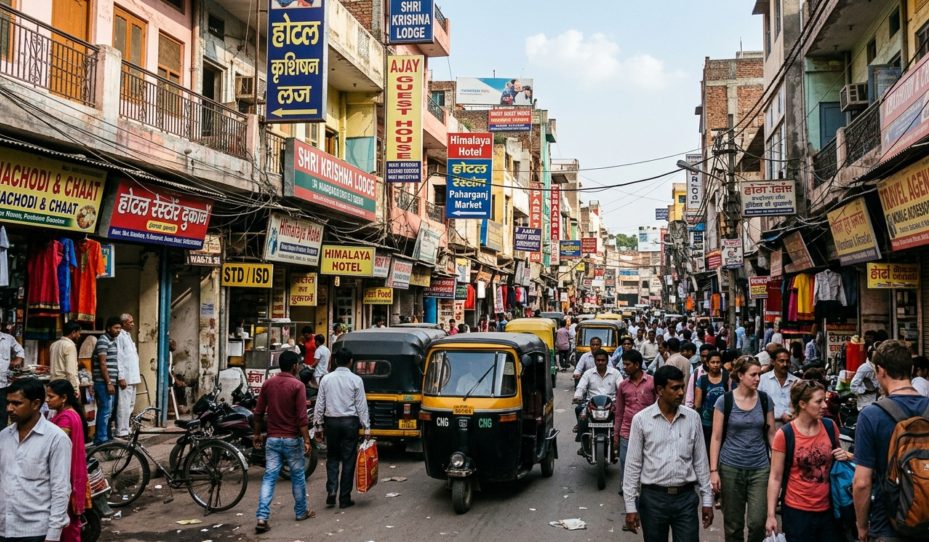
Paharganj :- Delhi’s Historic Backpackers’ Paradise and the Vibrant Cultural Market
Detailed History
One of the oldest and most vibrant localities of Delhi, the history of Paharganj dates back to the Mughal era. During Mughal rule, it was developed as a major strategic commercial suburb just outside the Ajmeri Gate, one of the main gateways of ‘Shahjahanabad‘ (Old Delhi). It derived its name ‘Paharganj‘ (meaning Hilly Market) due to its slightly elevated, hilly topography and sloping terrain.
Historically, it was one of the five principal markets of Delhi and housed the main grain market (Anaj Mandi) of the city. The destiny of Paharganj transformed dramatically in the 1930s with the construction of the New Delhi Railway Station right adjacent to it. Post-independence, and particularly during the ‘Hippie Movement’ of the 1970s, this place emerged as the grandest hub for budget travelers and backpackers from across the globe. Today, Paharganj stands as a unique, colorful, and historic bridge between Old and New Delhi.
Detailed Architecture
The architecture of Paharganj displays a fascinating blend of Old Delhi’s narrow, labyrinthine alleys and the vibrant, commercial framework adapted to western tourism.
- Exterior :– The exterior identity of Paharganj is heavily defined by its bustling Main Bazar road. The main street is lined on both sides by multi-story buildings that showcase a mix of colonial-era and modern architectural styles, with ground floors dominated by bright neon signboards and shop displays. High-rise budget hotels, bohemian cafes, garment shops, and a perpetual sea of crowds give its exterior layout an extremely energetic and dynamic appearance. Near the New Delhi Railway Station entrance, the access paths display a more spacious and modern urban transit infrastructure.
- Interior :– Branching off from the Main Bazar street, the interior layout of the inner alleys is highly dense, compact, and narrow. The internal architecture of the vintage hotels and budget guest houses here is smartly designed to maximize guest accommodation within limited urban spaces. Many famous cafes (such as Cafe Clairemont or Zion) feature highly creative interiors adorned with hippie wall arts, ambient low-lighting, and cozy wooden furniture, offering an international, homely, and comforting vibe to foreign travelers.
Travel Guide & Routes
Paharganj is an open, vast, and round-the-clock (24/7) active commercial and residential neighborhood in Delhi.
- Ticket :– No ticket or entry fee is charged to explore the Main Bazar, streets, or public zones of Paharganj; it is entirely free of cost.
- Visiting Time :– The main locality and its hotels operate 24/7. However, the retail shops usually open around 11:00 AM and close between 9:00 PM and 10:00 PM. The afternoon and late evening hours are considered the best times to experience the street food and shopping scene.
- How to Reach :– Reaching Paharganj is arguably the easiest in Delhi as it is situated directly opposite the New Delhi Railway Station (NDLS). The nearest metro transit points are the New Delhi Metro Station (Yellow Line and Airport Express Line) and the R.K. Ashram Marg Metro Station (Blue Line). Exiting either station places you directly at the entry points of Paharganj Main Bazar. Additionally, DTC buses, autos, and e-rickshaws are available from all parts of Delhi at all hours.
- Photography Spots :– If you are passionate about street and portrait photography, Paharganj is an absolute goldmine. The vibrant textile shops, foreign travelers navigating the chaotic lanes, glittering neon signs at night, and the panoramic aerial view of the New Delhi Railway Station from various popular rooftop cafes provide spectacular frames for urban photographers.
- Local Food & Famous Markets :– Paharganj is globally renowned for its eccentric food palate and budget-friendly shopping. The legendary ‘Sitaram Diwan Chand’ located here serves Chole-Bhature that are famous all over India. Furthermore, the rooftop cafes here are highly popular for serving authentic Italian pastas, Israeli falafels, and fresh European bakes from German bakeries. For shopping, the Main Bazar is celebrated for highly affordable hippie clothing, genuine leather bags, handicraft items, artificial junk jewelry, and aromatic traditional attars (perfumes).
Nearby Attractions :-
- Connaught Place (CP) :– Situated barely 1-2 kilometers away, this is Delhi’s premier commercial and heritage financial hub, famous for its grand white Georgian architecture and upscale brand showrooms.
- Hanuman Temple (Connaught Place) :– Located close by, this is an ancient and historic temple housing a magnificent, towering deity of Lord Hanuman, serving as a massive center of spiritual faith.
- Jama Masjid :– Located in Old Delhi, it is one of the largest and most magnificent mosques in India, renowned for its classic Mughal architecture and the lip-smacking Mughlai street food surrounding it.
- Sadar Bazar :– Located right adjacent to Paharganj, this is Delhi’s largest wholesale market complex where everything from household utilities to lifestyle goods can be purchased at rock-bottom prices.
Interesting Facts
- Paharganj is often affectionately called Delhi’s ‘International Village’ due to the casual presence of budget backpackers, spiritual seekers, and hippie culture enthusiasts from almost every country on Earth.
- The raw and rustic alleys of Paharganj have served as the background settings for several critically acclaimed Bollywood movies like ‘Dev D’, ‘Dil Se’, and various international indie documentaries.
- Many cafes and restaurants here custom-print their menus in Hebrew, Spanish, and French alongside Hindi and English to offer a seamless dining experience to their vast international clientele.
Important Questions and Answer :-
Question 1:- Is hard bargaining necessary while shopping in the Paharganj Main Bazar?
Answer:- Yes, bargaining is highly essential while purchasing items in Paharganj. Shopkeepers often quote premium prices to tourists, so always negotiate politely to get the best value for your items.
Question 2:- Do the food stalls and cafes in Paharganj remain open late into the night?
Answer:- Yes, owing to its proximity to the New Delhi Railway Station, several local dhabas, tea stalls, and rooftop cafes operate late into the night and early morning hours to cater to train travelers.
Author’s Thoughts :-
Paharganj is a magical urban theater in Delhi that presents a new story with every visit. It is certainly not a place designed for those who prefer pristine, manicured luxury; the true essence of Paharganj lies in its organized chaos, the lightning-fast pace of its narrow alleys, and its incredibly diverse, multi-ethnic soul. If you wish to experience the raw, unfiltered heartbeat of Delhi, feast on iconic Chole-Bhature, and cross paths with global nomads, a stroll through the lanes of Paharganj will surely become one of the most memorable chapters of your Delhi exploration.
“Paharganj is that kaleidoscopic caravan ground of Delhi where global pathways converge, and every narrow alleyway whispers a new chronicle of time.”