
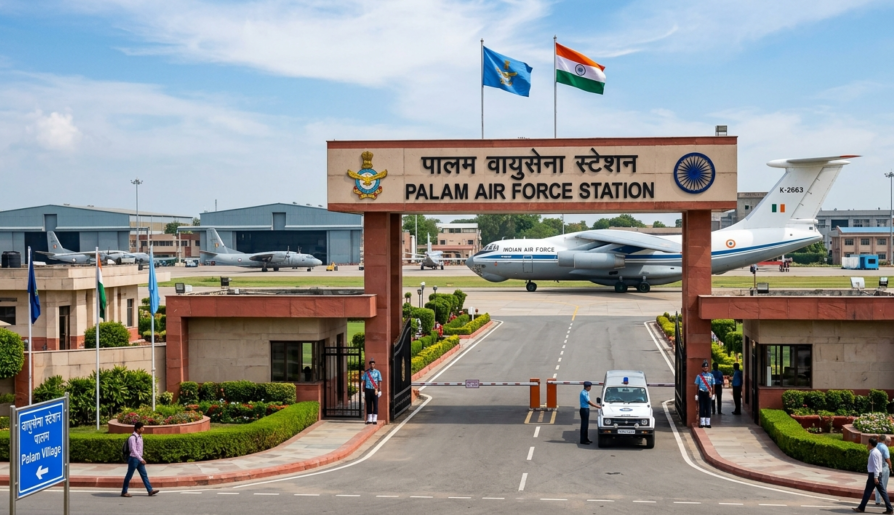
Palam Air Force Station, Delhi
Palam Air Force Station, officially designated as 3-Wing AFS Delhi, is a highly strategic and crucial base of the Indian Air Force. Located in the southwestern part of New Delhi, this station serves as the principal hub for VVIP aircraft operations, military logistics, and the airspace security of the national capital. For general citizens, the Indian Air Force Museum, situated right next to the secured technical area, is the star attraction showcasing India’s glorious aviation heritage.
Detailed History :-
The historical roots of Palam Air Force Station trace back to the Second World War era. Established in the year 1943 during British rule as ‘RAF Palam’ (Royal Air Force), it functioned as a frontline airfield coordinating Allied air operations across Asia.
Following India’s independence in 1947, command of the station was handed over to the Indian Air Force (IAF). Owing to its critical strategic location, civil aviation operations were also hosted here for a significant period. In 1962, commercial passenger traffic from Delhi’s first airfield (Safdarjung) was shifted to Palam. Later, to handle the exponential rise in international air traffic during the 1980s, a new terminal facility was constructed, and on May 2, 1986, it was renamed ‘Indira Gandhi International Airport’ (IGIA). Today, while commercial flights fly exclusively out of IGI, the original Palam station remains a dedicated and high-security military installation.
Detailed Architecture :-
While the structural core of Palam Air Force Station’s operational base is completely restricted due to military security, its public sector—the IAF Museum—exhibits a thoroughly planned and unique architectural layout:
- Indoor Exhibit Layout :– The interior gallery of the museum is divided into linear and U-shaped configurations. Upon entering, visitors navigate a single-story gallery exhibiting historic photographs, gallantry medals, customized uniforms, personal weapons, and artifacts belonging to former Chiefs of Air Staff preserved in pristine glass cases.
- The Massive Hangar :– The indoor transit path seamlessly leads into a towering, clear-span aircraft hangar. This structure houses small-scale vintage aircraft, frontline decommissioned fighter jets (such as the HAL Gnat and MiG-21), anti-aircraft artillery, radar units, and captured trophies of past conflicts.
- Outdoor Gallery & Open Expanse :– The outdoor display zone is flat and wide open, optimized to leverage natural daylight. Giant strategic transport aircraft (like the Antonov An-12) and heavy fighters are permanently parked in their authentic combat configurations alongside captured enemy tanks and heavy armored vehicles.
Travel Guide & Routes
Tickets & Entry :–
- Entry Ticket :– ₹30 per individual.
- Camera Fee :– Photography using mobile phones or digital cameras is completely free of charge.
- Clock Room & Parking :– Vehicle parking space and luggage storage at the dedicated baggage counter are provided entirely complimentary.
Timings :–
- Visiting Hours :– Open from 10:00 AM to 05:00 PM.
- Weekly Closure :– The museum remains strictly closed on Mondays, Tuesdays, and all Gazetted Government Holidays. It welcomes visitors from Wednesday through Sunday.
How to Reach :–
- By Metro :– The closest transit station is ‘Sadar Bazar Cantonment’ on the Magenta Line. The museum entrance gate is located just 650 meters away from the metro exit, which can be easily reached on foot or via an e-rickshaw.
- By Bus :– Numerous Delhi Transport Corporation (DTC) buses heading towards Dwarka Flyover or Palam Village stop directly at the ‘IOL’ bus stop, situated adjacent to the museum.
- By Road/Taxi :– The base is directly accessible from National Highway 48 (NH-48). Travelers from Delhi or NCR (Noida/Ghaziabad) can easily take a taxi or drive down via Dhaula Kuan onto the Palam Road. It is located just 1.5 kilometers away from IGI Airport Terminal 1.
Photography Spots :–
- Next to the massive laser-guided missile system mounted right at the museum’s entrance gate.
- In front of the legendary Sukhoi (Su-7) and MiG-21 FL fighter jets parked in the outdoor display yard.
- Beside the actual battle-tested enemy tanks and war trophies displayed in the open arena.
Local Food & Shopping :–
- Dining Options :– A dedicated light snack bar operates within the museum perimeter serving fresh tea, coffee, and quick refreshments. For extensive dining, the neighboring Delhi Cantt area and Gopinath Bazar host highly popular eateries famous for authentic North Indian Chole Bhature, Samosas, and South Indian cuisines.
- Famous Markets :– ‘Gopinath Bazar’ (Delhi Cantt) is the closest prominent market arena, celebrated for apparel, shoes, tactical gear, electronics, and daily essentials. Additionally, the bustling Palam Main Market serves as another excellent neighborhood retail hotspot.
Interesting Facts :-
- Pioneer Aerospace Museum :– Founded in 1967, this is the very first aviation and aerospace museum established in India. For decades, it stood as the country’s sole aviation archive until the Naval Aviation Museum opened in Goa in 1998.
- Vintage Combat Fleet :– The collection ranges from rare World War I era vintage trainers like the ‘Tiger Moth’ to frontline fighters deployed actively during the Kargil Conflict.
- The VVIP Flight Wing :– This base serves as the exclusive home of the IAF’s Communication Squadron, which meticulously maintains and pilots specialized aircraft (such as the Boeing 777 ‘Air India One’) designated for the transport of the President, Prime Minister, and visiting foreign Heads of State.
Important Questions and Answer :-
Question 1:– Are general civilians allowed to tour the operational zones of Palam Air Force Station?
Answer:- No, due to high-level defense protocols, the primary technical and administrative command areas of Palam Air Force Station are strictly restricted. Civilians can only visit the public-access Indian Air Force Museum situated inside the station complex.
Question 2:– Is this museum environment suitable for young children?
Answer:- Absolutely. It serves as an incredibly educational and inspiring venue for children, offering them a close-up look at actual fighter planes and chronicling the heroism of the air force, which fosters national pride and an interest in aviation science.
Question 3:– Do I need to pay extra to take pictures with my phone inside the museum?
Answer:- No, there is no additional or hidden fee for standard photography using mobile devices or digital cameras inside the Palam IAF Museum. It is included in the basic entry ticket.
“Safeguarding the legacy of the skies and the valiant tales of India’s air warriors, Palam Air Force Station stands as a living testament to the nation’s soaring military prowess.”