
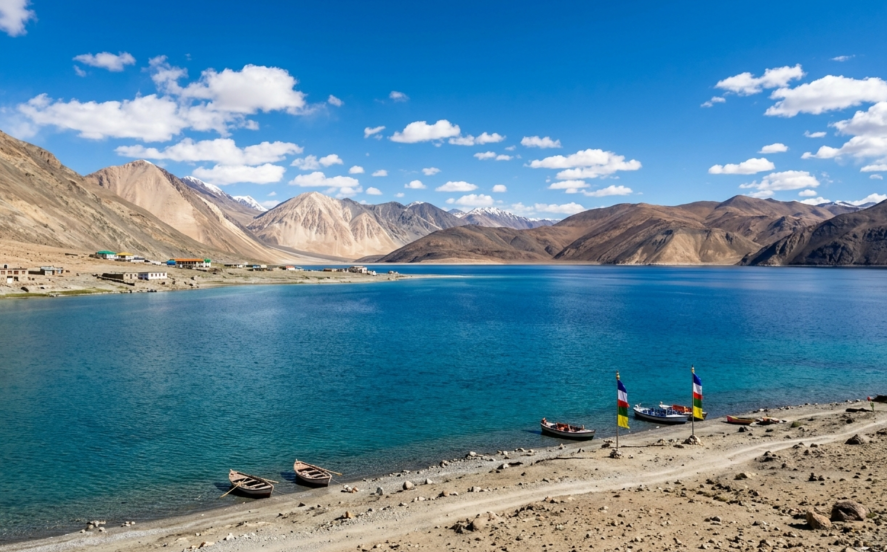
Pangong Tso Lake :- A Magical Realm of Colors in the Himalayas
Detailed History
Pangong Tso, also known as Pangong Lake, is a magnificent endorheic lake located in the Union Territory of Ladakh at an elevation of 4,350 meters. The name ‘Pangong‘ is derived from the Tibetan word for ‘High Grassland Lake‘. Spanning about 134 km, it stretches from India to China, with about one-third of it lying in India. Historically part of the ancient trade routes, it gained massive popularity worldwide after being featured in the movie ‘3 Idiots’. It remains a strategically sensitive and breathtakingly beautiful natural wonder.
Detailed Architecture/Structure
Exterior Structure :–
- Linear Formation :– The lake is extremely long and narrow, nestled between the towering ridges of the Karakoram and Himalayan ranges.
- Surrounding Terrain :– It is bordered by stark, arid, and brownish mountains. The contrast between the dry, rugged mountains and the vibrant blue water defines its exterior aesthetic.
- Saline Nature :– Being an endorheic basin, it does not drain into any sea. The high salt concentration makes it a saline lake.
Internal Ecosystem :–
- Color-Changing Phenomenon :– The most famous internal feature is its ability to change colors from deep blue to turquoise and light green as the sun moves across the sky.
- Crystal Clarity :– The water is remarkably clear due to the lack of industrial pollution and human interference.
- Biology :– Due to high salinity and freezing temperatures, the lake has very little aquatic life, hosting only some micro-organisms and crustaceans.
Nearby Attractions :-
- Spangmik Village :– The most popular residential hub for tourists near the lake.
- Chang La Pass :– The gateway to the lake, standing at a staggering 5,360 meters.
- Tangste :– A picturesque town offering a glimpse into local Ladakhi culture and monasteries.
- Rezang La War Memorial :– A tribute to the brave soldiers who fought during the 1962 war.
- Chushul Valley :– A remote and scenic valley known for its raw Himalayan beauty.
Travel Guide & Routes :-
- Tickets & Permits :– Indian tourists require an Inner Line Permit (ILP), which can be obtained online or from the Leh DC office.
- Timing :– The ideal time is from late May to September. In winter, the lake freezes completely.
- How to Reach :– It is about 160-170 km from Leh. One can hire a taxi or ride a motorcycle, which takes about 5-6 hours.
- Photography Spots :– The ‘Yellow Scooter’ spot from 3 Idiots and the crystal-clear shoreline during sunrise.
- Local Taste :– Warm yourself with ‘Thukpa‘ (noodle soup) and ‘Butter Tea’ at the local lakeside stalls.
- Famous Markets :– Leh Main Market for Tibetan antiques, prayer flags, and woolens.
Interesting Facts
- Despite being a saltwater lake, it freezes solid during the winter months, allowing people to walk or even drive on it.
- It is one of the highest saltwater lakes in the world.
- The Line of Actual Control (LAC) between India and China passes through this lake.
Important Questions and Answer :-
- Question:- What is the altitude of Pangong Lake?
- Answer:- It is located at approximately 4,350 meters (14,270 feet) above sea level.
- Question:- Can we go for a boat ride in Pangong?
- Answer:- No, civilian boating is not permitted due to security reasons.
- Question:- Is one day enough for a Pangong trip?
- Answer:- While a day trip is possible, an overnight stay is highly recommended to witness the sunrise and sunset.
- Question:- Is oxygen a problem at Pangong?
- Answer:- Yes, the air is thin. It is essential to acclimatize in Leh for at least 48 hours before visiting.
- Question:- Are there permanent hotels at the lakeside?
- Answer:- Permanent construction is restricted; tourists mostly stay in luxury tented camps or local homestays in Spangmik.
Author’s Thoughts :-
Pangong Tso is a place that defies description. The sheer scale of the landscape and the silence that envelopes the blue waters make you feel incredibly small yet profoundly connected to nature. It is a destination that demands respect for its harsh environment and rewards you with views that are literally out of this world. It is the crown jewel of Ladakh’s wilderness.
“Where the blue of the sky meets the soul of the earth—that is Pangong Tso.”