
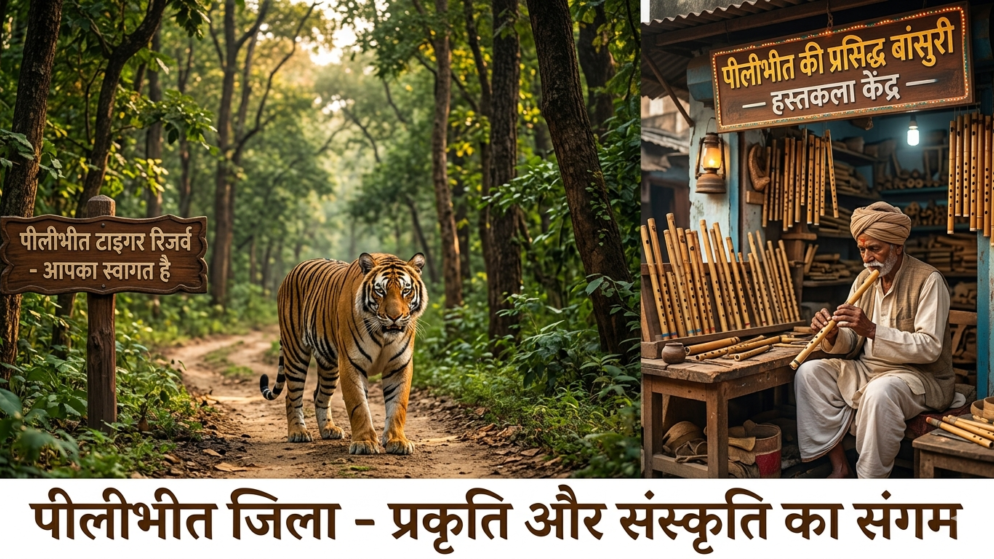
Pilibhit :- The Greenery of Terai and the Abode of Tigers
Detailed History
Pilibhit is an exceptionally beautiful district rich in natural resources, located in the Rohilkhand region of Uttar Pradesh. Situated on the Indo-Nepal border, this district is known for its dense forest wealth. Historically, the name Pilibhit is derived from the words ‘Pili‘ (yellowish soil) and ‘Bhit‘ (mound or wall). During the medieval period, the area was under Mughal rule and later governed by Rohilla chiefs. Hafiz Rehmat Khan, a prominent Rohilla leader, constructed the magnificent Jama Masjid and several other structures here. Today, Pilibhit is globally recognized for its ‘Tiger Reserve‘ and its world-class handcrafted ‘Flutes‘ (Bansuri). It is a preferred destination in Uttar Pradesh for nature lovers and wildlife enthusiasts.
Detailed Architecture
The architecture of Pilibhit displays a blend of historical Mughal style and the natural simplicity of the Terai region.
- Exterior Architecture :– The external structure of the Jama Masjid reflects the grandeur of Mughal architecture with its massive gateways and beautiful domes. Traditional brick and lime work can be seen in the older markets and administrative buildings. Due to the Terai climate, rural houses are built to provide protection from humidity and wild animals.
- Interior Architecture :– The carvings and arches inside the Jama Masjid are reminiscent of the Jama Masjid in Delhi. Inside temples like Gauri Shankar, there is a tranquil atmosphere with finely carved pillars. The flute-making workshops of Pilibhit also have a unique setup where local artisans artistically shape the bamboo.
Nearby Attractions
- Pilibhit Tiger Reserve :– The biggest attraction of the district, where you can spot tigers, leopards, deer, and hundreds of bird species. The Chuka Beach inside the reserve is a unique tourist spot.
- Jama Masjid :– Built in 1769, this mosque is famous for its architecture, representing a perfect confluence of Mughal and Rohilla styles.
- Gauri Shankar Temple :– An ancient and sacred temple located near the confluence of the Devha and Khakra rivers. A grand fair is organized here on Mahashivratri.
- Chuka Beach :– Located on the banks of the Sharda Sagar Dam, this spot offers a beach-like experience. Tree houses are available for overnight stays.
- Mathot Ghat :– A peaceful and scenic spot on the banks of the Sharda River, known for its natural beauty.
Travel Guide & Routes
- Tickets and Timings :– Prior booking and a prescribed fee are mandatory for the Tiger Reserve and safaris. Entry to temples and mosques is Free. Safari timings are divided into morning and evening slots.
- How to Reach :–
- By Rail :– Pilibhit Junction (PBE) is the main station, well-connected to Bareilly, Lucknow, and Delhi.
- By Road :– Pilibhit is connected via NH-730 and NH-731 to major cities in UP. It can be reached from Bareilly in 1-2 hours.
- By Air :– The nearest airport is Pantnagar (PGH), located about 70 km away.
- Photography Spots :– Sunset at Chuka Beach, the dense forests of the Tiger Reserve, and the architecture of Jama Masjid.
- Local Taste :– The ‘Khurma’ sweet of Pilibhit and the ‘Dal-makhani’ at local dhabas are highly popular.
- Famous Markets :– Flute Market (Bansuri Bazar), where you can buy the world-famous Pilibhit flutes. Additionally, Sadar Bazar is excellent for shopping.
Interesting Facts
- Pilibhit is known as ‘The Flute City‘ because it produces the finest flutes in India.
- Pilibhit Tiger Reserve has received the international ‘TX2’ award for doubling its tiger population.
- The Jama Masjid here is considered an exact replica of Delhi’s Jama Masjid, built by Rohilla rulers.
Important Questions and Answer :-
- Question 1:- What is Pilibhit most famous for? Answer:- Pilibhit is primarily famous for its Tiger Reserve and the world-renowned flute-making industry.
- Question 2:- Where is Chuka Beach located? Answer:- Chuka Beach is located on the banks of the Sharda Sagar Dam within the Pilibhit Tiger Reserve.
- Question 3:- Is the Tiger Reserve open throughout the year? Answer:- No, the Tiger Reserve remains closed for tourists during the monsoon season (usually from June to November).
- Question 4:- What is the distance from Pilibhit to Bareilly? Answer:- The distance by road is approximately 55 to 60 kilometers.
- Question 5:- Which is the most famous sweet of Pilibhit? Answer:- ‘Khurma’ is the most famous and traditional sweet of Pilibhit.
Author’s Perspective
In my view, Pilibhit is a hidden gem of Uttar Pradesh where nature smiles in its purest form. Traveling through the dense Terai forests and hearing the rustle of a tiger is a thrill that cannot be described in words. While the sweet melody of the flute fills the air, the glorious history of the Jama Masjid takes us back in time. If you wish to escape the city noise and enjoy the silence of the forest and the cool Terai breeze, there is no better place than Pilibhit.
“Pilibhit is a wonderful land of echoing melodies and the roar of tigers.”