
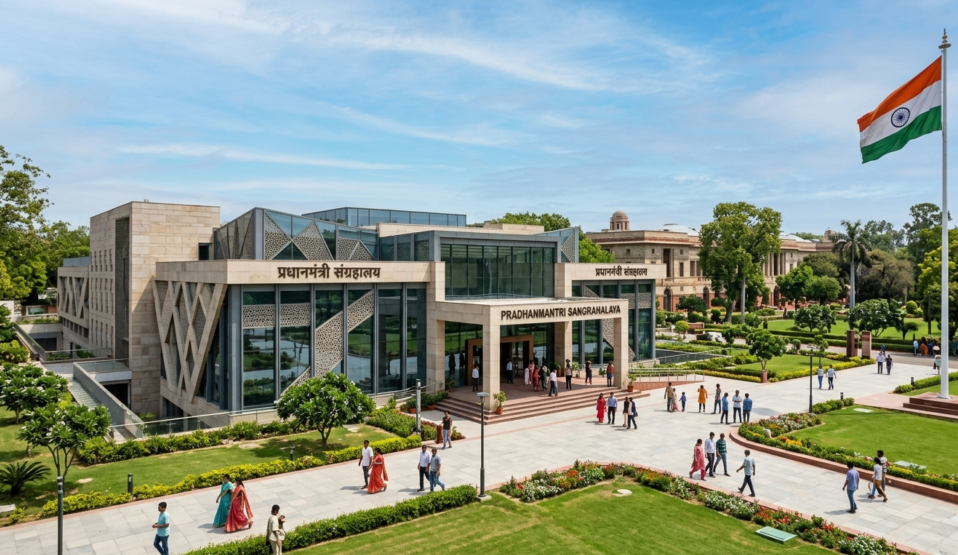
Pradhanmantri Sangrahalaya, New Delhi :- A Magnificent Saga of Modern India’s Nation-Building and Leadership
Nestled within the historic Teen Murti Estate along Teen Murti Marg in New Delhi, the Pradhanmantri Sangrahalaya (Prime Ministers’ Museum) stands as the definitive, state-of-the-art institution documenting the political, social, and economic evolution of independent India. Far outgrowing the paradigms of a traditional, passive gallery, it functions as an interactive, highly immersive cultural bridge that traces the journey of a resilient nation through the lenses of its leadership. Dedicated to the nation in April 2022, the museum comprehensively honors every single Prime Minister of India, seamlessly chronicling their early struggles, path-breaking policy initiatives, core institutional decisions, and the monumental milestones achieved during their respective tenures. Powered by futuristic technologies such as high-definition holograms, Virtual Reality (VR), kinetic art installations, and multi-touch interactive displays, this architectural marvel offers a deeply inspiring and educational odyssey. For global travelers and history enthusiasts eager to decipher how India navigated complex geopolitical waves to emerge as a global powerhouse, this museum is an absolute, non-negotiable destination.
Detailed History
The foundational philosophy of the Pradhanmantri Sangrahalaya is rooted in institutional inclusivity and the holistic preservation of India’s democratic heritage.
- The Legacy of Teen Murti Estate :– The geographic footprint of the museum carries immense historical weight. Originally engineered during the British Raj as ‘Flagstaff House’, the grand mansion served as the official residence of the Commander-in-Chief of the British Indian Army. Post-Independence, the neoclassical estate was designated as the official residence of India’s first Prime Minister, Pandit Jawaharlal Nehru, who inhabited the premises for 16 years until his demise in 1964. Subsequently, the campus was converted into the iconic Teen Murti Bhavan, housing the Nehru Memorial Museum and Library (NMML).
- The Evolution of the Concept :– As India’s democratic identity matured, the state recognized the imperative need to institutionalize a collective tribute that acknowledges the equal and distinct contributions of every Prime Minister, moving beyond single-leader narratives. Under the visionary leadership of Prime Minister Narendra Modi, a comprehensive master plan was sanctioned to construct a futuristic museum facility within the active perimeter of the Teen Murti estate, integrating and meticulously upgrading the heritage structure without disrupting its historic integrity.
- The Grand Dedication :– Constructed with a stellar capital investment of approximately ₹271 crores, the museum was formally inaugurated and dedicated to the nation on April 14, 2022, strategically coinciding with the birth anniversary of the architect of the Indian Constitution, Babasaheb Dr. B.R. Ambedkar. The institution stands as a non-partisan monument, providing equal curatorial space and dignity to all Prime Ministers—irrespective of their political affiliations or the duration of their governance—thereby presenting an unbiased, empirical record of history to the global youth.
Detailed Architecture
The architectural grammar of the Pradhanmantri Sangrahalaya is a spectacular synthesis of ancient Indian motifs and futuristic, sustainable engineering principles.
- Exterior Synthesis and Sustainable Design :– The structural geometry of the main building speaks volumes about India’s democratic consciousness. The exterior envelope incorporates a sweeping, kinetic design language where the roofline directly mirrors the continuous silhouette of the ‘Ashoka Chakra’—the ultimate national emblem representing dynamism, progress, and eternal righteousness. Engineered as a green building, its construction strictly prioritized environmental preservation, successfully building around the existing old-growth trees of the estate through complex triangular and fluidic circular geometries. The facade gracefully employs premium Indian sandstones, high-performance concrete, and advanced glazing systems.
- Internal Spatial Organization and Layout :– Spanning a massive spatial footprint of over 10,000 square meters, the curatorial experience is systematically split into two distinct architectural wings (Block I and Block II), encompassing a vast web of 43 specialized experiential galleries:
- Block I (The Heritage Teen Murti Bhavan) :– This classical wing remains profoundly dedicated to the foundational era of Pandit Jawaharlal Nehru. Visitors can explore his authentic living spaces, the preserved study room, historical letters, and the original rare artifacts associated with the birth of the republic, all upgraded with subtle digital augmentation.
- Block II (The New Futuristic Wing) :– This newly engineered architectural pavilion houses the exhaustive individual galleries of all subsequent Prime Ministers, from Lal Bahadur Shastri, Indira Gandhi, and Atal Bihari Vajpayee to Dr. Manmohan Singh and the contemporary developmental milestones of the nation.
- A Technological Masterclass :– The definitive highlight of the Sangrahalaya is its flawless integration of cutting-edge digital media, departing completely from conventional text-on-wall museum formats:
- The Kinetic Light Sculpture :– The grand entrance atrium features a spectacular levitating kinetic light installation composed of hundreds of computer-controlled metallic spheres that dynamically morph in mid-air to create three-dimensional patterns of the Indian tricolor and the Ashoka Chakra.
- Holographic and Virtual Realities :– The facility integrates advanced 3D holographic projection rooms where visitors can watch lifelike projections of former Prime Ministers delivering era-defining public addresses. Advanced VR enclosures allow guests to virtually experience standing on the ramparts of the Red Fort or navigating India’s future deep-space launch vectors.
- Interactive Data Matrix and Time Machines :– Large multi-touch interactive tables and immersive soundscapes allow patrons to surgically explore archival film reels, classified state documents, and declassified briefs regarding pivotal milestones like the 1947 Partition, the historic 1974 and 1998 nuclear tests, and the 1991 economic liberalization.
Travel Guide & Routes
To orchestrate a seamless, highly organized, and enriching visit to the Pradhanmantri Sangrahalaya, utilize this comprehensive operational directory:
- Museum Operational Hours :–
- Summer Schedule (March to October) :– Open from 10:00 AM to 06:00 PM.
- Winter Schedule (November to February) :– Open from 10:00 AM to 05:00 PM.
- Crucial Advisory :– The physical ticket counter closes strictly 30 minutes before the museum shutters. Furthermore, the campus hosts a state-of-the-art Light & Sound Show (Sanskriti Pradarshani) every evening, the timings of which fluctuate depending on seasonal sunset vectors.
- Weekly Rest Day :– The entire institution observes a strict weekly closure on Mondays. It also remains non-operational on core national public holidays (January 26, August 15, October 2).
- Admission Tariff Matrix :–
- For Indian Nationals (Online Booking Discount) :– ₹100 per individual (Includes access to all primary galleries and grounds).
- For Indian Nationals (On-site Counter Purchase) :– ₹110 per individual.
- For International Tourists :– ₹750 per individual.
- For Institutional Student Tours :– Heavily subsidized to approximately ₹50 per student when booked under verified school credentials.
- Light & Sound Show Admission :– Requires an independent supplementary ticket priced between ₹50 and ₹100 depending on the seating tier.
- (Note: High-fidelity handheld Audio Guide units are issued complimentary with every gallery ticket, seamlessly streaming content in both Hindi and English based on the visitor’s proximity to the displays).
- How to Reach :–
- By Metro :– The absolute premier transit option is the Lok Kalyan Marg Metro Station located on the Yellow Line. The museum gates are situated roughly 1.2 kilometers from the station exit, easily covered via a brief 5-minute auto-rickshaw or e-rickshaw ride. Alternatively, the Udyog Bhawan Station (Yellow Line) and Central Secretariat Interchange Station (Yellow/Violet Lines) operate within immediate geometric proximity.
- By Road/Bus :– Nestled deeply within the prestigious Lutyens’ Delhi perimeter on Teen Murti Marg, the venue is effortlessly accessible via app-based cabs (Uber/Ola), local auto-rickshaws, and numerous arterial DTC bus routes terminating at the dedicated ‘Teen Murti’ transit bay.
- Distance from Railway Hubs :– Situated roughly 6 kilometers from New Delhi Railway Station (NDLS) and 7 kilometers from Hazrat Nizamuddin Railway Station.
- Photography and Interactive Engagements :–
- Standard smartphone photography for non-commercial personal use is permitted throughout the open-air courtyards and public lobbies, though flash photography remains strictly restricted inside specific sensitive archive rooms.
- The Digital Engagement Studio :– Visitors can access an advanced digital studio to curate personalized, high-tech souvenirs for a nominal additional fee. This includes options like taking a ‘Virtual Walk with the PM’, capturing a lifelike holographic image with their choice of leader, or receiving a personalized ‘Future Vision of India’ certificate complete with the digital signature of the Prime Minister.
- Culinary Options (Where to Dine) :–
- The Museum Souvenir Cafe :– An impeccably managed in-house culinary cafe operates within the estate, serving premium gourmet coffees, fresh club sandwiches, and a wide variety of high-quality Indian regional snacks.
- Khan Market :– Located 3 kilometers from the estate, this ultra-premium lifestyle enclave features world-class continental dining, legendary bakeries, and fine-dining bistros (such as The Big Chill Cafe and Cafe Turtle) for a premium gastronomic experience.
- Famous Shopping Hubs Around :–
- Dilli Haat (INA) :– Situated 4 kilometers away, this landmark open-air ethnic marketplace is the ultimate destination for sourcing authentic regional handicrafts, handloom textiles, and tribal arts directly from master weavers across India.
- Sarojini Nagar Market :– Positioned roughly 4.5 kilometers away, this hyper-popular market is globally famous for offering highly affordable, fast-fashion apparel, export-surplus clothing, and trendy accessories.
Nearby Attractions
Maximize your Lutyens’ Delhi exploration by pairing your visit with these highly adjacent historical and national monuments.
- National Rail Museum :– Positioned 3 kilometers west, this sprawling interactive park archives the majestic structural history of Indian Railways, featuring heritage steam locomotives and functional toy train rides.
- Nehru Planetarium :– Located natively within the very same Teen Murti complex, this iconic planetarium hosts stellar public shows on astronomy, cosmic evolution, and space sciences.
- India Gate & Kartavya Path :– Located 3.5 kilometers away, this monumental national war memorial anchors the newly redesigned, majestic Central Vista Avenue.
- Safdarjung Tomb :– Positioned 2.5 kilometers from the venue, this stunning 18th-century garden tomb stands as a breathtaking, photogenic masterpiece of late-Mughal architectural design.
Interesting Facts
- A Digital Masterpiece :– The Sangrahalaya is widely recognized as one of the world’s most technologically integrated museum spaces, relying heavily on 7D projection setups, augmented reality loops, and specialized sensor matrices to communicate history completely independent of human guides.
- The Constitutional Genesis Archive :– The museum houses a dedicated interactive pavilion tracking the profound intellectual debates behind the drafting of the Indian Constitution, allowing visitors to inspect rare digital facsimiles of the original illustrated pages.
- A Non-Partisan Democratic Record :– Setting a global precedent in unbiased curation, the museum dedicates exhaustive spatial real estate to celebrate leaders with short tenures, providing rich context on the critical reforms introduced by Prime Ministers like Morarji Desai, Choudhary Charan Singh, Chandra Shekhar, P.V. Narasimha Rao, and H.D. Deve Gowda.
- The Future India Space Cruiser :– The concluding gallery features a highly immersive, mock-aviation ‘Helicopter Simulator Ride’ (VR) that takes visitors on a breathtaking virtual flight over India’s future smart infrastructure, hyperloop projects, high-speed rail lines, and deep-space ISRO rocket tracking arrays.
Important Questions and Answer :-
Question 1:- Where is the Pradhanmantri Sangrahalaya located, and when was it established?
Answer:– The museum is dynamically positioned within the historic ‘Teen Murti Estate’ along Teen Murti Marg in Central New Delhi. It was formally inaugurated and opened to the global public on April 14, 2022, by Prime Minister Narendra Modi.
Question 2:– What is the admission ticket tariff, and is there a provision for online booking?
Answer:– Yes, tickets can be booked seamlessly via the official web portal. Online booking coordinates a discounted rate of ₹100 for Indian nationals, while physical counter tickets cost ₹110. International visitors are charged ₹750. Separate tickets are required for the evening Light & Sound Show.
Question 3:– Is the museum accessible on Mondays, and what is the closest public transit hub?
Answer:– No, the museum remains completely closed on Mondays and on official national holidays. The most convenient public transport option is the Delhi Metro network, with Lok Kalyan Marg Station (Yellow Line) being the closest transit point.
Question 4:– What is the ideal time duration required to fully explore the museum galleries?
Answer:– Due to the massive volume of data, interactive touch screens, individual leader galleries, and high-tech VR simulators, a comprehensive and meaningful tour requires a minimum of 3 to 4 hours.
Question 5:– Is the historic residence of India’s first Prime Minister preserved within this new complex?
Answer:– Yes, the original Teen Murti Bhavan structure has been meticulously woven into the layout as ‘Block I’. While its structural fabric has been dynamically updated with immersive audio-visual loops, the actual living quarters, study rooms, and personal libraries of Pandit Jawaharlal Nehru have been preserved with pristine historical accuracy.
Author’s Thoughts
From an objective historical and curatorial perspective, the Pradhanmantri Sangrahalaya is far more than a spatial archive of past governance; it stands as a living testament to the endurance of India’s democratic fabric. The sheer intellectual honesty of this space lies in its non-partisan lens, proving that the building of a superpower is a collaborative, continuous relay race where every single leader has pushed the nation forward against distinct macroeconomic and geopolitical crises. In an era dominated by superficial digital summaries, this museum invites the youth to slow down and physically interact with the real crucible of decision-making—whether it is managing the economic crisis of 1991 or steering the Green Revolution. The masterful deployment of virtual and kinetic technology ensures that history does not feel distant or dry; instead, it pulsates with life. It is an essential pilgrimage for every citizen seeking to understand the institutional foundations of their liberty and for every global traveler looking to witness the complex political machinery behind the rise of modern India.
“Enweaving independent India’s grand democratic evolution, monumental policies, and diverse leadership within a breathtaking matrix of futuristic technology, this museum profoundly sparks a deep sense of national pride and collective hope in every visitor’s heart.”