
Historical Heritage :- Complete History and Travel Guide of Roshanara Bagh Delhi
Detailed History
Roshanara Bagh is a historic and stunningly beautiful Mughal-era garden located near Shakti Nagar in the northern part of Delhi. This garden was built in the year 1650 by Princess Roshanara Begum, the second daughter of the Mughal Emperor Shah Jahan. Roshanara Begum was widely known for her clever diplomacy, sharp intellect, and deep artistic understanding. In the historic and bloody war of succession, she openly supported Aurangzeb against their own brother Dara Shikoh. Upon ascending the throne of Delhi, Aurangzeb expressed his deep gratitude by bestowing upon her the supreme title of ‘Padshah Begum‘, making her the most powerful woman in the empire.
Roshanara Begum had a profound love for nature, trees, and gardening, which led her to develop this vast garden as her private residence and pleasure retreat. After her death in 1671, in accordance with her will and last wish, she was buried right in the center of this garden, etching this royal grove into the pages of history as her beautiful mausoleum. During the British colonial period, several modifications were made to the original layout of the garden, and a major portion of it was converted into the ‘Roshanara Club’ and cricket ground, where historic matches are still played today.
Detailed Architecture
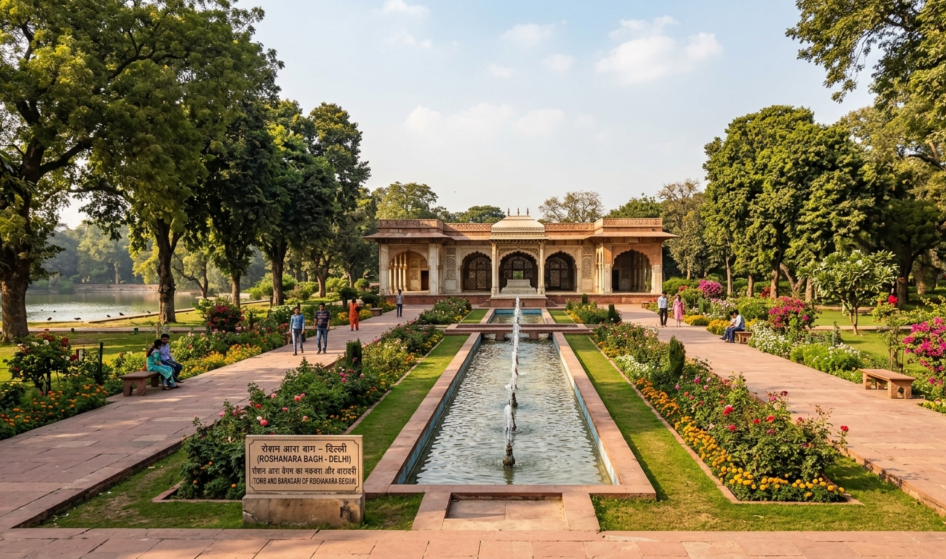
The architectural design of Roshanara Bagh is based on the traditional Mughal ‘Charbagh‘ style, where the entire garden was divided into four square quadrants by water channels, fountains, and paved walkways. At the absolute center of this garden lies the tomb of Roshanara Begum, which stands as a beautiful Baradari (an open pavilion with twelve doors) constructed on an elevated platform.
Exterior Architecture :-
This Baradari is surrounded by beautiful arched arcades on all sides, enhancing its structural grandeur. Exquisitely carved bastions (burj) stand at all four corners of the building, reflecting the meticulous craftsmanship of Mughal architecture. The platform was once surrounded by a massive water lake and fountains, giving the structure the ethereal feel of a palace floating in water. The main entrance gate of the garden is colossal, lofty, and ornately carved, bearing witness to the royal opulence and security arrangements of that golden era.
Interior Architecture :-
Stepping inside the Baradari reveals the main chamber, at the exact center of which lies the Mazar (grave) of Roshanara Begum. The most unique feature of this grave is that it is completely open from the top, with lush green natural grass growing over it. According to Mughal traditions, the graves of those who preferred humility and simplicity were left open under the sky. The high ceilings and walls of the chamber were once adorned with extremely intricate and vibrant fresco paintings over plaster, the magnificent remnants of which can still be witnessed on the ceilings today. The delicate marble lattices (jalis) and fine carvings continue to fascinate tourists.
Travel Guide & Routes
- Ticket and Entry Fee :– Entry to Roshanara Bagh is completely Free. There is no ticket required of any kind.
- Visiting Days :– The garden remains open on all seven days of the week.
- Opening and Closing Time :– From 5:00 AM to 8:00 PM (The timings may vary slightly depending on sunrise and sunset seasons).
- How to Reach :–
- By Metro :– The nearest metro stations are ‘Pul Bangash’ and ‘Pratap Nagar’ located on the Red Line. Apart from these, the ‘Vishwavidyalaya’ metro station on the Yellow Line is also very close. You can easily take an e-rickshaw or an auto from the metro station to reach the garden.
- By Road and Bus :– Roshanara Road is a major route in Old Delhi. You can easily catch a direct bus, cab, or auto from any corner of Delhi to this place.
- Photography Spots :– The facade of the historic main Baradari, the grass-covered Mazar of Roshanara Begum, and the centuries-old massive trees (especially the orchards and palm trees) serve as excellent photography spots.
- Local Food :– Outside the garden and in the nearby markets of Shakti Nagar, Kamla Nagar, and Old Delhi, you can easily savor Delhi’s famous street food, such as Chole Bhature, Chaat-Papdi, Kachori, and Kulfi.
- Nearby Markets :– The famous ‘Kamla Nagar Market’ is located right next to it, which is highly popular for shopping and apparel. Additionally, Sadar Bazar and Chandni Chowk are also just a short distance away for wholesale shopping.
Nearby Attractions
If you are planning a visit to Roshanara Bagh, you can also explore these prominent historical and religious landmarks located in its vicinity.
- Sheesh Mahal (Shalimar Bagh) :– Another historic Mughal garden where Aurangzeb’s coronation took place, located a short distance away.
- Delhi University (North Campus) :– The beautiful campus and the historic Viceregal Lodge (where freedom fighter Bhagat Singh was held captive) are highly worth visiting.
- Kamla Nehru Ridge (The Ridge) :– A fantastic forested area for nature lovers and bird watching enthusiasts, housing the Mutiny Memorial (Jeetgarh) and an Ashokan Pillar.
- Majnu ka Tila (Little Tibet) :– This locality is immensely famous for its Buddhist monasteries, vibrant Tibetan culture, and delicious Tibetan cuisine (Momos, Thukpa).
- Ancient Hanuman Temple (Marghat Wale Baba) :– Situated near Kashmiri Gate, this is one of the oldest and most revered Hanuman temples in Delhi.
Author’s Perspective
Roshanara Bagh is not merely a park or a tomb; it is a silent witness to that volatile era of the Mughal empire where siblings turned against each other’s blood for the royal throne. While history often portrays Roshanara Begum as a shrewd and ruthless princess, stepping into this serene garden brings you face-to-face with her artistic and nature-loving persona. In today’s time, as Delhi rapidly transforms into a concrete jungle, this garden encapsulates a unique world of history and greenery that offers immense mental peace. If you wish to spend a few moments of tranquility away from Delhi’s hustle-bustle and want to experience history up close, Roshanara Bagh must feature on your itinerary.
Interesting Facts
- The Roofless Grave :– The grave of Roshanara Begum has no concrete roof or dome over it. It is completely open to the sky, and grass grows naturally over it, reflecting a unique tradition of simplicity from the Mughal era.
- Birthplace of Indian Cricket :– The ‘Roshanara Club’ located inside this garden is considered one of the historic cradles of Indian cricket. When the blueprint for the establishment of the Board of Control for Cricket in India (BCCI) was drafted in 1932, this club played a monumental role.
- Home to Rare Trees :– The garden boasts several trees that date back to the British colonial era and even earlier, providing a magnificent atmosphere for nature enthusiasts.
- An Anonymous End :– Very few people know that despite being Shah Jahan’s cherished daughter and Aurangzeb’s most powerful advisor, Roshanara spent her final days in absolute isolation within this quiet garden.
Important Questions and Answer :-
Question 1:- Where is Roshanara Bagh located?
Answer:- Roshanara Bagh is located near Shakti Nagar and Roshanara Road in North Delhi, close to the North Campus of Delhi University.
Question 2:– Who was Roshanara Begum?
Answer:- Roshanara Begum was the daughter of Mughal Emperor Shah Jahan and Mumtaz Mahal, and the younger sister of Emperor Aurangzeb.
Question 3:– Is photography allowed inside Roshanara Bagh?
Answer:- Yes, general photography is fully permitted within the Roshanara Bagh and tomb complex, and there are no charges for it.
Question 4:– What is the best time to visit Roshanara Bagh?
Answer: The months between October and March are the best time to visit, as Delhi’s weather remains very pleasant. During the day, early morning or evening walks offer the most peaceful and beautiful experience.
“It is a unique confluence of Mughal politics and the lap of nature, where history still sleeps peacefully under a blanket of green grass.”