
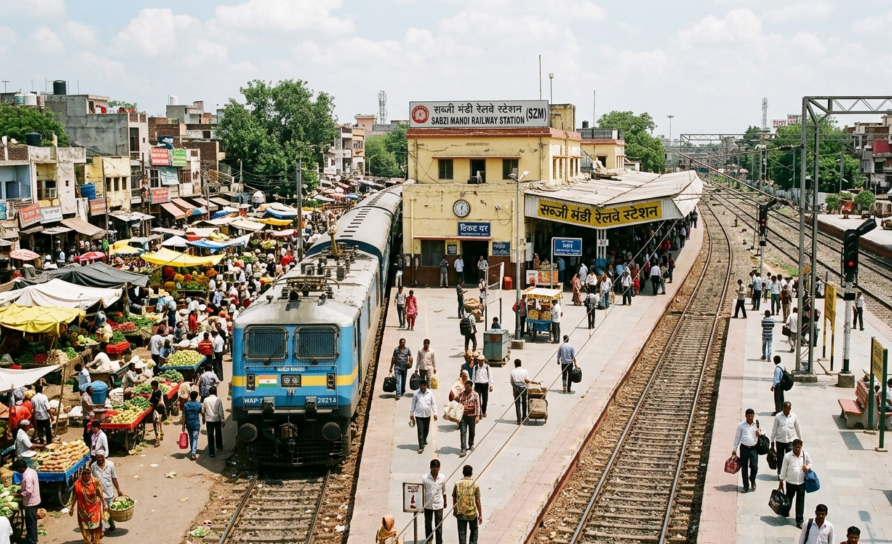
The Historic and Commercial Link :- Sabzi Mandi Railway Station (SZM)
Located in the northern district of India’s capital city, the Sabzi Mandi Railway Station (SZM) stands as an immensely historic, deeply rooted, and strategically vital rail node of the Northern Railway zone. Positioned between the densely populated pockets of Old and North Delhi, this station serves as a crucial transit halt for passengers traveling along the high-density Delhi-Ambala-Kalka and Delhi-Amritsar rail corridors, effectively balancing the immense commuter load off central terminals like New Delhi (NDLS) and Delhi Junction (DLI).
Detailed History :-
The historical origins and operational growth of the Sabzi Mandi Railway Station are profoundly intertwined with the commercial evolution of colonial Delhi. The terminal derives its unique identity from the historic ‘Sabzi Mandi‘ (wholesale vegetable market) that flourished adjacent to the site, serving as the primary culinary trading lifeline of the capital from the Mughal era down to modern times.
- Dawn of the Colonial Rail :– The station was conceptualized and set up under the British Raj in the late 1890s, marking the structural expansion of the railway lines branching out from Delhi toward Punjab and the North-Western frontier. Initially, it functioned heavily as a strategic freight depot, designed to unload fresh agricultural produce, timber, and commercial goods from neighboring states.
- Passenger Transformation :– Following India’s independence, the exponential residential and institutional expansion of North Delhi necessitated its transformation into a full-fledged passenger station. Today, it hosts a consistent schedule of regional passenger fleets, cross-country express lines, and high-frequency intercity trains servicing Haryana, Punjab, Himachal Pradesh, and Jammu & Kashmir.
Detailed Architecture :-
The structural blueprint of Sabzi Mandi Railway Station beautifully reflects the minimalism of classic Indian railway engineering layered over subtle remnants of its old colonial-era footprint.
- Platforms and Spatial Layout :– The terminal operates systematically via 4 active platforms. The architectural layout features a simplified, linear configuration that allows passengers to navigate from the entrance gates to the train coaches with speed and minimal stress.
- Heritage Fabric and Modernization :– Constructed with heavy-set brick structures and traditional high-roof concrete platform sheds, the station exudes an unmistakable old-world charm. To meet modern transit demands, recent infrastructure upgrades have integrated digital train advisory systems, optimized ticketing enclosures, and streamlined Foot-Over Bridges (FOBs) complete with comfortable ramp alignments to assist elderly and burdened commuters.
Travel Guide & Routes :-
- Ticket :– Entering the active tracking platforms requires a mandatory, valid Platform Ticket (accessible via automated on-site machines or UTS mobile apps). Passengers can secure unreserved or express transit tickets directly through the primary UTS ticketing windows located at the main entry lobby.
- Timings :– Sabzi Mandi Station functions continuously 24 Hours a day, 7 Days a week, handling a relentless cycle of local suburban trains and long-distance overnight expresses.
- How to Reach :– Strategically nested in North Delhi, closely bordering Pratap Nagar, Kamla Nagar, and the Mall Road zones.
- By Metro :– The most effective and popular mode of commute is via the Delhi Metro. The ‘Pratap Nagar’ Metro Station (Red Line) is located just a few hundred meters away, with immediate e-rickshaws bridging the short distance in under 3 minutes. The ‘Shastri Nagar’ Metro Station and ‘Pul Bangash’ Metro Station (both on the Red Line) are also within the immediate vicinity.
- By Road :– Benefiting from close access to the historic GT Karnal Road and Rohtak Road networks, the station is highly accessible. Public DTC buses, local auto-rickshaws, and app-based cab fleets (Ola/Uber) service the drop-off points seamlessly at all hours.
- Photography Spots :– The sweeping vistas of the bustling northern rail tracks from the central Foot-Over Bridge, the iconic old-style station signage blocks, and the visual aesthetics of morning intercity fleets pulling against the backdrop of historic North Delhi houses make for great photography. Tracking areas are strictly restricted for safety.
- Local Flavors & Famous Markets :– Savor authentic local street snacks like crisp kachoris, spicy chole bhature, and traditional sweets right outside the station lanes. For retail therapy, the famous youth fashion hub of Kamla Nagar Market, the wholesale textile lanes of Ghantaghar, and the northern fringes of the legendary Sadar Bazar are located just a short distance away.
Nearby Attractions :-
- Kamla Nagar Market :- A highly vibrant and trendy commercial high-street of North Delhi, globally celebrated for its diverse retail lifestyle fashion brands, multi-cuisine diners, and lively youth-centric street cafes.
- University of Delhi – North Campus :- Located a mere 2 km away, this is the historic academic heart of India, housing legendary institutions like St. Stephen’s College, Hindu College, and Kirori Mal College amidst lush green avenues and red-brick structures.
- Roshanara Bagh :- A spectacular, sprawling Mughal-era garden constructed by Princess Roshanara Begum, the daughter of Emperor Shah Jahan. The complex encloses her historic architectural mausoleum and a tranquil natural lake, serving as a peaceful green escape.
- Kamla Nehru Ridge Forest :- A massive, dense forest reserve protecting crucial chapters of colonial history, including the iconic British-era Mutiny Memorial (Jeetgarh) and ancient Ashokan Pillar fragments. It is a haven for nature walks and birdwatching.
- Shalimar Bagh & Sheesh Mahal :- Another landmark Mughal pleasure garden historically significant as the grand site where Mughal Emperor Aurangzeb celebrated his formal coronation. Its ancient pavilions and manicured orchards offer a deep dive into medieval history.
Interesting Facts :-
- While the original massive wholesale vegetable market that gave the station its name was officially shifted to Azadpur (now Asia’s largest fruit and vegetable market) to ease city congestion, the station proudly preserves its historical identity.
- The station forms an integral part of the historic Delhi-Ambala rail link, a path engineered meticulously by British officers to fast-track regional trade and political movement into the summer capital of Shimla.
- Owing to its unmatched proximity to the DU North Campus, SZM serves as a primary daily transit lifesaver for thousands of outstation university students and academic professors commuting from Haryana and Punjab.
Important Questions and Answer :-
Question 1:- What is the official Indian Railways station booking code for Sabzi Mandi?
Answer:- The official IRCTC booking code for this station is SZM.
Question 2:– Which metro line provides the closest direct access to Sabzi Mandi Station?
Answer:- The Red Line of the Delhi Metro provides the closest direct access via the Pratap Nagar Metro Station.
Question 3:– Which major geographic destinations are heavily connected via this terminal?
Answer:- This station serves as a high-frequency gateway toward the Northern states of India, connecting commuters directly to key cities across Haryana (Panipat, Ambala), Punjab (Ludhiana, Amritsar), and Himachal Pradesh.
Author’s Thoughts :-
The Sabzi Mandi Railway Station stands as a beautiful, nostalgic anchor within Delhi’s rapidly transforming urban landscape. It might lack the architectural glass facades of Anand Vihar or the massive commercial scale of New Delhi, but it rewards travelers with an authentic, unhurried old-world charm that tells stories of a bygone trading era. The energetic footsteps of university students mixed with the diligent schedules of local merchants infuse this historic complex with a unique, comforting warmth. If you are positioned across North Delhi and your travel charts a path toward the northern plains of Haryana or Punjab, departing from Sabzi Mandi Station guarantees an exceptionally smooth, highly practical, and nostalgic journey.
“Stay connected with us on this journey through the depths of history and spirituality.”