
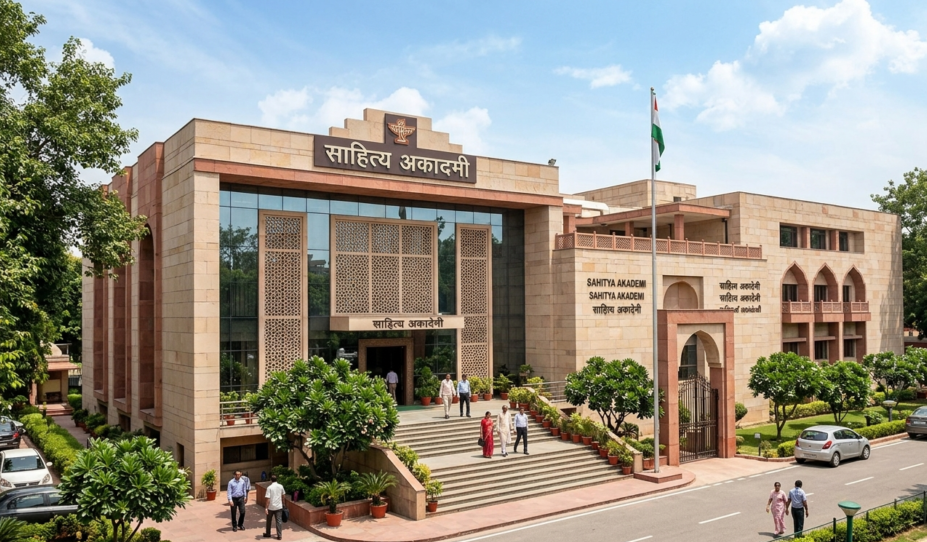
The Pilgrimage of Words :- The Prestigious Sahitya Akademi, Delhi
When we search for Delhi’s history solely within stones, forts, and tombs, we miss out on its living history—the one written with ink upon pages. Located in the vibrant cultural hub of Mandi House, Sahitya Akademi (India’s National Academy of Letters) is one such invaluable heritage. It is not merely an institutional building; it is the brightest star in the sky of India’s linguistic diversity, intellectual consciousness, and literary universe. In this detailed blog, let us delve deep into the history, architecture, and profound significance of India’s premier literary institution.
Detailed History :-
The history of Sahitya Akademi is deeply intertwined with the cultural renaissance of post-independence India and the vision of uniting a diverse nation through the thread of languages.
- Establishment and Inauguration :– Sahitya Akademi was established by the Government of India on March 12, 1954. It was formally inaugurated by Maulana Abul Kalam Azad, the first Education Minister of independent India.
- The First President :– The first President of this great institution was none other than India’s first Prime Minister, Pandit Jawaharlal Nehru, who was himself an eminent writer and thinker. Alongside him, scholars like Dr. Sarvepalli Radhakrishnan served as the Vice President.
- Core Objective :– Its primary purpose is to foster and coordinate literary activities in all Indian languages, promote high literary standards, and act as a bridge of translation to bring various regional languages closer to one another.
- Recognized Languages :– Starting with a few languages, today the Akademi promotes and honors exemplary literary works in 24 major languages (the 22 languages recognized by the Indian Constitution, along with English and Rajasthani).
Detailed Architecture :-
Sahitya Akademi is housed within ‘Rabindra Bhavan’, one of Delhi’s most aesthetically pleasing cultural complexes, which possesses a distinct architectural vocabulary.
- The Architect and Style :– Rabindra Bhavan was designed by India’s legendary modernist architect, Habib Rahman. It was constructed in 1961 to mark the centenary birth anniversary of Gurudev Rabindranath Tagore.
- Blend of Modernism and Tradition :– The design represents a beautiful synthesis of international modernism and traditional Indian architectural elements. Its sweeping curved facades, exposed concrete jali (lattice) work, and expansive corridors create a peaceful, contemplative environment tailored for art and literature.
- Auditoriums and Galleries :– The complex features state-of-the-art visual art exhibition galleries, a grand auditorium, and spacious conference rooms that host national and international seminars, literary meets, and poetry recitals year-round.
- World-Class Library :– The library housed here is one of the richest repositories in India. It contains over 300,000 rare books, documents, and journals covering literary, historical, and cultural themes across all 24 recognized languages.
Travel Guide & Routes :-
If you are a lover of literature and wish to visit this temple of knowledge, the following guide will be highly useful.
- Tickets :– Entry to the Sahitya Akademi complex, its public exhibitions, and the library (for reading/browsing) is completely Free. No tickets are required.
- Visiting Time :– The offices and the library remain open from 9:30 AM to 6:00 PM (Monday to Saturday). It remains closed on Sundays and central government gazetted holidays.
- How to Reach :–
- By Metro :– The nearest metro station is ‘Mandi House’ (Blue and Violet Lines). The Rabindra Bhavan complex is located right at the intersection of Kasturba Gandhi Marg and Ferozeshah Road, just a 2-minute walk from the metro exit.
- By Road :– Being located in central Delhi (near Connaught Place), the venue is effortlessly accessible by local buses, autos, and cabs from all corners of the city.
Photography Spots :-
While Sahitya Akademi is a space dedicated to intellectual stillness, its architecture and surroundings offer some beautiful visual frames.
- The Exterior Facade of Rabindra Bhavan :– The brutalist concrete latticework and the dramatic spiral staircases designed by Habib Rahman offer a brilliant backdrop for architectural and monochrome photography.
- The Corridors of the Library :– Capturing the towering rows of bookshelves casting long shadows over silent readers embodies a profound intellectual atmosphere. (Prior permission may be required for indoor photography).
- Busts and Murals of Literary Legends :– The statues and portraits of legendary Indian writers installed across the lawns and corridors make for great historical and thematic frames.
Local Food & Famous Markets :-
Mandi House is the cultural heart of Delhi, and its culinary scene is just as vibrant and artistic as its theaters.
- Local Food :–
- Triveni Terrace Cafe :– Located just a stone’s throw away, this open-air cafe is the favorite hangout zone for Delhi’s intellectuals and artists. It is celebrated for its serene green ambiance, legendary filter coffee, Shami Kebabs, and Keema Paranthas.
- Shri Ram Centre Canteen :– Their Chole Bhature and hot chai are incredibly popular among theater artists and visitors alike.
- Famous Markets :–
- Bengali Market :– Located within walking distance, this iconic market is famous all over Delhi for its street chaat, traditional Bengali sweets, and the legendary ‘Natthu’s Sweets’.
- Connaught Place (CP) :– Located just 1.5 km away, CP is Delhi’s largest open-air heritage shopping and dining destination.
Nearby Attractions :-
Surrounding the Sahitya Akademi are some of India’s most important artistic, theatrical, and historical institutions.
- Lalit Kala Akademi & Sangeet Natak Akademi :– These national academies for visual arts and performing arts share the same Rabindra Bhavan campus.
- Kamani Auditorium & Shri Ram Centre :– Two of Delhi’s premier proscenium theaters where top-tier Indian stage plays are regularly enacted.
- National School of Drama (NSD) :– India’s premier theater training institute, situated right across the Mandi House roundabout.
- Agrasen Ki Baoli :– A stunning, deep historical stepwell located just a 10-minute walk away.
Interesting Facts
- Three National Academies, One Roof :– Rabindra Bhavan is the only unique complex in India that houses the national headquarters of literature (Sahitya), visual arts (Lalit Kala), and performing arts (Sangeet Natak) together.
- Highest Literary Honors :– The annual ‘Sahitya Akademi Award’ presented by this institution is considered the second-highest and most prestigious literary honor in India, right after the Jnanpith Award.
- The Festival of Letters :– Every year, the Akademi hosts the ‘Sahityotsav‘ (Festival of Letters), which stands as one of India’s oldest and largest state-sponsored literary celebrations.
Important Questions and Answer :-
Question 1:– When was Sahitya Akademi established and who was its first President?
Answer:– Sahitya Akademi was founded on March 12, 1954, by the Government of India and inaugurated by Maulana Abul Kalam Azad. Its first President was the then Prime Minister, Pandit Jawaharlal Nehru.
Question 2:- Where is Sahitya Akademi located and what is the nearest metro station?
Answer:– It is located inside the Rabindra Bhavan complex at Mandi House, New Delhi. The nearest metro station is ‘Mandi House’ (Blue and Violet Lines).
Question 3:– How many languages does the Sahitya Akademi officially recognize for its operations?
Answer:– It officially recognizes 24 languages: 22 languages from the Eighth Schedule of the Indian Constitution, along with English and Rajasthani.
Question 4:– Can the general public access the Sahitya Akademi Library?
Answer:– Yes, the library is open to the general public for spot-reference and reading purposes for free. However, borrowing books requires a formal institutional membership.
Author’s Thoughts :-
Stepping away from the bustling traffic of Mandi House into the quiet courtyard of Rabindra Bhavan, the chaotic noise of Delhi suddenly evaporates. For me, Sahitya Akademi is not just an administrative building; it is where the soul of India breathes. Standing under this roof, knowing that the thoughts, words, and manuscripts of legends like Tagore, Nehru, Premchand, Mirza Ghalib, and Mahadevi Verma are preserved here, fills one with absolute reverence. In today’s digital era, where languages are shrinking into short text codes, Sahitya Akademi stands as a resilient shield for our linguistic heritage. The scent of old paper in its air reminds us that societies may evolve and governments may change, but the words preserved here are truly immortal.
“Nestled in the cultural courtyard of Mandi House, Sahitya Akademi is a grand pilgrimage of words that weaves the diverse voices of India’s 24 languages into one beautiful, seamless melody.”