
Sambhal :- The Land of Ancient History and Kalki Avatar
Detailed History
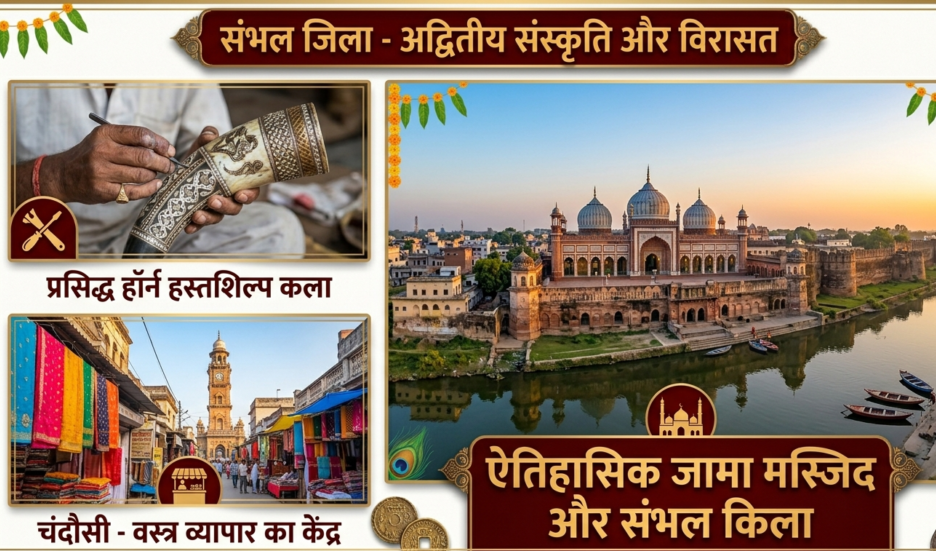
Sambhal is an extremely ancient and historical district of Uttar Pradesh, with its roots deeply embedded in mythological eras. According to Hindu scriptures and Puranas, Sambhal is the sacred place where the tenth and final avatar of Lord Vishnu, ‘Kalki Avatar‘, will manifest. In the medieval period, Sambhal was a significant administrative center for the Delhi Sultanate and the Mughal Empire. The city finds special mention during the reigns of Prithviraj Chauhan and Mughal Emperor Babur. Babur built a grand mosque here. Today, the district is famous not only for its spiritual beliefs but also for its handicraft art, which has given it a unique international identity.
Detailed Architecture
The architecture of Sambhal displays a deep influence of ancient Indian religious styles and Mughal grandeur.
- Exterior Architecture :– The historical Shahi Jama Masjid (built by Babur) reflects Mughal style, featuring massive domes and high walls. Ancient temples in the district predominantly use the traditional Nagara style. The older parts of the city, with their narrow lanes and ancient gateways, create a historical ambiance.
- Interior Architecture :– The inner sanctums and carved pillars of the temples provide a peaceful and devotional atmosphere. The true essence of Sambhal’s architecture is also visible in the homes where ‘Horn and Bone Handicraft’ is practiced, featuring intricate work done with small tools on decorative items.
Nearby Attractions
- Kalki Vishnu Temple :– The most important religious site in Sambhal. It is believed that Lord Kalki will take birth here, making it a focal point for devotees and researchers.
- Shahi Jama Masjid :– Built by Mughal Emperor Babur, this mosque is known for its historical architecture and tranquility.
- Pandav Temple :– Associated with the Mahabharata era, this temple is considered extremely ancient and preserves memories of the Pandavas.
- Surya Kund :– An ancient sacred reservoir where bathing is considered to have special religious significance.
- Handicraft Centers :– Sambhal is famous for its artifacts made from horns and bones. The workshops here are definitely worth a visit.
Travel Guide & Routes
- Tickets and Timings :– Entry to most temples and historical sites is Free. Temple visiting hours are generally from 5:00 AM to 9:00 PM.
- How to Reach :–
- By Rail :– Sambhal has its own railway station (SML), connected to major cities like Moradabad and Aligarh.
- By Road :– Sambhal is well-connected by road to Delhi (approx. 160 km), Moradabad, and Agra. It is easily accessible by private vehicle or bus.
- By Air :– The nearest major airport is Delhi (IGI) or Pantnagar.
- Photography Spots :– The premises of Kalki Temple, the minarets of Shahi Jama Masjid, and displays of local handicraft art.
- Local Taste :– The ‘Sendhal Chaat’, ‘Biryani’, and ‘Milk Cake’ are very famous. The local cuisine is known for its unique spices.
- Famous Markets :– Handicraft Market, where you can buy beautiful artifacts, jewelry, and home decor items made from bone and horn.
Interesting Facts
- Sambhal is one of the few places in the world where magnificent artifacts are crafted from the horns and bones of deceased animals, exported globally.
- According to mythology, the beginning of Satya Yuga will be marked from this place when Kalki Avatar destroys unrighteousness.
- At one point in history, Sambhal was proposed as a potential capital for the Delhi Sultanate.
Important Questions and Answer :-
- Question 1:- Why is Sambhal considered religiously significant? Answer:- Sambhal is revered as the birthplace of the future incarnation of Lord Vishnu, ‘Lord Kalki’.
- Question 2:- What is the most famous handicraft here? Answer:- Sambhal is world-famous for its ‘Horn and Bone Handicraft’.
- Question 3:- Is Sambhal connected to Delhi by road? Answer:- Yes, Sambhal is about 160 km from Delhi and is well-connected by road.
- Question 4:- When is the best time to visit? Answer:- The period from October to March is the most pleasant and ideal time for a visit.
- Question 5:- Which is the main historical monument here? Answer:- The Shahi Jama Masjid, built by Mughal Emperor Babur, is a major historical monument.
Author’s Perspective
In my view, Sambhal is a place where faith and art meet in an extraordinary way. While the anticipation of Kalki Avatar fills the air with a spiritual mystery, the skill of the artisans here breathes life into mute bones and horns. Walking through the lanes of Sambhal, you realize how strongly this city holds onto its ancient heritage. If you are interested in Indian mythology and wish to see rare handicrafts, a trip to Sambhal will offer an experience from another world.
S “Sambhal holds the fragrance of unparalleled handicrafts and the anticipation of a future incarnation.”