
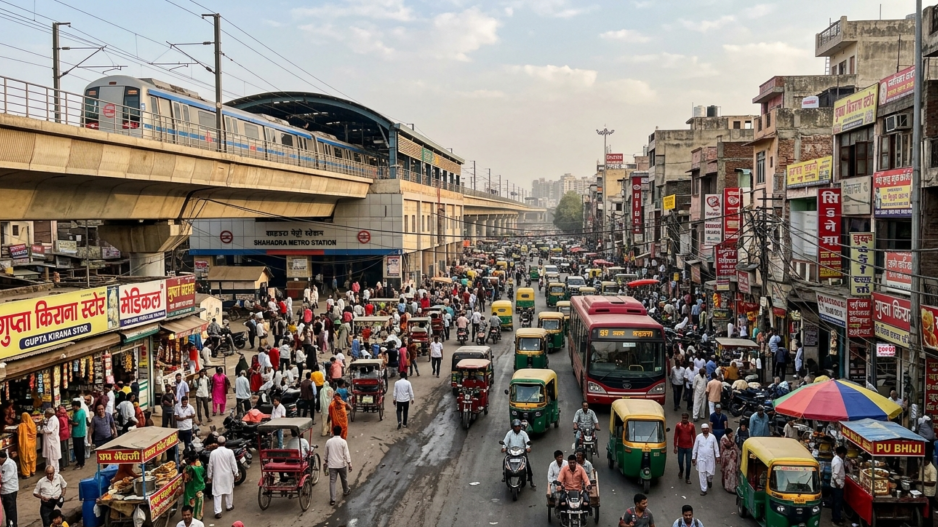
Shahdara :- The Historic Gateway of Delhi, Mercantile Heritage, and the Crucible of Traditional Enterprise
Shahdara is far more than a mere administrative enclave in the National Capital Territory – it stands as an authentic, living archive of Delhi’s commercial evolution and socio-cultural endurance. Positioned on the eastern floodplains of the Yamuna River, it holds the distinction of being the foundational settlement of the entire ‘Trans-Yamuna‘ tract. Characterized by a highly distinct urban personality, Shahdara seamlessly balances its 17th-century Mughal ancestry with the intense commercial energy of legacy wholesale markets and high-speed metro connectivity, mirroring the earthy charisma of Old Delhi.
Detailed History :-
The historic blueprint of Shahdara is profoundly rooted in the golden age of the Mughal Empire. Etymologically derived from Persian, the word ‘Shahdara’ translates literally to the “Royal Gateway” or the “Door of the King“. In 1638, when Mughal Emperor Shah Jahan established the fortified seat of Shahjahanabad (Old Delhi), all royal caravans, elite merchants, and massive agricultural supplies originating from Eastern India (Uttar Pradesh, Bihar, and Bengal) converged at this specific location before crossing the Yamuna.
During the height of Mughal rule, the state systematically structured Shahdara into a highly vital wholesale grain market (Ganj). Such was its economic affluence that in 1739, during the chaotic sack of Delhi, the Persian invader Nadir Shah targeted Shahdara’s immense imperial granaries to disrupt the city’s supply chains. Following the partition of British India in 1947, the region served as a major rehabilitation sanctuary for displaced families from West Punjab, embedding a highly resilient mercantile spirit into its social fabric. Today, it stands as a pivotal trading center that successfully preserves its deep-set historical identity.
Detailed Architecture :-
The architectural landscape of Shahdara presents a compelling look at vernacular urban density mixed with mid-20th-century commercial-cum-residential construction frameworks.
- Legacy Bazaars and Commercial Houses :– The old quarters of Shahdara, such as Chhota Bazar and Bara Bazar, feature a high-density structural blueprint. Buildings follow the classic style of mixed-use architecture, where ground floors are fitted with elevated platforms designed for retail interactions, while the upper tiers serve as family quarters. In the deeper alleys, one can still spot weathered brick archways and carved wooden facades reminiscent of late Mughal and colonial construction styles.
- Industrial and Modern Infrastructure :– The modern wings of Shahdara lining the Grand Trunk Road exhibit contemporary concrete commercial plazas, banking complexes, and mid-rise residential apartments. Furthermore, the Shahdara Metro Station stands as a defining modern monument, engineered with massive pre-cast concrete columns and expansive steel truss-roofing.
- Historic Religious Enclaves :– The ancient temples, historical gurudwaras, and mosques across the block showcase traditional Indian structural masonry, with their structural spires and minarets rising gracefully over the highly condensed urban canopies.
Travel Guide & Routes :-
- Tickets & Entry Fees :– Entry into all traditional market blocks, historical alleyways, and public religious structures throughout Shahdara is completely free of charge. No ticketing or reservation protocols exist.
- Visiting Time :– Mainstream wholesale and retail markets operate with maximum intensity from 11:00 AM to 09:00 PM. Visitors must note that Shahdara’s definitive retail hub, ‘Chhota Bazar’, remains strictly closed on Wednesdays for its weekly holiday. For culinary walks, the optimal period to explore the historic street-food alleys is between 05:00 PM and 10:00 PM.
- How to Reach :–
- By Metro :– The Delhi Metro network’s ‘Red Line’ acts as the definitive transit link for this district. The high-capacity ‘Shahdara’ Metro Station and the nearby ‘Welcome’ station (Red Line/Pink Line interchange) provide instant connectivity to all corners of Delhi-NCR.
- By Rail :– Shahdara Junction (DSA) is a historic rail terminal, serving as a critical operational stop for regional EMU commuter trains and lines running along the Delhi-Meerut corridor.
- By Road :– The historic Grand Trunk Road (GT Road) passes directly through the heart of the district, linking Shahdara seamlessly to the Kashmere Gate ISBT (a brief 15-minute drive away) and the UP borders of Anand Vihar and Ghaziabad. Local transit relies on a highly efficient fleet of e-rickshaws and eco-friendly cycle rickshaws.
- Photography Spots :– The highly atmospheric, vibrant streetscapes of Chhota Bazar, the vintage industrial architecture of the Shahdara Junction railway platforms, and the dramatic evening vistas of the illuminated elevated metro corridors.
- Local Flavors :– Shahdara is an exceptional destination for dedicated food lovers. Do not miss the legendary, heavily spiced Chhole Bhature at ‘Shyam Ji‘, the iconic crisp Bedmi-Kachori setups in Chhota Bazar, and old-school thick Rabri-Jlebi desserts. Additionally, legacy street vendors serve brilliant variations of traditional potato chaat, spicy golgappas, and rich Kulfi-Falooda.
- Famous Markets :– ‘Chhota Bazar’ (universally celebrated as one of Delhi’s finest, highly economical markets for women’s ethnic ensembles, bridal sarees, and designer textiles) and the legacy ‘Shahdara Grain Market’.
Interesting Facts :-
- Shahdara Metro Station holds a legendary rank in Indian transit history, marking the absolute birthplace of the Delhi Metro. On December 25, 2002, India’s pioneer commercial metro train made its maiden run from Shahdara to Tis Hazari.
- During the Mughal era, Shahdara’s imperial grain markets wielded massive economic power, directly dictating the baseline valuation and supply economics of essential commodities across northern India.
- It was the very first locality in the Trans-Yamuna tract to undergo comprehensive urban development, serving as the commercial bridge between the historic walled city and outlying provinces.
Important Questions and Answer :-
Question 1:– What makes Shahdara’s Chhota Bazar a specialized shopping destination?
Answer:- Chhota Bazar is highly rated across the capital for its incredible inventory of traditional Indian bridal wear, customized dress materials, hand-embroidered sarees, and cosmetics at wholesale-equivalent rates. It mirrors the economic structure of Chandni Chowk, offering excellent value in a dense, walkable market setting.
Question 2:- What is the historical milestone associated with Shahdara in terms of modern urban transport?
Answer:- Shahdara is the historical launchpad for the country’s advanced mass transit evolution. The commercial operations of the Delhi Metro were officially flagged off from Shahdara Station in 2002 by the late Prime Minister Shri Atal Bihari Vajpayee, completely transforming urban mobility in India.
Question 3:– Does Shahdara support manufacturing industries alongside its retail markets?
Answer:- Yes, the larger Shahdara district and its adjoining institutional zones (like the GT Road Industrial Belt) house a dense concentration of small-to-medium-scale manufacturing units specialized in polymers, rubber processing, metal casting, and ready-made garment production.
Author’s Thoughts :-
From my perspective, Shahdara represents the unyielding, authentic character of Delhi – a territory that gracefully incorporates rapid modernization without sacrificing its mercantile soul. While contemporary Delhi chases massive shopping malls and gleaming glass high-rise towers, the bustling lanes of Chhota Bazar preserve an invaluable human connection, marked by spirited bargaining, multi-generational shopkeepers, and warm hospitality. It is a highly rewarding destination for travelers seeking to immerse themselves in Delhi’s authentic trade history, exceptional street culinary arts, and old-school mercantile lifestyle on a highly conservative budget. “Shahdara stands as a magnificent historic bridge between the imperial passages of the Mughal Court and the birth of India’s advanced metro transit, where every legacy alleyway still resonates with the proud rhythm of traditional trade.”