
Detailed History
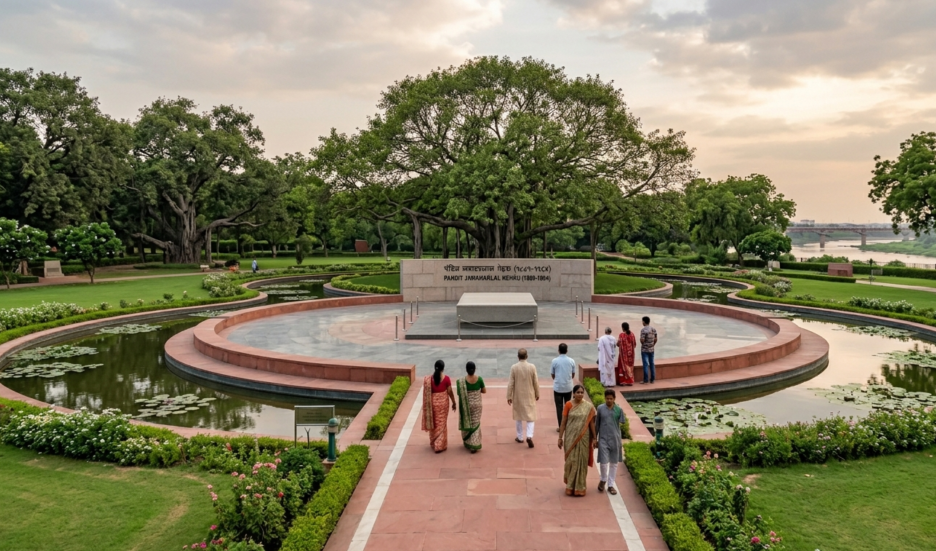
Shantivan (also spelled Shanti Vana) is the memorial of India’s first Prime Minister, Pandit Jawaharlal Nehru. In Hindi, ‘Shantivan’ translates to the “Forest of Peace” or “Garden of Peace“. Following Pandit Nehru’s demise on May 27, 1964, his last rites were performed here on the banks of the Yamuna River, just north of Raj Ghat. The site was named ‘Shantivan’ to reflect his peace-loving persona, his commitment to the Non-Aligned Movement, and his core principles of ‘Panchsheel’.
This historic site serves as a poignant reminder of Nehru’s immense contribution to India’s freedom struggle and the nation-building process. Every year on May 27 (his death anniversary) and November 14 (Children’s Day / birth anniversary), the President, Prime Minister, and other dignitaries visit Shantivan to pay their respects. The serene environment and lush green surroundings offer a peaceful retreat to all visitors.
Detailed Architecture :-
The architecture of Shantivan is simple, natural, and dignified, reflecting the humble yet profound philosophy of Pandit Nehru.
- The Plinth :– A large, elevated earthen platform marks the spot where Nehruji was cremated. This plinth is surrounded by sprawling, beautifully manicured green lawns on all sides.
- The Monolith :– A massive, majestic monolith is installed within the memorial complex, inscribed with Pandit Nehru’s ideals, vision, and his profound sentiments for the nation.
- Exterior and Interior Design :– Unlike conventional monuments, there are no grand or ostentatious concrete structures here. The entire landscape is deeply integrated with nature. It features dense trees, well-trimmed hedges, and velvet-like lawns. Since Nehruji was deeply fond of children and red roses, beautiful rose beds and floral displays are a key highlights of the gardens.
- Photography Spots :– The winding pathways leading to the memorial, surrounded by a dense canopy of trees and vibrant greenery, provide excellent spots for photography. The soft morning and evening light adds a magical touch to the pictures.
Travel Guide & Routes :-
- Ticket :– Entry to Shantivan is completely Free for all domestic and international tourists.
- Visiting Time :– The memorial remains open all seven days of the week from 06:30 AM to 06:00 PM.
- How to Reach :–
- By Metro :– The nearest metro station is Delhi Gate Metro Station on the Violet Line, located about 1.5 km away. You can easily take an auto-rickshaw or e-rickshaw from there. Kashmere Gate and Chandni Chowk metro stations are also nearby.
- By Bus :– Numerous Delhi transport buses running on the Ring Road have designated stops near Raj Ghat and Shantivan.
- By Road :– You can drive down or hire a cab (Ola/Uber) directly to Ring Road. Ample parking space is available at the venue.
- Nearby Attractions :– Raj Ghat (Mahatma Gandhi Memorial), Shakti Sthal (Indira Gandhi Memorial), Veer Bhumi (Rajiv Gandhi Memorial), Vijay Ghat (Lal Bahadur Shastri Memorial), and the iconic Red Fort.
- Local Flavors & Famous Markets :– Located very close to Old Delhi, visitors can head to Chandni Chowk to savor the world-famous paranthas at Gali Paranthe Wali, Dahi Bhallas at Natraj, and authentic Mughlai cuisine at Karim’s. For shopping, Chandni Chowk, Dariba Kalan (silver jewelry), and the Sunday Chor Bazaar are highly recommended.
Interesting Facts :-
- The name ‘Shantivan’ was chosen specifically to honor Pandit Nehru’s lifelong advocacy for global peace and non-violence.
- The memorials of his daughter, Indira Gandhi (Shakti Sthal), and his grandson, Rajiv Gandhi (Veer Bhumi), are located in the immediate vicinity.
- On Children’s Day (November 14), special prayer meetings, cultural performances, and children’s assemblies are organized at the venue.
- Shantivan functions as one of Delhi’s prominent urban lung spaces, hosting an array of local and migratory bird species.
Important Questions and Answer :-
Question 1:– Where exactly is Shantivan located in Delhi?
Answer:- Shantivan is located on the Ring Road in New Delhi, adjacent to Raj Ghat and running parallel to the banks of the Yamuna River.
Question 2:– Is photography and videography allowed inside Shantivan?
Answer:- Yes, general photography is permitted inside the complex free of charge, provided visitors maintain the decorum and silence of the memorial.
Question 3:– What is the best time of the year to visit Shantivan?
Answer:- The best time to visit is during the winter months from October to March when the weather in Delhi is pleasant. Early mornings or late evenings are ideal for a peaceful stroll.
“The lush green expanse and absolute tranquility of Shantivan beautifully echo the legacy of the architect of modern India, Pandit Jawaharlal Nehru, and his eternal love for the nation.”