
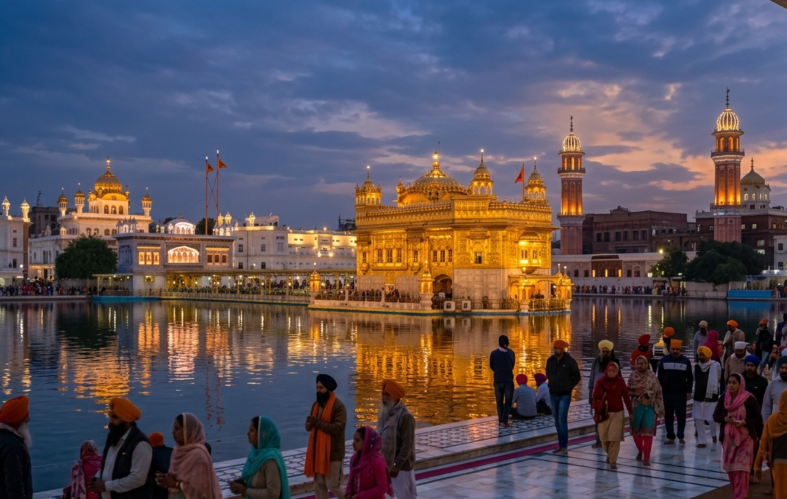
Shri Harmandir Sahib (The Golden Temple), Amritsar :- The Sacred Pool of Nectar, Glorious History, and Supreme Architectural Splendor
Detailed History :-
Located in the heart of Amritsar city in the northern state of Punjab, India, Shri Harmandir Sahib (profoundly recognized globally as The Golden Temple) stands as the ultimate spiritual baseline and the most sacred pilgrimage sanctuary of Sikhism. This holy shrine is not merely an epicenter of Sikh faith, but a living testament to human equality, universal peace, and absolute cross-cultural brotherhood. According to glorious historical blueprints, the site’s layout was conceived in the 16th century (circa 1577) by the fourth Sikh Guru, Guru Ram Das Ji, who excavated a massive natural holy pool of water, naming it ‘Amritsar‘ (The Pool of Ambrosial Nectar). This historic reservoir eventually lent its name to the flourishing metropolis that grew around it. The structural conceptualization of the central temple was systematically initiated by the fifth Sikh Guru, Guru Arjan Dev Ji. He heavily emphasized that the upcoming shrine must remain totally unconfined by religious boundaries. In a monumental gesture of interfaith harmony, Guru Arjan Dev Ji invited the celebrated Muslim Sufi saint of Lahore, Hazrat Mian Mir Ji, to lay the foundational cornerstone of the temple in December 1588. Following its architectural completion in 1604, the holy volume of Sikh scriptures, the ‘Adi Granth’ (Guru Granth Sahib), was reverently installed inside the sanctum, and the venerable sage Baba Buddha Ji was appointed as its first Head Priest (Granthi). In the early 19th century, the legendary ruler of the Sikh Empire, Maharaja Ranjit Singh Ji, reinforced the complex against external vulnerabilities and commissioned the casing of the temple’s upper floors and central dome with pure, heavy gold leaf foils, earning the complex its immortal global title, ‘The Golden Temple’.
Detailed Architecture :-
The structural formulation of Shri Harmandir Sahib represents an incredibly rare, brilliant, and aesthetic amalgamation of Indo-Islamic stone masonry and traditional Sikh architecture. Erected safely at the dead center of the vast square water reservoir, the temple creates the visual illusion of a golden lotus blooming gracefully over the water surface.
- The Four Entrance Gateways :– The defining psychological and structural attribute of the complex is its layout featuring four grand entry gates facing the North, South, East, and West directions. Departing entirely from orthodox ancient temple architecture that usually enforces a singular narrow portal, these four entry gateways structurally broadcast to the world that individuals from any corner of the globe—regardless of caste, creed, color, gender, or nationality—are received here with equal cosmic love.
- The Amrit Sarovar and The Causeway :– The main sanctuary stands isolated inside the ‘Amrit Sarovar’. To grant access from the peripheral marble circumband (Parikrama) to the inner altar, an elegant 202-foot-long marble bridge (causeway) was engineered. The seamless optical reflection of the heavily gilded temple dancing upon the undulating water current creates a breathtakingly celestial sight at any hour of the day.
- Gold Embellishments and Fine Pietra Dura :– Under Maharaja Ranjit Singh’s patronage, roughly 400 kilograms of pure gold plating were integrated into the primary structure. The inner walls of the three-story sanctuary feature intricate floral relief works, delicate marble inlay styles (Pietra Dura), and precious gemstone placements, topped by a magnificent fluted golden dome sculpted in the pattern of an inverted lotus.
- The Akal Takht :– Standing aligned directly opposite the primary causeway within the complex perimeter is ‘Shri Akal Takht Sahib’ (The Throne of the Timeless One). Founded by the sixth Guru, Guru Hargobind Ji, it stands as the highest seat of temporal, political, and judicial authority for global Sikh affairs.
Travel Guide & Routes :-
- Entry Ticket and Basic Protocols :– Entry, access, and participation in the public prayers inside the Golden Temple are completely Free. There are no premium queues, express tickets, or VIP passes; all humanity blends into a single queue of humility. Prior to step-crossing the entry gates, all tourists must strictly cover their heads completely (free headscarves are widely distributed at entry bays) and deposit their footwear at the organized, complimentary shoe-keeping centers (Joda Ghar), followed by walking through a shallow foot-washing stream of fresh water.
- Operational Timings and Holy Ceremonies :– The temple arches stay open to the world 24 Hours a day, 365 days a year. The complex transitions into a spellbinding golden matrix under night illumination. Daily at dawn (between 2:00 AM and 3:00 AM), the Guru Granth Sahib is carried in a spectacular golden palanquin from the Akal Takht to the main shrine in a ceremony known as ‘Prakash Seva’, and returned at night (between 10:00 PM and 11:00 PM) during the ‘Sukhasan Seva‘. Witnessing these transitions draws thousands of nightly observers.
- How to Reach :–
- By Air :– The city is directly served by the Sri Guru Ram Dass Jee International Airport (ATQ), located a brief 11 to 12 km drive from the temple campus. The airport connects Amritsar directly to major Indian transit hubs and multiple international destinations (such as London and Dubai). High-frequency e-rickshaws, pre-paid taxis, and local shuttle buses run around the clock from the terminals.
- By Rail :– The Amritsar Junction Railway Station (ASR) is an extensively integrated mega-terminal linked seamlessly to New Delhi, Mumbai, Kolkata, and Jammu via premium superfast rail fleets like Shatabdi and Vande Bharat Express. The temple stands barely 3 km from the station exit.
- By Road :– Amritsar is positioned along National Highway 1 (Grand Trunk Road), offering smooth highway multi-lane corridors. Daily luxury Volvo bus liners connect Amritsar Central Bus Terminal to Delhi, Chandigarh, and Jalandhar, with the temple board operating free transit shuttle coaches directly from the terminal gates.
- Local Flavors and The Legendary Langar :– Nestled inside the complex is the ‘Guru Ka Langar’, officially documented as the largest free community kitchen on Earth. It serves wholesome, strictly vegetarian, and Satvik meals (consisting of slow-cooked lentils, hot flatbreads, steamed rice, and sweet pudding) to over 100,000 pilgrims daily, scaling to over 200,000 on weekends and festivals, with everyone dining together sitting flat on jute floor mats. Outside the heritage core, you can explore traditional Amritsari street markets to taste authentic Amritsari Kulcha (crisp clay-oven flatbreads), thick churned Lassi, rich Dal Makhani, and Ghee-loaded Pinni sweets.
- Central Shopping Bazaars :– The grand walkway leading to the shrine, known as the ‘Heritage Street‘, is an architecturally unified, pedestrian-only zone. The adjoining local bazaars are world-famous for shopping for genuine leather Juttis (traditional footwear), vibrant hand-embroidered Phulkari dupattas, steel Kadas, ceremonial Kirpans, and traditional spiced Amritsari papads and sun-dried lentil chunks (Wadiyan).
- Photography Spots :– Capturing breathtaking wide-angle landscapes of the golden sanctum surrounded by the deep white marble perimeter and blue waters is highly encouraged along the open-air Parikrama tracks. Sunset hours and early twilight offer unparalleled lighting angles for photographers. However, capturing digital images or recording reels inside the immediate multi-story interior of the inner sanctum is strictly prohibited.
Nearby Attractions :-
- Jallianwala Bagh :– Located a flat 300-meter walk from the Golden Temple plaza, this somber, historic memorial garden preserves the tragic site where General Dyer’s troops opened unprovoked fire on a peaceful public gathering on April 13, 1919. Bullet marks remain preserved along its brick walls.
- Wagah Border :– Perched roughly 30 km from the city center lies the international border line between India and Pakistan. Every single evening, tens of thousands of visitors assemble to witness the high-voltage, high-stepping patriotic ‘Beating Retreat’ and flag-lowering military ceremony.
- The Partition Museum :– Housed within the historic Town Hall complex, this stands as the world’s first specialized museum dedicated entirely to preserving the emotional archives, belongings, and historical records of the 1947 partition of India.
- Durgiana Temple :– Built using a nearly identical architectural footprint featuring a central marble shrine sitting inside a wide water reservoir, this beautiful historical Hindu temple is dedicated to Goddess Durga and Lord Vishnu.
Interesting Facts :-
- The Magnanimous Kitchen Metrics :– The mega-kitchen of Guru Ka Langar uses heavy automation, including massive mechanized flatbread turners that roll out thousands of rotis per hour. The most remarkable aspect is that the entire operation—from peeling tons of vegetables to washing lakhs of metal plates—is executed flawlessly by voluntary service workers (Sevadars), who often include billionaire tycoons, celebrities, and global travelers working side-by-side.
- The Healing Tree of the Sarovar :– The water of the Amrit Sarovar is continuously filtered through a central filtration plant. At the northern perimeter stands the ‘Dukh Bhanjani Beri’, an ancient jujube tree believed to possess immense spiritually healing and therapeutic properties.
- A Symbol of Syncretism :– The conscious selection of a Muslim Sufi master, Hazrat Mian Mir, to place the foundational brick of Sikhism’s crown jewel remains an unmatched, immortal milestone of deep cross-cultural unity in South Asian history.
Important Questions and Answer :-
Question 1:– Are non-Sikhs or foreign nationals fully permitted to enter the Golden Temple, and what are the specific cultural dress codes?
Answer:– Absolutely. Shri Harmandir Sahib is warmly open to all of humanity, without exception. The mandatory guidelines focus entirely on basic respect: you must leave your shoes and socks at the free cloakrooms, wash your feet in the shallow water channels at the steps, and keep your head securely covered with a scarf or bandana at all times inside the walls. Bringing in cigarettes, tobacco, or alcohol is completely prohibited.
Question 2:- What is considered the absolute best hour of the day to tour the Golden Temple for a spiritual experience?
Answer:– While the complex is perpetually open, visiting during the Amrit Vela (between 3:00 AM and 5:00 AM) offers an otherworldly experience. The entire white marble plaza is wrapped in a misty, ethereal silence broken only by live, soul-stirring classical Raaga-based Gurbani Kirtan as the holy scriptures are escorted in the golden palanquin. Alternatively, a late-night visit offers a dazzling view of the gold architecture shimmering under floodlights.
Question 3:– Does the Golden Temple management provide overnight stay facilities for outstation tourists inside the complex?
Answer:– Yes, the temple administration body (SGPC) manages several massive, clean pilgrim hostels, known as ‘Sarais’ (such as the Sri Guru Ram Das Niwas), situated right outside the temple gates. These facilities offer private rooms and shared dormitory bedding at highly nominal maintenance rates or voluntary donations, ensuring a safe stay for global travelers.
Author’s Thoughts :-
Stepping onto the cool, polished marble tracks of Shri Harmandir Sahib causes the chaotic internal chatter of the human mind to instantly evaporate, replaced by a deep, enveloping wave of pure tranquility. Sitting flat on the marble floor while the morning breeze carries the melodic waves of live string-instrument Kirtan across the blue water creates a surreal sense of peace. Dining in the grand halls of the Langar serves as a beautiful equalizer, showing us that before the eyes of the divine, all structural human hierarchies melt away. If you are seeking an encounter with profound spiritual peace, clean human devotion, and ultimate selflessness, a journey to the golden arches of Amritsar is an indispensable milestone for your soul.
S “Where the physical brilliance of gold is completely outshone by the pure light of human humility and selfless service, the eternal court of the Gurus stands supreme.”