
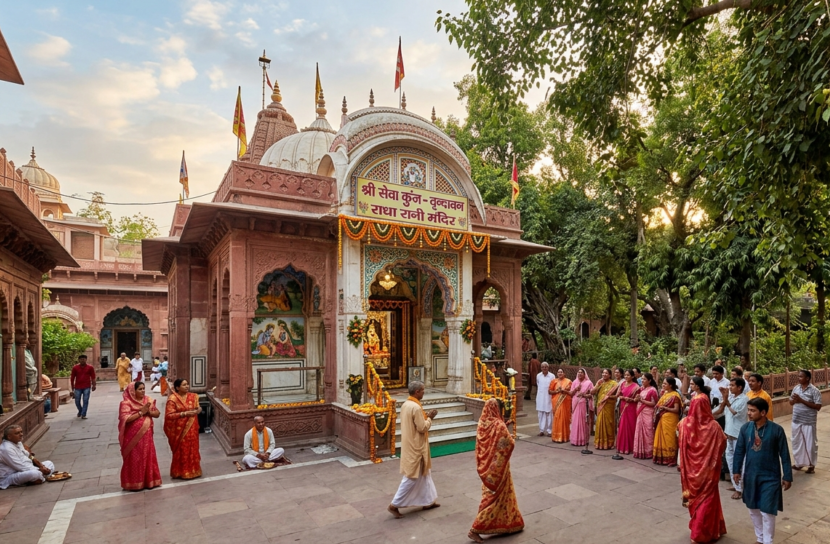
Shri Seva Kunj Vrindavan :- History, Architecture, and Complete Travel Guide
Here is the detailed English translation of the blog based on the sacred, divine, and mysterious journey to Sri Seva Kunj, Vrindavan (Mathura).
Detailed History
Sri Seva Kunj (also known as ‘Nikunj Van’) is considered one of the most sacred, ancient, and mysterious sites in Vrindavan. This holy shrine was established in the 16th century by Saint Sri Hit Harivansh Mahaprabhu, the founder of the Radha Vallabh Sampradaya.
According to sacred tradition, this is the very divine grove where Lord Krishna and Sri Radha Rani performed their eternal pastimes alongside their close sakhis (companions). The place came to be known as ‘Seva Kunj‘ because Lord Krishna Himself lovingly served the lotus feet of His beloved Sri Radha Rani here, feeding Her betel leaves (paan) and braiding Her hair with His own hands.
Similar to Nidhivan, Seva Kunj holds an enduring mystery and belief that Lord Krishna and Radha Rani perform the divine ‘Raasleela’ here every single night. For this reason, after the evening Aarti, the doors of Seva Kunj are strictly locked, and no human, animal, or bird is permitted to stay inside overnight.
Detailed Architecture
- Unique Structure of Groves :– Seva Kunj is not a traditional stone building, but a dense, vast garden filled with sacred Tulsi plants, flowering creepers, and ancient trees. A striking feature of these trees is that their branches are deeply intertwined, appearing as if they are embraced in eternal devotion. It is believed that these creepers and trees transform into Gopis at night.
- Sri Radha Rani Temple (Rang Mahal) :– At the center of the complex sits a small and deeply revered temple known as the ‘Sri Radha Rani Temple’. The main altar houses a beautiful painting depicting Lord Krishna serving the lotus feet of Radha Rani. Every evening after Aarti, priests place cosmetics, sandalwood paste, attire, betel leaves, and fresh water inside before locking the sanctum.
- Lalita Kund :– Situated within the complex is an ancient sacred water tank named ‘Lalita Kund’. Legend holds that when Sri Radha Rani’s dear sakhi, Lalita Ji, felt thirsty during the Raasleela, Lord Krishna carved out this pond using His divine flute (Vanshi).
Travel Guide & Routes
- Entry Fee :– Free (No entry tickets or VIP passes required for general darshan).
- Timings :–
- Morning:- 06:00 AM to 12:00 PM (Summers) / 06:30 AM to 12:30 PM (Winters)
- Evening:- 05:00 PM to 07:30 PM (The complex is evacuated and closed immediately after the evening Aarti).
- How to Reach :–
- By Train :– The nearest major railway station is Mathura Junction (approx. 14 km). E-rickshaws, auto-rickshaws, and taxis are easily available to Vrindavan.
- By Road :– Vrindavan is well-connected via NH-19 and the Yamuna Expressway from Delhi and Agra. The shrine is about 2 km from the Vrindavan Bus Stand near Radha Vallabh Temple, accessible via e-rickshaws or on foot through narrow lanes.
- By Air :– The nearest international airport is Indira Gandhi International Airport, New Delhi (approx. 150 km), and the domestic airport is Agra (approx. 72 km).
- Photography Spots :– Photography and videography inside the Seva Kunj complex are strictly banned. Visitors can take photos in the outer historical lanes. (Note: The surrounding lanes have many monkeys, so keep your glasses, mobile phones, and belongings secure.)
- Local Flavors & Famous Markets :– Enjoy Vrindavan’s famous Lassi, Rabri, Makkhan-Mishri, Peda, and hot Kachori-Sabzi in the nearby lanes. At surrounding shops, you can purchase Radha-name scarves, Tulsi rosary beads, brass items, and deity attire.
Interesting Facts
- Lord Krishna’s Humble Service :– This is the only sacred spot in the entire Braj region where Lord Krishna assumes a servant’s mood to serve the lotus feet of Sri Radha Rani.
- Strict Night Prohibition :– After the evening Aarti, all entry gates of Seva Kunj are locked. Belief holds that anyone attempting to hide inside to watch the Raasleela loses their sight or mental balance.
- Manifestation of Lalita Kund :– The sacred Lalita Kund within the complex was created directly by Lord Krishna using His flute to quench Sakhi Lalita’s thirst.
Important Questions and Answer :-
Question 1:- Is there an entry fee to visit Seva Kunj?
Answer:- No, entry and darshan at Seva Kunj are completely free of charge.
Question 2:- What time does Seva Kunj close in the evening?
Answer:- Seva Kunj closes immediately after the evening Aarti (between 07:00 PM and 07:30 PM), after which no one is allowed to remain inside.
Question 3:- Is photography allowed inside Seva Kunj?
Answer:- No, taking photographs or recording videos inside the Seva Kunj complex is strictly prohibited.
Nearby Attractions
- Sri Radha Vallabh Temple :– Located within short walking distance, serving as the central seat of the Radha Vallabh Sampradaya.
- Sri Bankey Bihari Temple :– Vrindavan’s most famous shrine, located just 500–700 meters away.
- Radha Raman Temple :– A 500-year-old historic shrine situated a short walk away.
- Shahji Temple :– Renowned for its marble craftsmanship and Belgian glass chandeliers, located nearby.
Author’s Thoughts
Stepping into Seva Kunj feels like crossing into a otherworldly realm of divine love. The dense green groves and quiet atmosphere fill the soul with profound tranquility. Where human logic ends, the mystery and selfless devotion of Seva Kunj begin. Lord Krishna’s act of serving Radha Rani’s lotus feet teaches that pure love knows no pride. When visiting Vrindavan, experiencing the quiet grace of Seva Kunj is an essential spiritual pilgrimage.
“Where Lord Krishna Himself serves the lotus feet of Radha Rani, that sacred divine grove is Seva Kunj Vrindavan.”