
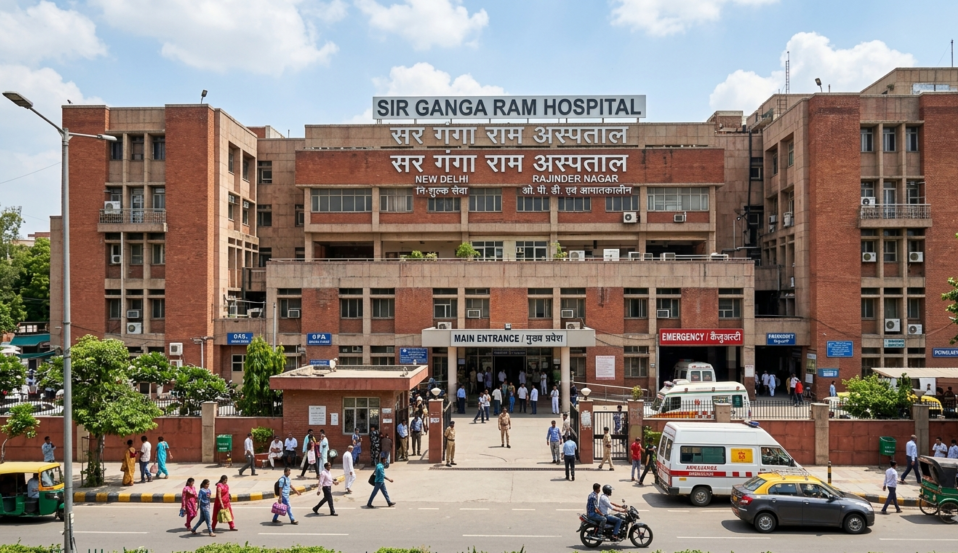
Sir Ganga Ram Hospital, Delhi :- A Legacy of Medical Excellence, Advanced Technology, and Human Service
Detailed History
Situated in the prominent Old Rajinder Nagar locality of Central-West Delhi, Sir Ganga Ram Hospital (SGRH) stands as one of India’s most prestigious, pioneering, and trusted multi-specialty private healthcare institutions. The history of this hospital encapsulates the trauma of India’s partition, the vision of a legendary philanthropist, and an extraordinary saga of selfless service to humanity.
The foundational roots of this hospital were initially laid in 1921 in Lahore (now in Pakistan) by Sir Ganga Ram, an iconic civil engineer, architect, and visionary philanthropist of his time (often revered as the ‘Father of Modern Lahore’). Following the partition of India in 1947, the original hospital remained in Lahore. Dr. Dharma Vira, a distinguished physician who migrated to Delhi, took upon himself the monumental task of reviving the hospital’s legacy on Indian soil.
Recognizing the nobility of the cause, India’s first Prime Minister, Pandit Jawaharlal Nehru, allocated a prime plot of land in Rajinder Nagar. Pandit Nehru laid the foundation stone of Sir Ganga Ram Hospital on April 13, 1951, and formally inaugurated the facility in 1954. What started as a modest charitable hospital gradually expanded into a world-class medical giant. Today, the hospital is managed by the ‘Sir Ganga Ram Trust Society’ without any government financial aid and is globally acclaimed for its unique institutional policy of providing identical high-tier medical care to both wealthy and underprivileged patients alike.
Detailed Architecture
Exterior Architecture :-
The sprawling campus of Sir Ganga Ram Hospital is spread over more than 11 acres of premium land, beautifully interspersed with well-maintained green spaces. Its exterior architecture presents a seamless integration of functional design and contemporary multi-story engineering. The primary heritage wing features a clean cream and white concrete layout that balances institutional simplicity with architectural elegance. Over the decades, systematic structural updates have added state-of-the-art multi-story zones, including the massive ‘SGRH Super Specialty Block’ and the dedicated ‘Research Block’. These newer complexes boast sleek global styling, marked by towering structural glass curtains and modern composite panels that mirror the design of premier international healthcare hubs.
Interior Architecture :-
Internally, Sir Ganga Ram Hospital is scientifically mapped out to optimize patient care and ensure seamless transit for critical emergencies. Entering the main building leads into a vast, fully air-conditioned central reception lobby and patient registration atrium. The corridors branching out to distinct specialty departments (such as Gastroenterology, Nephrology, and Organ Transplant units) are exceptionally wide, spotlessly clean, and finished with heavy-duty granite and anti-bacterial seamless flooring. The interiors house high-end modular Operation Theatres (OTs), advanced intensive care units (ICUs), and digitized diagnostic labs. Comfortable and spacious waiting lounges are integrated across every floor for patient families. The entire interior layout is fitted with highly visible digital signage and color-coded directory boards, enabling seamless navigation for visitors.
Travel Guide & Routes
For outpatients, families, and medical visitors planning to travel to Sir Ganga Ram Hospital, the comprehensive guide below outlines all key logistics.
- Ticket and Consultation Fee :– General entry into the hospital compound is entirely Free. Being a premier private trust hospital, doctor consultation fees vary based on the clinical specialty and seniority of the consultant (generally ranging between ₹1,000 and ₹1,500). However, the hospital strictly reserves a mandatory portion of its OPD clinics and inpatient beds to treat economically weaker section (EWS) patients free of cost or at highly subsidized rates.
- Timings (OPD & Emergency) :–
- General OPD Hours :– From 09:00 AM to 05:00 PM (Prior appointment booking with specific consultants is highly recommended).
- Emergency & Casualty Services :– Fully operational round-the-clock, 24 hours a day, 7 days a week.
- Opening and Closing Days :– Main outpatient consultation chambers run from Monday to Saturday. Regular OPD clinics remain closed on Sundays and major national holidays, while the Emergency wing, Trauma services, and inpatient critical care units function continuously.
- How to Reach :–
- By Metro :– The most convenient way to reach the hospital is via the Delhi Metro network. The nearest stations are the ‘Karol Bagh’ Metro Station (Blue Line) and the ‘Rajendra Place’ Metro Station (Blue Line). Both stations sit within a comfortable 1 to 1.5 km radius of the hospital, from where e-rickshaws and auto-rickshaws are readily available to drop you at the entrance gates within 5 minutes.
- By Bus :– The Shankar Road and Pusa Road bus stops serve as the closest transit hubs. Public buses heading towards Karol Bagh or Rajinder Nagar from major junctions like Anand Vihar, Kashmiri Gate, or Dhaula Kuan drop passengers a short walk away from the hospital perimeter.
- By Auto/Taxi/Cab :– Centrally located in West-Central Delhi, the hospital is roughly 5 km from New Delhi Railway Station. Visitors can seamlessly book app-based cabs, hop on local autos, or hire prepaid taxis to arrive directly at the primary entrance plaza.
Photography Spots, Local Food, and Famous Markets
Photography Spots
- The Sir Ganga Ram Statue & Landmark Board :– The bronze statue of the legendary founder Sir Ganga Ram, situated inside the main courtyard along with the central institutional board, stands as the most prominent and proud landmark photograph.
- The Facade of the Super Specialty Block :– The sleek, modern architectural lines and mirror-glass curtains of the newly built multi-story Super Specialty Block offer a brilliant modern backdrop for architectural shots.
- The Central Courtyard Lawns :– The beautifully manicured compact gardens near the primary wing inject a serene, positive visual aesthetic into the campus, making it a great spot for landscape captures. (Note: Photography or video recording inside clinical consulting chambers, active ICU wings, Operation Theatres, and of active patients is strictly prohibited by hospital law due to patient privacy guidelines.)
Local Food
Its close proximity to Karol Bagh and Old Rajinder Nagar offers access to some of Delhi’s most iconic and mouth-watering culinary spots.
- The In-house SGRH Canteen :– The hospital houses a modern, highly hygienic cafeteria that serves freshly prepared multi-cuisine meals, healthy diet platters, light snacks, and hot beverages for staff and patient relatives.
- Rajinder Nagar Chole Bhature :– The food lanes just outside the hospital perimeter are immensely popular for serving authentic, ultra-crisp local street favorites like piping hot Chole-Bhature, Bedmi-Kachoris, and samosas.
- Karol Bagh Street Delicacies :– A brief drive opens up access to Karol Bagh’s famous culinary institutions, known for specialized Kulfi-Falooda, chaat-papdi, and legacy family diners like Bikanerwala.
Famous Markets Nearby
- Karol Bagh Market :– One of Delhi’s largest and most iconic commercial hubs, featuring Ajmal Khan Road (famous for branded apparel), the legendary Gaffar Market (India’s premier electronics flea market), and Bank Street (renowned for traditional bridal gold and diamond jewelry).
- Old Rajinder Nagar Market :– Universally known as the prime hub for Civil Services (UPSC) aspirants, this vibrant locality is lined with major academic bookstores, stationery hubs, and trendy student cafés.
- Connaught Place (CP) :– Delhi’s premier open-air high-street business and lifestyle destination, located just a quick 15-minute drive from the hospital gates.
Interesting Facts
- A Trans-Border Journey :– Sir Ganga Ram Hospital holds the unique historical distinction of being the only major private hospital that originated in pre-partition Lahore and was successfully rebuilt and resurrected from scratch in post-independence Delhi.
- The Unique Self-Sustaining Charitable Model :– Operating on a strict ‘no-profit-no-loss’ philosophy, SGRH dynamically cross-subsidizes its funds, utilizing revenues generated from private wards to spend nearly 20% of its resources on providing free treatment, free beds, and free medicines to poor patients.
- Pioneer in Organ Transplants :– The hospital is recognized as a global frontrunner in advanced organ transplant surgeries, managing highly acclaimed multi-disciplinary programs for Liver, Kidney, and Cornea transplantations.
- A Hub of Medical Education :– SGRH is not just a treatment center; it is a premium postgraduate medical teaching and research institute accredited heavily under the National Board of Examinations (NBE).
Important Questions and Answer :-
Question 1:– When and by whom was Sir Ganga Ram Hospital established in Delhi?
Answer:- The foundation stone of the hospital in Delhi was laid by Pandit Jawaharlal Nehru in 1951, and it was inaugurated in 1954. The legacy was originally founded in 1921 in Lahore by the legendary civil engineer and philanthropist Sir Ganga Ram.
Question 2:– Where exactly is Sir Ganga Ram Hospital located in Delhi?
Answer:- The hospital is centrally located in Old Rajinder Nagar, right next to Pusa Road and close to the Karol Bagh area in New Delhi.
Question 3:- Which is the closest metro station to access Sir Ganga Ram Hospital?
Answer:- The closest metro stations are ‘Karol Bagh’ and ‘Rajendra Place’, both located on the Blue Line of the Delhi Metro network, from where the hospital is just a 5-minute rickshaw ride away.
Question 4:- Is Sir Ganga Ram Hospital a government-run hospital?
Answer:- No, it is a non-governmental, private trust multi-specialty hospital run and managed independently by the Sir Ganga Ram Trust Society.
Question 5:– Are emergency trauma services available round-the-clock at SGRH?
Answer:- Yes, the Emergency, Critical Care, and Trauma departments of Sir Ganga Ram Hospital operate continuously 24 hours a day, 7 days a week, throughout the year.
“Tracing its majestic journey from pre-partition Lahore to becoming a crowning jewel of modern medicine in India, Sir Ganga Ram Hospital stands tall as a flawless blend of global technology and deep human empathy.”