
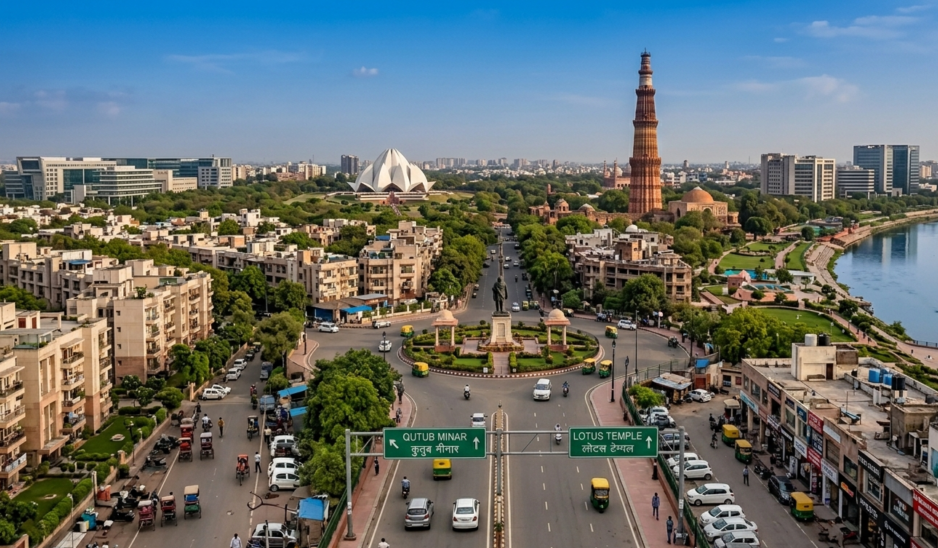
South Delhi :- The Ultimate Confluence of History, Luxury, and Modern Lifestyle
South Delhi is widely recognized as the most affluent, vibrant, and culturally rich quadrant of India’s capital city. It is a unique territory where UNESCO World Heritage sites and centuries-old ruins coexist seamlessly with elite residential neighborhoods, high-end luxury malls, and trendy culinary hubs. This region holds an irresistible appeal for history enthusiasts, avid shoppers, food connoisseurs, and the urban youth alike.
Detailed History :-
The history of South Delhi is essentially the foundational story of Delhi itself. Out of the historic ‘Seven Cities of Delhi‘ established by consecutive medieval rulers, a majority were built right within this southern region.
The urban timeline begins in the 11th century with Lal Kot (Qila Rai Pithora), founded by the Tomar King Anangpal, the remnants of which can still be traced around Mehrauli. Following this, Alauddin Khilji established the fortified city of Siri, Ghiyasuddin Tughlaq constructed the massive and formidable Tughlaqabad Fort, and Muhammad bin Tughlaq laid the foundations of Jahanpanah. The later arrivals of Sher Shah Suri and the Mughal emperor Humayun left an indelible architectural mark, beautifully epitomized today by Humayun’s Tomb. Through the colonial period and post-independence development, the zone gradually transformed into India’s most prestigious residential and upscale commercial district.
Detailed Architecture :-
The architectural profile of South Delhi offers a rich chronicle of evolution—spanning early Islamic architecture, the heavily battered, sloped masonry walls of the Tughlaq era, grand Mughal symmetrical designs, and contemporary modern concepts.
- Qutub Minar Complex :– This complex houses the 73-meter-high minaret, the tallest brick tower in the world. Its structural red sandstone is embellished with intricate Quranic inscriptions and complex geometric carvings. The historic Iron Pillar in the courtyard remains a legendary marvel of 4th-century ancient Indian metallurgy.
- Humayun’s Tomb :– Representing the earliest grand example of Mughal garden tombs in India, this monument served as the direct architectural inspiration for the Taj Mahal. It features the classic ‘Charbagh‘ layout (a four-quadrant garden design) executed with a grand synthesis of red sandstone and white marble accents.
- Lodhi Gardens and Safdarjung Tomb :– The prominent historical tombs within Lodhi Gardens (such as Bada Gumbad and Sheesh Gumbad) showcase 15th-century Sayyid and Lodhi styles characterized by massive stone structures and austere elegance. Conversely, Safdarjung Tomb stands as the final, delicate architectural expression of the sunset years of the Mughal Empire.
- The Lotus Temple (Bahá’í House of Worship) :– A milestone of modern expressionist architecture, this structure is shaped in the form of 27 free-standing petals made of pure white Greek marble arranged to mimic a blooming lotus. It deliberately houses no idols or religious icons, reflecting a universal philosophy of peace and unity.
Travel Guide & Routes :-
- Tickets & Entry Fees :– For globally recognized UNESCO heritage sites like Qutub Minar and Humayun’s Tomb, entry tickets cost ₹40 for Indian citizens and ₹600 for foreign nationals (discounts are available on online portals). Admission to the Lotus Temple, Lodhi Gardens, and the medieval ruins within Hauz Khas Village is entirely free.
- Visiting Time :– Most historical monuments remain open from sunrise to sunset (approximately 06:00 AM to 06:00 PM). The Lotus Temple welcomes visitors from 09:00 AM to 05:30 PM (closed on Mondays). Elite entertainment zones like Saket Malls and Hauz Khas cafes operate well into the night, shutting around 11:00 PM.
- How to Reach :–
- By Metro :– The Delhi Metro network’s ‘Yellow Line’ and ‘Magenta Line’ intersect extensively through South Delhi. The key transit hubs include ‘Qutub Minar’, ‘Hauz Khas’, ‘Saket’, and ‘Jawaharlal Nehru Stadium‘ stations.
- By Road :– The Ring Road and Outer Ring Road corridors make South Delhi exceptionally accessible from all parts of the capital. The Indira Gandhi International Airport is situated just a 20-to-30-minute drive away. App-based taxis, auto-rickshaws, and local e-rickshaws are highly ubiquitous for localized transport.
- Photography Spots :– The central reflecting pools at Humayun’s Tomb, the monumental Alai Darwaza within the Qutub complex, the vibrant murals of the Lodhi Art District (India’s first open-air public gallery), and the historic stone balconies overlooking the lake at Hauz Khas Village are premier choices for photography.
- Local Flavors :– The chic alleyways of Hauz Khas Village and upscale plazas in Saket are famous for international continental and gourmet Italian food. On the street-food spectrum, the exceptional momos of Lajpat Nagar (including the famous Dolma Auntie Momos) and the authentic Bengali street delicacies (Puchkas and Kathi Rolls) at Chittaranjan Park (CR Park) are legendary.
- Famous Markets :– ‘Lajpat Nagar (Central Market)’ and ‘Sarojini Nagar Market’ are internationally famous destinations for budget-friendly apparel, fabrics, and fast fashion. For high-end domestic luxury labels and international luxury retailers, ‘DLF Avenue’ (Saket) and ‘South Extension‘ are the definitive markets.
Interesting Facts :-
- The ‘Lodhi Art District‘ stands as India’s premier open-air public art initiative, where creative talent from across the globe has transformed the plain facades of government residential quarters into spectacular vibrant canvases.
- The Mehrauli Archaeological Park is a singular geographical location containing continuous archaeological remnants spanning over 1,000 years of Delhi’s history, ranging from the early Tomar Rajput period to the colonial British Raj.
- The ‘Kiran Nadar Museum of Art‘ (KNMA) located in Saket is India’s pioneer private museum completely dedicated to modern and contemporary art exhibitions.
Important Questions and Answer :-
Question 1:– Which are the best destinations for budget shopping in South Delhi?
Answer:- Sarojini Nagar Market and Lajpat Nagar Central Market are undisputed havens for budget fashion. With proficient bargaining skills, visitors can secure high-fashion clothing, footwear, and accessories at highly nominal prices.
Question 2:- What makes Hauz Khas Village a unique urban hotspot?
Answer:- Hauz Khas Village is a unique geographic intersection of ancient history and trendy modern nightlife. It features a scenic 14th-century reservoir and madrasa complex built during the Khilji and Tughlaq dynasties, situated immediately adjacent to elite pubs, rooftop fine-dining cafes, and contemporary art galleries.
Question 3:– Can individuals of any faith offer prayers inside the Lotus Temple?
Answer:- Yes. The Lotus Temple is a Bahá’í House of Worship that centers on the absolute unity of God, religion, and humanity. People belonging to any faith, nationality, or caste are welcome to enter, meditate, or sit in silent contemplation without undergoing any specific religious rituals.
Author’s Thoughts :-
From my perspective, South Delhi is an urban experience defined by its beautiful contradictions. It gives you the rare luxury of turning the pages of ancient history in the morning and diving into ultra-modern cosmopolitan life by evening. Strolling past the quiet, ancient tombs of Lodhi Gardens at dawn, navigating the bustling street stalls of Sarojini Nagar in the afternoon, and watching the sunset behind the medieval stone domes of Hauz Khas creates an entirely magical experience. South Delhi is not merely an elite district to reside in; it is a distinct, sophisticated lifestyle that stays with you long after you leave.
“Cradling the majestic ruins of yesteryear alongside the progressive strides of tomorrow, South Delhi remains the most alluring and sophisticated face of the capital.”