
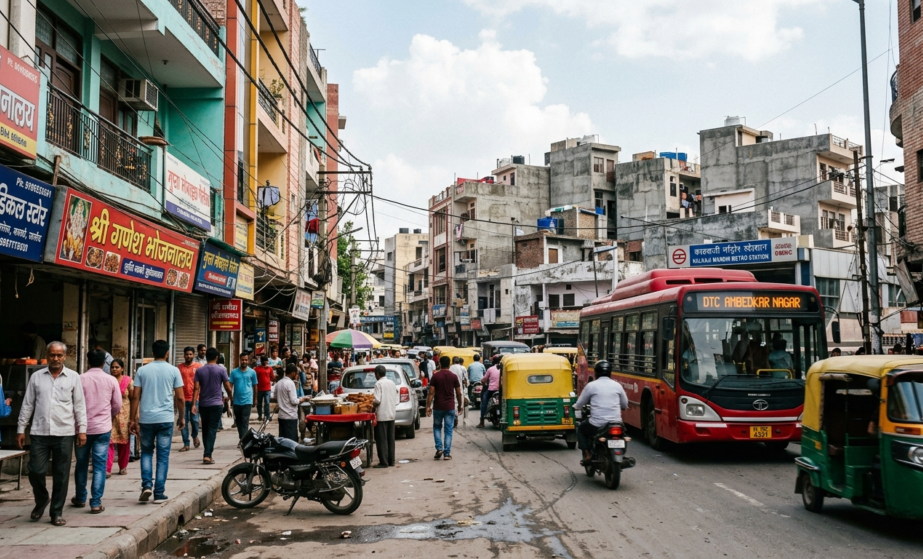
South East Delhi :- The Vibrant Crucible of Historic Legacies, Modern Art, and Techno-Commercial Culture
South East Delhi stands as an exceptionally prominent, highly dynamic, and economically robust administrative zone of India’s capital city. Renowned for its dense tapestry of historical sites, avant-garde public art districts, massive technological trading plazas, and a highly diverse multicultural population, it commands a unique position. While its spiritual sanctuaries offer a profound sense of peace to global seekers, its commercial spaces drive a significant parallel trade volume. This sector represents a seamless integration of medieval antiquity and high-speed modern lifestyle.
Detailed History :-
The historic timeline of South East Delhi is profoundly linked to the early foundational phases of the Delhi Sultanate and the subsequent arrival of legendary Sufi mystics. Since the 13th and 14th centuries, the localized Nizamuddin sector has served as the epicentre of Sufi thought in South Asia, acting as the sacred ground for the revered saint Hazrat Nizamuddin Auliya and his legendary disciple, the poet Amir Khusrau.
Following the partition of British India, the state executed systematic resettlement layouts, building sprawling residential enclaves in Lajpat Nagar and Kalkaji to house thousands of displaced families. Later, consecutive waves of workforce migration from Uttar Pradesh, Bihar, and West Bengal introduces deep socio-cultural diversity. The neighborhood of Chittaranjan Park (CR Park) was deliberately mapped out in the 1970s to establish a structured commune for Bengali families. Today, this administrative zone functions as a highly organized matrix combining monumental antiquities, premium residential zones, and the city’s highest-yield corporate markets.
Detailed Architecture :-
The architectural profile of South East Delhi offers a balanced transition from early medieval Islamic stonemasonry and post-independence planned low-rise residential structures to sleek contemporary commercial towers.
- Hazrat Nizamuddin Dargah Complex :– Representing an iconic specimen of traditional Islamic architecture, the central mausoleum features a striking white marble dome accented by intricate jaali (lattice) stone screens and monumental red sandstone arches. Directly adjacent rests the ‘Chausath Khamba’ (64 Pillars) – a brilliant pure-marble Mughal structure – and the quiet, historic tomb of the legendary classical poet Mirza Ghalib.
- Nehru Place :– This financial center is a classic operational showcase of 1970s ‘Brutalist Architecture’. Characterized by massive multi-story raw concrete office towers, elevated public plazas, and interconnected commercial blocks, it is custom-built for high-volume corporate operations.
- Okhla Industrial Area & Corporate Enclaves :– The corporate blocks of Okhla showcase contemporary glass-curtain architecture and minimalist industrial masonry designed to meet the demands of major multinational tech firms and global logistics centers.
Travel Guide & Routes :-
- Tickets & Entry Fees :– Entry to primary spiritual landmarks including the Hazrat Nizamuddin Dargah, the historic Kalkaji Temple, and the commercial common areas of Nehru Place is completely free of charge. Exploring the open-air street galleries of the Lodhi Art District carries no fee. Only specialized interior spaces like the National Crafts Museum (bordering the outer edge near Pragati Maidan) require a nominal admission fee of ₹20.
- Visiting Time :– Mainstream retail street markets and financial sectors operate at peak capacity from 11:00 AM to 09:30 PM. The primary electronics market at Nehru Place remains completely closed on Sundays. For a profound spiritual experience, the ideal time to visit the Nizamuddin Dargah is Thursday or Friday evening during the formal musical sessions.
- How to Reach :–
- By Metro :– The Delhi Metro network’s ‘Violet Line’, ‘Pink Line’, and ‘Magenta Line’ provide comprehensive connectivity across the district. Key high-traffic transit nodes include ‘Nehru Place’, ‘Lajpat Nagar’ (Pink/Violet interchange), ‘Kalkaji Mandir’, and ‘Hazrat Nizamuddin’ stations.
- By Rail & Road :– Hazrat Nizamuddin Railway Station (NZM) is one of Delhi’s primary high-capacity rail terminals, serving as the definitive launching pad for premier cross-country superfast trains like the Rajdhani and Duranti Express networks to Western and Southern India. The Mathura Road highway (NH-2) provides direct vehicular paths to Faridabad and Agra.
- Photography Spots :– The atmospheric, medieval alleys of Nizamuddin, the spectacular public art canvases covering the walls of the Lodhi Art District, the monumental, colorful festive structures across CR Park during the autumn festival season, and the migratory avian habitats along the Okhla Bird Sanctuary border.
- Local Flavors :– South East Delhi is an absolute paradise for dedicated food lovers. Chittaranjan Park (CR Park) is famous for authentic Bengali street delicacies like mustard fish fry, spicy Puchkas, and fresh Rasgullas. Lajpat Nagar offers legendary street snacks like savory Ram Laddus and Dolma Auntie’s signature steamed Momos, while the legacy kitchens of Karim’s and Ghalib Kebab Corner in Nizamuddin serve exceptional Mughlai slow-cooked meats and tandoori breads.
- Famous Markets :– ‘Nehru Place’ (Asia’s single largest wholesale commercial hub for computer IT systems, software licensing, and hardware accessories), ‘Lajpat Nagar (Central Market)’ (renowned for high-end traditional Indian ensembles, bridal wear fabrics, and footwear), and ‘Kalkaji High Street’.
Interesting Facts :-
- The sprawling trade complex of Nehru Place is officially recognized as Asia’s largest wholesale IT market, anchoring the digital supply chains and tech hardware restructuring for the entire subcontinent.
- Chittaranjan Park (CR Park) is universally celebrated as Delhi’s “Mini Kolkata,” preserving an authentic cultural enclave with specialized fish markets, regional bookstores, and traditional sweet shops.
- Hazrat Nizamuddin Railway Station is the premier point of origin for the ‘Gatimaan Express’—one of India’s fastest scheduled trains—allowing tourists to commute to the Taj Mahal in Agra in record time.
Important Questions and Answer :-
Question 1:- What are the key rules to remember when shopping at Nehru Place?
Answer:- The main computer and commercial electronic market at Nehru Place remains strictly closed on Sundays. When sourcing hardware or software, it is highly recommended to buy directly from authorized brand dealers inside the formal complexes and demand a standard printed invoice, as street-side vendors frequently trade in counterfeit accessories or unauthorized software.
Question 2:- When can visitors witness the traditional Sufi musical performances at Nizamuddin Dargah?
Answer:- The world-famous Sufi Qawwali sessions at the Dargah are traditionally performed on Thursday and Friday evenings, commencing shortly after the Maghrib (sunset) prayers. The atmosphere during these hours is deeply spiritual and charges the entire courtyard.
Question 3:– What makes Lajpat Nagar Central Market a premier destination for travelers?
Answer:- Central Market is a legendary fashion hub, specifically highly rated for its immense variety of traditional Indian attire, customized embroidery work, designer textiles, and highly competitive street-shopping options, paired with some of the city’s most famous legacy street-food joints.
Author’s Thoughts :-
To me, South East Delhi is a compelling territory that masterfully plays with sensory contrasts. Within a radius of just a few kilometers, you experience an incredible transition from the fast-paced, high-volume corporate rush of Nehru Place’s raw concrete towers to the timeless, mystical serenity of Nizamuddin’s evening Qawwalis or the vibrant visual storytelling across the walls of the Lodhi Art District. It is a sector where the sharp mechanics of modern commerce effortlessly respect the deep-seated cultural roots of its diverse residents. If you want to witness how the capital balances its hyper-commercial ambitions with a soulful artistic and spiritual heart, South East Delhi is your definitive destination.
“South East Delhi represents a brilliant urban paradox, anchoring the subcontinent’s most explosive technological trade directly alongside the timeless, mystical echoes of Sufi devotion.”