
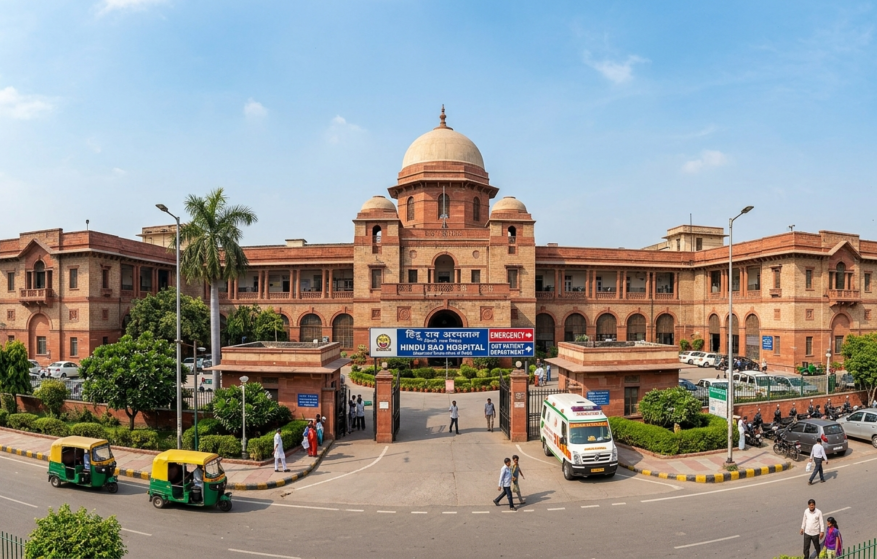
The Bala Pillar at Hindu Rao Hospital :- A Gothic Emblem of Delhi’s 1857 Historic Resilience
Detailed History
The Bala Pillar, historically designated as the Delhi Mutiny Memorial (now officially renamed Ajitgarh), stands prominently within the elevated estate of the Hindu Rao Hospital on the Delhi Ridge in North Delhi. Far beyond its contemporary identity as a premier municipal medical institution, this hillside complex operates as a vital monumental archives of India’s colonial, military, and revolutionary history, encapsulating the raw memories of the First War of Indian Independence (the 1857 Uprising).
The core mansion flanking the monument was originally commissioned in the early 1820s by William Fraser, the British Resident to the Mughal Court. Following his demise, the grand estate was acquired by Raja Hindu Rao, a Maratha nobleman and the brother of the Regent of Gwalior, thereby permanently naming the entire ridge and the palace structure as ‘Hindu Rao’. During the intense geopolitical explosion of 1857, this elevated mansion transformed into the supreme strategic military headquarters for the British forces due to its sweeping command over the walled city of Old Delhi and the Kashmiri Gate. Recognizing its geopolitical value, Indian revolutionary soldiers launched relentless, bloody offensives to reclaim this ridge from colonial control.
Following the suppression of the uprising, the British administration constructed a monumental victory spire on this exact operational ridge in 1863 to honor the officers and loyalist soldiers of the Delhi Field Force who perished during the conflict. In 1972, celebrating the 25th anniversary of Indian Independence, the Government of India formally renamed the site ‘Ajitgarh’ (The Unconquered Fort) and installed a corrective historical plaque, shifting the memorial’s focal tribute away from imperial forces to honor the supreme sacrifice of the immortal Indian freedom fighters who laid down their lives to break the shackles of foreign tyranny. In 1911, the adjacent operational mansion was systematically converted into a clinical center, which today functions as the largest tertiary hospital under the Municipal Corporation of Delhi.
Detailed Architecture :-
The architecture of the Bala Pillar (Mutiny Memorial) inside the Hindu Rao estate represents an exceptional, high-utility specimen of the Gothic Revival Architectural style that dominated Victorian public infrastructure in the mid-19th century.
- The Octagonal Spire Framework :– Crafted entirely out of rich, locally quarried red sandstone, the memorial is configured as a soaring octagonal spire that tapers dramatically as it ascends toward the skyline. Its overarching morphology closely resembles the structural spires of traditional Gothic cathedrals.
- Intricate Ornamental Detailing :– The exterior architecture features classic pointed Gothic arches, deeply recessed ornamental windows, and precisely carved defensive crenellations. The lower tiers of the octagonal base are inset with authentic white marble memorial plaques. These colonial-era slabs catalog detailed casualty registers, listing the names, regiments, and operational ranks of the British forces who fell during the Ridge campaigns.
- The Nationalist Corrective Plaque :– Directly contrasting the imperial inscriptions, a prominent stone plaque erected at the entrance by the Indian state structurally redefines the site’s historical narrative. It explicitly states that the targeted ‘mutineers’ referenced in colonial records were, in absolute truth, patriotic Indian soldiers fighting a righteous war of liberation against an oppressive foreign regime.
- Photography Spots :– Enveloped by the dense, rustic forests of the Kamla Nehru Ridge, this deep red Gothic spire offers an extraordinary canvas for heritage, architectural, and high-contrast documentary photography. The early morning golden hour, as light passes through the pointed arches, projects sharp geometric shadows along the sandstone floor. Furthermore, the colonial facades of the primary Hindu Rao Hospital buildings and the sweeping panoramic views of the Old Delhi cityscape visible from the rear cliffs present phenomenal frames for urban landscape photographers.
Travel Guide & Routes :-
- Ticket :– As the historical pillar is located within a public municipal park zone adjacent to the hospital infrastructure, there is absolutely no entry fee or ticket fee. Access remains completely free to all historians and travelers.
- Visiting Time :– The monument grounds are accessible to the public from 08:00 AM to 06:00 PM daily. Given its structural proximity to active hospital recovery wards, visitors are strictly required to maintain code silence. The optimal period for a detailed exploration is during the cool winter months spanning from October to March.
- How to Reach :–
- By Metro :– The most efficient transit route is through the Delhi Metro. The closest stations are Pul Bangash Metro Station on the Red Line and the massive Kashmiri Gate Metro Station (Interchange for Red, Yellow, and Violet Lines). Additionally, the Vidhan Sabha Metro Station on the Yellow Line provides quick access. From any of these exits, local e-rickshaws or auto-rickshaws can drop you directly up the winding hill of the Hindu Rao complex.
- By Bus :– Located near the Kashmiri Gate ISBT and Old Delhi Railway Station, the venue is serviced by an expansive network of inter-city and local DTC buses. The Hindu Rao Hospital Bus Halt serves as the immediate drop-off coordinate.
- By Road :– Commuters can easily drive or hire app-based cabs (Ola/Uber) via Rani Jhansi Road or Civil Lines to access the hill station entrance. Dedicated parking zones are available within the institutional hospital complex.
- Nearby Attractions :– The historic St. James’ Church at Kashmiri Gate, the ancient Delhi-Topra Ashokan Pillar (situated just further down the same forest ridge), the 14th-century Tughlaq-era Pir Ghaib Observatory, and the colonial ruins of Qudsia Bagh.
- Local Flavors & Famous Markets :– Descending from the historic ridge takes you directly into Malka Ganj and the bustling Kamla Nagar Market, the ultimate cultural and commercial hub for Delhi University students. Visitors can enjoy legendary local street food mainstays like the iconic ‘Bille Di Hatti’ for heavy Chole Bhature, spicy kachoris, and customized samosas. Kamla Nagar is also highly preferred across North Delhi for its expansive high-street fashion, footwear boutiques, and digital accessory markets.
Interesting Facts :-
- While the British administration designed the structure to project imperial dominance, its post-independence renaming to ‘Ajitgarh’ poetically subverted the monument to celebrate the eternal, unyielding spirit of the Indian revolutionaries.
- The spire is strategically positioned on the exact geographical site of the British military’s ‘Right Battery’—the high-caliber artillery position that proved instrumental in breaching the heavy northern stone walls of Kashmiri Gate during the final assault of September 1857.
- The dense forests of the Delhi Ridge surrounding the Hindu Rao site are frequently listed among Delhi’s most mysterious and haunted locations, driven by generations of local urban legends surrounding the thousands of casualties buried across the hills during the 1857 siege.
Important Questions and Answer :-
Question 1:- Why is this monument colloquially referred to as the ‘Bala Pillar’ or ‘Bada Rao Pillar’ by local residents?
Answer:- While its official historic name was the Mutiny Memorial, its physical position inside the Bara Hindu Rao municipal locality caused the local populace to colloquially simplify its identity over the decades to ‘Bala Pillar’ or the ‘Pillar of Hindu Rao’.
Question 2:- How does the architectural narrative of the monument change between the marble plaques and the main entrance stone?
Answer:- The internal white marble plaques preserve the high-precision colonial records of British casualties, framing the war as a mutiny, while the prominent external Indian plaque explicitly honors those same forces as national martyrs who waged a revolutionary war for absolute independence.
Question 3:- Can individual tourists explore the monument without disrupting the operations of Hindu Rao Hospital?
Answer:- Yes, the monument is positioned in an isolated, beautifully manicured heritage park compound that sits at a protected distance from the main clinical emergency and treatment blocks, allowing history enthusiasts to explore the architecture peacefully without interfering with hospital logistics.
Author’s Thoughts :-
Standing beneath the colossal shadow of this red sandstone spire on the Delhi Ridge, one can almost feel the heavy vibrations of an era gone by. It is a profound historical irony that a monument constructed by an empire to celebrate its survival now stands as an eternal tribute to the very forces that sought to dismantle it. The Bala Pillar serves as a powerful architectural reminder that modern Delhi’s peaceful landscapes were once forged in the crucible of revolution. Away from the manicured lawns of central monuments, a walk up the historic Hindu Rao hill is essential for anyone seeking to touch the raw, unedited, and deeply moving pulse of India’s freedom struggle.
“Secluded gracefully within the dense forests of the Delhi Ridge, the Bala Pillar stands as a magnificent Gothic monolith, chronicling the fall of imperial hubris and the immortal memory of India’s revolutionary martyrs.”