
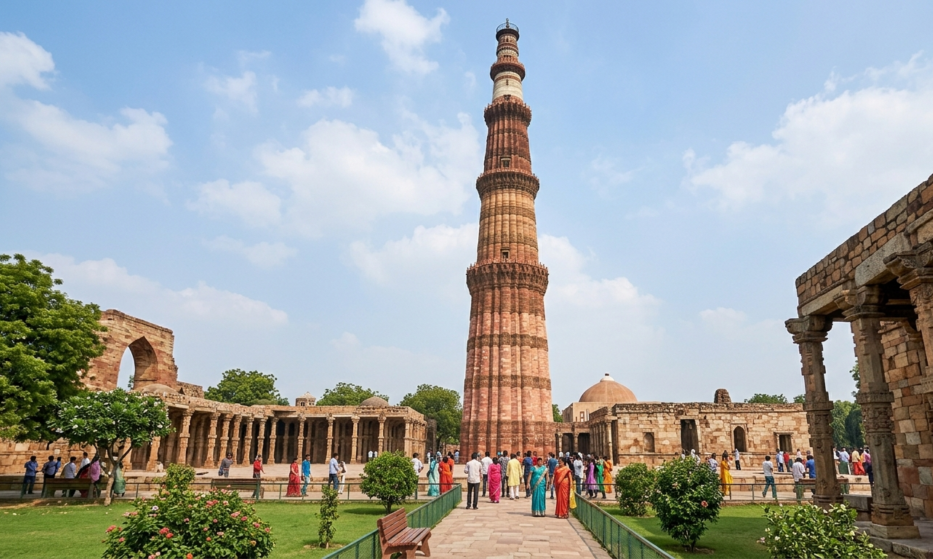
Heritage Monument :- The Qutub Minar
Detailed History
Situated in the Mehrauli area of South Delhi, the Qutub Minar is one of the tallest and most magnificent brick minarets in the world. The construction of this historic monument was initiated in 1199 AD by Qutb-ud-din Aibak, the founder and first ruler of the Delhi Sultanate. However, he could only complete the lowermost storey (base basement) during his lifetime. His successor and son-in-law, Shams-ud-din Iltutmish, expanded the structure by adding three more storeys to it in 1220 AD.
In 1368 AD, lightning struck the monument, severely damaging the topmost storey. This was later repaired and rebuilt by Firoz Shah Tughlaq, who also added the fifth and final storey to the minar. Later, in 1505, a massive earthquake caused significant damage to the structure, which was subsequently repaired by Sikandar Lodi. The minaret was named in honor of the revered Sufi saint, Khwaja Qutbuddin Bakhtiar Kaki. Recognizing its profound architectural brilliance and cultural value, UNESCO inscribed the Qutub Minar and its complex as a World Heritage Site in 1993.
Detailed Architecture
The architecture of the Qutub Minar represents an exemplary display of the Indo-Islamic architectural style, seamlessly blending traditional Indian masonry with Islamic design principles.
- Exterior :– The Qutub Minar stands at an imposing height of 72.5 meters (238 feet). It features a base diameter of 14.3 meters, which tapers gradually as it ascends, reducing to a mere 2.7 meters at the top summit. The first three storeys are constructed entirely out of premium red sandstone, while the fourth and fifth storeys beautifully incorporate a combination of red sandstone and smooth white marble. looped carvings of delicate floral motifs, geometric designs, and inscriptions of holy Quranic verses cover the outer surface. Elaborate balconies separate each storey, supported by finely carved stalactite brackets that enhance its aesthetic look.
- Interior :– The interior of the tower contains a winding spiral staircase comprising 379 steps leading to the top. However, due to public safety regulations, entry inside the minaret has been strictly prohibited for tourists since 1981. Within the larger complex lies the ‘Quwwat-ul-Islam’ Mosque, which displays highly detailed pillars featuring traditional Indian motifs. Standing proudly in the central courtyard is the famous ‘Iron Pillar’, a marvel of metallurgy from the ancient Gupta Empire.
Travel Guide & Routes
- Ticket and Charges :– The entry fee for Indian citizens is approximately ₹35 to ₹40 (online or digital ticketing options carry a small discount). For foreign tourists, the ticket is priced between ₹550 and ₹600. Entry is entirely free for children under the age of 15.
- Visiting Time :– The Qutub Minar complex remains open to the public on all seven days of the week. The visiting hours are from 7:00 AM to 5:00 PM (typically from sunrise to sunset). Visitors often stay back until twilight to witness the monument beautifully lit up.
- How to Reach :–
- By Metro :– The absolute easiest way to reach the monument is via the Delhi Metro network. The ‘Qutub Minar Metro Station’ located on the Yellow Line is the closest station. From there, local e-rickshaws and autos take about 5 minutes to drop you at the entrance gate.
- By Bus & Auto :– Several DTC buses routes connecting to Mehrauli, Saket, or Gurgaon pass right next to the Qutub Minar complex. App-based cabs (Ola/Uber) and regular auto-rickshaws are easily accessible from any part of Delhi.
- Photography Spots :– The expansive green lawns facing the tower, the ruins of the Alai Minar, the arched frames inside Iltutmish’s Tomb, and the classic angle near the Iron Pillar serve as the prime photography locations.
- Local Flavors :– Mehrauli and the nearby neighborhood of Saket host numerous chic cafes and fine-dining restaurants. Food enthusiasts can enjoy local favorites like Malai Chaap, Tandoori Momos, and a variety of North Indian Mughlai items. Nearby premium malls also offer broad global culinary options.
- Famous Markets :– For local ethnic items, the traditional Mehrauli market is close by. For a high-end shopping experience, Select CITYWALK and DLF Avenue malls in Saket are immensely popular commercial destinations located just a brief drive away.
Nearby Attractions in Detail :-
- Iron Pillar :– Located inside the same complex, this iconic iron pillar dates back to the 4th century AD (commissioned during the Gupta Dynasty). Its most spectacular feature is its rust-resistant composition; despite being exposed to open-air weathering for over 1600 years, it remains entirely free of rust, showcasing the supreme metallurgical expertise of ancient India.
- Alai Minar :– Alaud-din Khalji envisioned building a grand minaret that would stand twice as high as the Qutub Minar. However, following his demise in 1316 AD, the project was permanently abandoned. Today, only the massive, unfinished 24.5-meter-high rubble stone base remains at the site.
- Mehrauli Archaeological Park :– Situated adjacent to the Qutub Minar, this vast park spreads over 200 acres and protects over 100 historically significant structures, including the Tomb of Balban, the Jamali Kamali Mosque, and Rajon ki Baoli, making it a paradise for history buffs.
- Garden of Five Senses :– Located in Said-ul-Ajaib near Saket, this is a beautifully landscaped 20-acre public leisure park. It features themed gardens, cascading fountains, solar energy displays, and modern art sculptures, offering a serene getaway from the city’s fast life.
Interesting Facts
- The Qutub Minar is not perfectly vertical; it has a slight lean. Due to extensive structural restorations over centuries and natural water seepage in its foundations, the tower leans about 65 cm towards the north-west, though it is structurally completely secure.
- The tower is historically referred to as the ‘Tower of Victory’, constructed to mark the establishment and dominance of Muslim rule in northern India.
- Historical inscriptions and archaeological evidence show that the Quwwat-ul-Islam mosque inside the complex was constructed utilizing materials obtained from the deconstruction of 27 ancient Hindu and Jain temples.
- The Qutub Minar was the very first major heritage monument in India to introduce a dedicated architectural illumination system, allowing it to glow beautifully at night.
Important Questions and Answer :-
Question 1:– What is the total height of the Qutub Minar and how many steps are inside?
Answer:– The total height of the Qutub Minar is 72.5 meters, and it features a winding spiral staircase of 379 steps leading to the top level.
Question 2:– Why is public entry prohibited inside the Qutub Minar?
Answer:– On December 4, 1981, a severe stampede inside the tower led to a tragic accident resulting in the loss of several lives. Following this event, public entry into the interior staircase was permanently closed for safety and preservation reasons.
Question 3:- Who completed the final construction stages of the Qutub Minar?
Answer:– While Qutb-ud-din Aibak raised the foundation level, it was completed up to the fourth level by Iltutmish. The final fifth storey and structural repairs were later commissioned by Firoz Shah Tughlaq.
Author’s Thoughts
The Qutub Minar is far more than just a towering monument of brick and stone; it is a majestic page of medieval history etched against the skyline of Delhi. Walking through its ancient courtyard and observing the intricate script carved into the red sandstone leaves one in absolute awe of the craftsmen of a bygone era. Having survived earthquakes, lightning strikes, and the relentless march of time, it stands as a resilient symbol of endurance. Visiting this monument and watching its shadows lengthen at sunset offers a deeply nostalgic experience that links you directly with India’s rich, multilayered past.
“Reaching gracefully towards the heavens, the grand Qutub Minar remains an eternal testament to ancient architectural genius and the timeless flow of history.”