
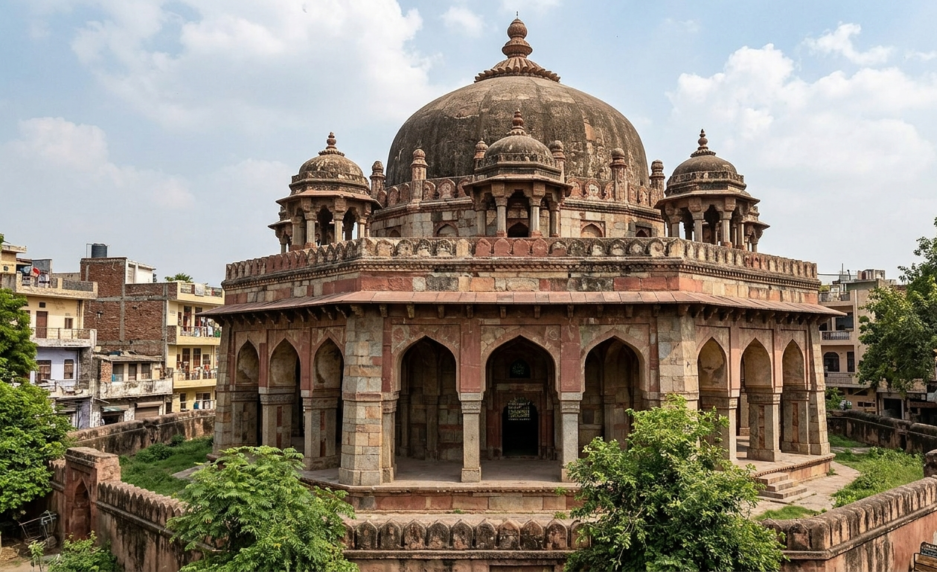
Tomb of Mubarak Shah, Delhi :- A Historic Heritage of the Sayyid Dynasty
Detailed History
The Tomb of Mubarak Shah is a significant historical monument located in the Kotla Mubarakpur area of South Delhi. This mausoleum is the final resting place of Sultan Muizz-ud-din Mubarak Shah, the second ruler of the Sayyid Dynasty, who ruled the Delhi Sultanate from 1421 to 1434 AD. During his reign, the Sultan had commissioned the construction of a new city called ‘Mubarakabad‘ along the banks of the Yamuna River. However, in January 1434, he was brutally assassinated as part of a court conspiracy led by his own vizier. Following his sudden demise, his nephew and successor, Muhammad Shah, completed the construction of this grand tomb.
The monument represents a crucial architectural transition in the history of Delhi. Although the Sayyid period was politically turbulent and short-lived, its innovative architectural styles laid the foundational blueprint for the later Lodi Dynasty structures. Today, while the tomb stands completely enclosed within a highly congested urban residential and commercial colony, its historical integrity and archaeological value remain undeniably profound.
Detailed Architecture :-
Architecturally, the Tomb of Mubarak Shah is one of the earliest and finest examples of octagonal (eight-sided) mausoleums in India.
- Octagonal Layout :– Shifting away from the traditional square tombs of the Tughlaq era, this monument features a distinct octagonal design. It is surrounded by a wide verandah with three arched openings on each of its eight faces.
- Central Dome and Kiosks (Chhatris) :– The structure is crowned by a massive central dome resting on an elevated drum. Surrounding this main dome on the roof are beautiful decorative kiosks (chhatris) that align perfectly with the octagonal geometry of the building, topped with traditional finials.
- Interior and Graves:– The central inner chamber houses the marble cenotaph of Sultan Mubarak Shah, surrounded by several other smaller graves belonging to his family members. The interior ceilings and arches retain traces of exquisite incised plasterwork and traditional Islamic geometric motifs.
- Photography Spots :– Despite being nestled amidst contemporary buildings, the symmetrical arched verandahs, weathered stones, and the contrast of the ancient dome against the modern urban backdrop offer an incredible subject for architectural photographers. The early morning light accentuates the textures of the stone beautifully.
Travel Guide & Routes :-
- Ticket :– Entry to the Tomb of Mubarak Shah is completely Free for all domestic and international visitors.
- Visiting Time :– The monument is open daily from sunrise to sunset (06:00 AM to 06:00 PM).
- How to Reach :–
- By Metro :– The closest metro station is South Extension Metro Station on the Pink Line. From there, you can hire an e-rickshaw or an auto-rickshaw to enter Kotla Mubarakpur, after which the tomb can be reached via a short walk through the lanes. INA and Violet Line stations are also nearby.
- By Bus :– Buses heading toward South Extension or AIIMS drop passengers off on the main Ring Road, from where the market area is easily accessible.
- By Road :– Since the monument is located deep within a heavily crowded market and residential maze, driving a four-wheeler directly to the site is highly discouraged. Accessing it via a two-wheeler, auto, or on foot is the most convenient route.
- Nearby Attractions :– South Extension Market, Lodhi Garden (which houses similar Sayyid and Lodi era tombs), Safdarjung Tomb, and Dilli Haat (INA).
- Local Flavors & Famous Markets :– The tomb is situated right inside the Kotla Mubarakpur Market, which is famous for fabrics, hardware, and local street snacks. For a premium shopping experience, visitors can step out into the adjacent South Extension Market. Food enthusiasts can explore the vibrant food joints under the Defence Colony flyover or visit Dilli Haat to experience multi-state regional cuisines.
Interesting Facts :-
- This monument is among the first few Sultanate-era tombs in Delhi to seamlessly incorporate independent chhatris (kiosks) on the roof around the main dome structure.
- The entire locality ‘Kotla Mubarakpur’ derives its name from this very monument, which was originally built inside a large fortified enclosure (Kotla) belonging to Mubarak Shah.
- Historians believe that the design of this tomb heavily inspired the construction of the famous Tomb of Sikandar Lodi located in the nearby Lodhi Gardens.
Important Questions and Answer :-
Question 1:– Who was Sultan Mubarak Shah?
Answer:- Mubarak Shah was the second ruler of the Sayyid Dynasty who governed the Delhi Sultanate for nearly 13 years between 1421 and 1434 AD.
Question 2:– Where exactly is Mubarak Shah’s tomb situated in Delhi?
Answer:- It is located within the narrow inner lanes of a dense residential-cum-commercial urban settlement called Kotla Mubarakpur in South Delhi.
Question 3:– Does one need to book tickets online to visit this tomb?
Answer:- No, it is a protected monument under the Archaeological Survey of India (ASI) and entry is absolutely free without any prior booking.
Author’s Thoughts :-
Navigating through the bustling crowds of Kotla Mubarakpur and suddenly coming across this majestic medieval structure is like discovering a hidden time capsule. It is fascinating yet surreal to see centuries-old octagonal arches standing right next to modern residential balconies. While it may not enjoy the sprawling landscapes of Lodhi Garden or Humayun’s Tomb, its raw historical presence offers a distinct charm for offbeat explorers. The survival of such historical marvels amidst Delhi’s rapid urbanization reminds us of the layered and complex heritage this city holds.
“Standing as a silent spectator amidst the bustling lanes of Kotla Mubarakpur, this magnificent octagonal tomb beautifully echoes the turbulent history and architectural brilliance of the Sayyid Dynasty.”