
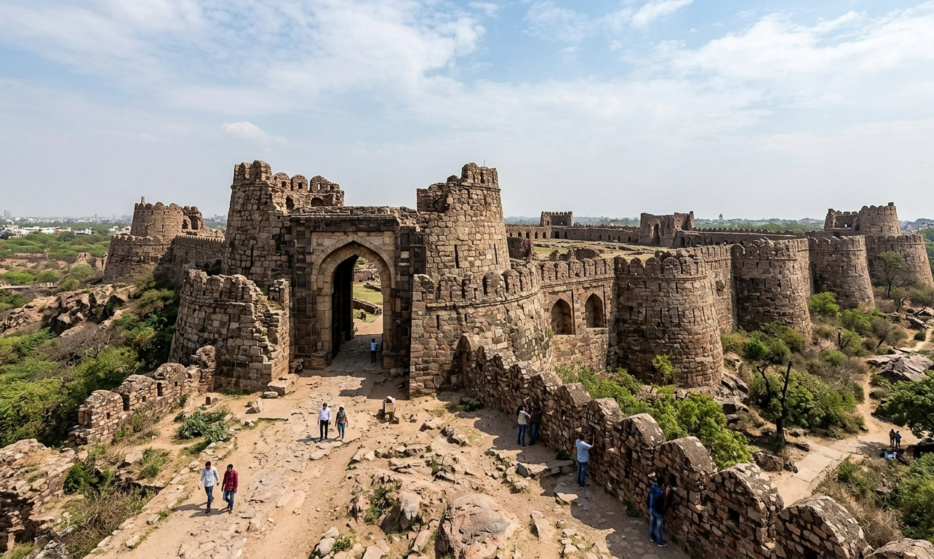
Tughlaqabad Fort, Delhi :- A Massive and Cursed Ruin of History
Perched on the Mehrauli-Badarpur Road in South Delhi, the Tughlaqabad Fort represents the remnants of the fifth historic city of Delhi. This colossal fortification is a supreme manifestation of early Tughlaq military architecture, defined by heavy engineering. Renowned for its towering stone bastions, subterranean escape vaults, and the legendary curse of the Sufi saint Hazrat Nizamuddin Auliya, this monument continues to mystify travelers and history enthusiasts alike.
Detailed History
The political history of Tughlaqabad Fort is directly tied to the ascent of Ghiyasuddin Tughlaq (1321–1325 AD), the founder of the Tughlaq Dynasty. Prior to ascending the throne, while serving as a military commander under the Khalji rulers, Ghazi Malik (Ghiyasuddin) had suggested to his king that the elevated, rocky ridge in South Delhi was an ideal spot for an impregnable fortress. The sultan mockingly replied that he should build it himself when he became king. Upon seizing power years later, Ghiyasuddin immediately prioritized the realization of this massive stronghold.
The abrupt desertion of this grand city is linked to a highly famous medieval curse. Driven by a desire to complete his fortress quickly, the Sultan commanded all laborers in Delhi to work exclusively on the fort day and night. At the same exact time, the revered Sufi saint Hazrat Nizamuddin Auliya was building a historic stepwell (Baoli) in Delhi. To bypass the royal decree, the laborers began working on the fort during the daytime and dug the saint’s baoli at night under the light of oil lamps. Infuriated, the Sultan banned the sale of oil in the city. The saint then proclaimed a haunting curse directed at the citadel:
“Ya rahe ujad, ya base gujar!”
(Meaning: May this fort either remain completely desolate or be inhabited only by nomadic herdsmen.)
Historical accounts show that this curse materialized with tragic speed. Within three years of the fort’s completion, Ghiyasuddin Tughlaq perished in a suspicious structural collapse of a wooden pavilion, and his successor, Muhammad bin Tughlaq, abandoned the fortress entirely to establish a new base at Jahanpanah. The grand citadel fell silent and was never reinhabited.
Detailed Architecture
The architecture of Tughlaqabad Fort is widely celebrated for its sheer scale, sloping retaining walls, and the usage of cyclopean masonry.
- Exterior:– The fort layout is laid out in a half-octagonal geometry across the rugged, elevated quartz ridge. The outer defensive curtain walls extend over 6 kilometers, reaching staggering heights of 15 to 30 meters at key defensive junctures. The walls are designed with a distinct inward batter or slope (Sloping Walls)—a core Tughlaq design element implemented to deflect heavy impact from enemy battering rams. The citadel originally featured 52 massive gateways (Gates), of which only a scattered few survive as structural ruins today.
- Interior:– The inner operational zone of the fort was structured into three specific zones: the residential sectors for the populace, the royal palace area (Zanana), and the citadel (Mundia). The inner structures showcase multi-tier bastions, subterranean tunnels (Secret Passages), deep grain silos, and expansive deep-cut water storage systems. Directly connected to the main southern ramparts via an elevated causeway sits the Tomb of Ghiyasuddin Tughlaq, a self-contained fortress-like structure built out of rich red sandstone and topped with a brilliant white marble dome.
Travel Guide & Routes :-
For travelers planning a journey through the medieval ruins of Tughlaqabad Fort, the detailed travel information is compiled sequentially below.
- Entry Ticket :– The entry fee for Indian citizens and tourists from SAARC nations is ₹25, whereas international visitors are charged ₹300. Children under the age of 15 can enter for free.
- Visiting Time :– The monument grounds are accessible to public view from 7:00 AM to 5:00 PM (Sunrise to Sunset).
- Closing Day :– The fort complex is functional and open on all seven days of the week.
- Photography Spots :– The imposing sloping outer battlements, the sprawling aerial views of modern Delhi from the highest bastions, the deep structural ruins of the internal palaces, and the majestic facade of Ghiyasuddin’s tomb framed against the ancient causeway serve as magnificent photography spots.
- Local Food :– There are no commercial dining establishments inside or directly outside the fort gates, so it is highly recommended to carry personal water bottles and snacks. For fine dining, visitors can head a few kilometers away to Saket, Alaknanda, or Kalkaji, which offer vast arrays of Mughlai food, North Indian restaurants, and contemporary lifestyle cafes.
- Famous Market :– The surrounding locality hosts the basic Tughlaqabad local market. For extensive shopping expeditions, the nearby ‘Kalkaji Market’ and the expansive high-end shopping malls in Saket (Select Citywalk) are the most popular destinations.
- How to Reach :–
- By Metro :– The nearest transit stations are Tughlakabad Metro Station (Violet Line) and Govindpuri Metro Station. From either station, you can readily hop onto an auto-rickshaw, an e-rickshaw, or a local public bus to reach the main entry gates within 10 to 15 minutes.
- By Road :– Located directly on the prime Mehrauli-Badarpur corridor, the fort is exceptionally well-connected. You can book an app-based cab, hail a local auto-rickshaw, or travel via specific DTC buses that stop right at the Tughlaqabad Fort bus stop.
Nearby Attractions
During your exploration of Tughlaqabad, you can easily combine your visit with these notable historical and spiritual destinations nearby.
- Adilabad Fort :– A smaller, fortified structure built directly opposite Tughlaqabad by Ghiyasuddin’s son and successor, Muhammad bin Tughlaq.
- Kalkaji Temple :– One of Delhi’s oldest and highly revered shrines dedicated to Goddess Kali, showcasing interesting regional temple architecture.
- Lotus Temple (Bahá’í House of Worship) :– A globally acclaimed architectural marvel shaped like a blooming white lotus, serving as a tranquil meditation center.
- Asola Bhatti Wildlife Sanctuary :– Located just a short distance from the fort, this massive reserve offers scenic forest trails and hidden blue lakes for nature enthusiasts.
Interesting Facts
- The stone blocks utilized to forge the fort walls are so unusually massive that medieval locals genuinely believed the fortress was not built by ordinary humans, but rather erected overnight by ‘Jinns’ under royal command.
- The Tomb of Ghiyasuddin Tughlaq was originally surrounded by a massive artificial lake fed by rainwater runoff, ensuring that the mausoleum functioned as an island fortress to keep enemies at bay.
- According to contemporary medieval chronicles, the entire structural grid of this massive city-fortress was completed in a brief span of 2 to 3 years, marking it as one of the fastest and most aggressive construction projects of its time.
Important Questions and Answer :-
Question 1:- Where is Tughlaqabad Fort located and who commissioned its build?
Answer:- Tughlaqabad Fort is situated on the Mehrauli-Badarpur Road in South Delhi. It was built by Sultan Ghiyasuddin Tughlaq, the founder of the Tughlaq Dynasty, between 1321 and 1323 AD.
Question 2:– Why is Tughlaqabad Fort referred to as a cursed monument?
Answer:- The fort is deemed cursed due to the historic pronouncement made by the Sufi saint Hazrat Nizamuddin Auliya, who stated that the city would remain desolate. His prophecy proved true as the city was abandoned shortly after its completion.
Question 3:- What is the ticket price for entering the Tughlaqabad Fort complex?
Answer:- The admission fee is ₹25 for domestic Indian travelers and ₹300 for international tourists.
Question 4:– Which is the closest metro station to reach Tughlaqabad Fort?
Answer:- The nearest transit points on the Delhi Metro network are the Tughlakabad Metro Station and the Govindpuri Metro Station, both situated on the Violet Line.
Author’s Thoughts
Standing amidst the silent, towering ruins of Tughlaqabad Fort, one is confronted with a powerful reminder of human vanity and the impermanence of absolute power. The massive stone barriers that a Sultan built by straining his kingdom’s resources and crossing paths with revered saints now play host to wild overgrowth and soaring eagles. Unlike the heavily manicured gardens of Safdarjung or Humayun’s Tomb, Tughlaqabad offers a raw, unfiltered, and deeply evocative encounter with medieval history. For travelers who prefer uncrowded terrains, dramatic landscapes, and a genuine sense of historical mystery, walking through the forgotten gateways of Tughlaqabad is an unforgettable experience.
“The crumbling, cyclopean walls of Tughlaqabad stand as an eternal monument to the reality that while empires may fall to ruins, the words of the mystics endure through the ages.”