
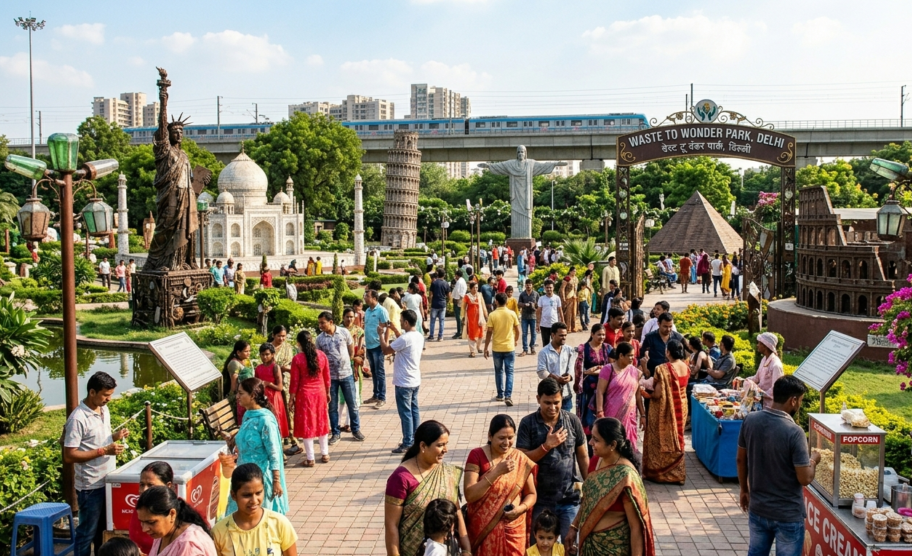
Waste to Wonder Park Delhi :- Complete History and Architecture
Situated near Sarai Kale Khan in New Delhi, ‘Waste to Wonder Park‘ is a highly innovative, unique, and eco-friendly theme park. This park is the first-of-its-kind dynamic concept in the world where the exact replicas of the Seven Wonders of the World have been constructed entirely out of industrial waste, discarded scrap metal, and junk automobile parts. Developed by the South Delhi Municipal Corporation (SDMC), this park stands as a premier global benchmark demonstrating the core principle of “Waste to Wealth.”
Detailed History
The inspiration behind Waste to Wonder Park traced back to the ‘Seven Wonders Park’ in Kota, Rajasthan, which gained widespread popularity after being featured in a Bollywood film. Taking the concept a step further, the municipal authorities of Delhi decided to add a revolutionary ecological twist by utilizing entirely recycled and scrap structural components.
The construction of this eco-themed park commenced in 2018. A dedicated team of specialized engineers, master welders, and contemporary sculptors collaborated to accomplish this complex structural task. The entire park was completed in a record timeline of just six months and was formally inaugurated on February 21, 2019, by the then Home Minister, Rajnath Singh.
A staggering 150 tonnes of scrap material sourced directly from the municipal junk stores and roadside scrap yards of Delhi was processed to build these monuments. The materials used included decommissioned street light poles, scrap metal sheets, old bicycle rims, automobile chassis, discarded iron pipes, and thousands of old nuts and bolts. The project serves a dual purpose: expanding tourist hotspots in the capital while creating deep public awareness regarding sustainable urban waste management.
Detailed Architecture
The architectural core of Waste to Wonder Park lies in the creative assembly of asymmetric scrap into symmetric historical forms. Each of the seven replicas has been carefully calibrated according to the true dimensional ratios of its original counterpart. The individual architectural highlights are as follows.
Structural Features of the Seven Replicas
- 1. Taj Mahal (India) :– Built using approximately 24 tonnes of heavy metal scrap, the majestic minarets and complex central dome of this monument are configured out of old truck parts, bicycle rims, park benches, and intricate iron sheets welded together to replicate the symmetrical contours of Agra’s original wonder.
- 2. Eiffel Tower (France) :– Soaring to a commanding height of nearly 70 feet, this replica replicates the iconic Parisian lattice tower. It was forged using 40 tonnes of heavy iron angles, discarded industrial channels, and old street lampposts.
- 3. Leaning Tower of Pisa (Italy) :– Replicating the exact engineering lean of the historical original, this 57-foot-tall structure features concentric tiers built out of discarded heavy metal pipes, factory storage drums, and structural metal rings.
- 4. Statue of Liberty (USA) :– Standing approximately 35 feet tall, this artistic sculpture uses layered, hammered metal sheets to replicate the flowing robes of Lady Liberty. The signature torch is cleverly illuminated using old circular vehicle headlights.
- 5. Christ the Redeemer (Brazil) :– This 25-foot structure features the outstretched hands of Christ, beautifully welded using old engine parts, discarded metallic bars, and scrap framework components anchored securely onto a heavy pedestal.
- 6. Colosseum of Rome (Italy) :– The distinct, semi-ruined architectural arcades of the Roman amphitheater are captured here through curved layers built from automobile gears, clutch plates, old wheel hubs, and industrial chains.
- 7. Pyramid of Giza (Egypt) :– The clean geometric slope of the ancient Egyptian wonder is built out of hundreds of square scrap metal sheets welded onto a reinforced iron frame, providing a sharp minimalist facade.
- Eco-Friendly Power & Lighting :– A key structural highlight of the park is its self-sustaining grid. The entire park is powered by integrated Solar Panels and wind turbines. The clean energy generated during the daytime powers the advanced architectural LED floodlights that dramatically illuminate the monuments after dusk.
Travel Guide & Routes
If you are planning an educational family outing or a photography trip to Waste to Wonder Park, here is your comprehensive logistics manual.
- Ticket (Entry Fee) :– Entry to the park is regulated by a nominal nominal fee. Tickets for Adults are priced at ₹50, and for Children (3 to 12 years), it is ₹25. Entry is completely Free for senior citizens and students from municipal corporate schools. (Note: Ticket prices might vary slightly on Sundays and national holidays).
- Visiting Time :– The park is open from Tuesday to Sunday, between 11:00 AM and 11:00 PM. Please note that the park remains completely closed on Mondays for regular technical maintenance. The most rewarding time to visit is post-sunset when the spectacular illumination transforms the scrap metal into glowing art installations.
- Photography Spots :– The illuminated Eiffel Tower silhouette, the walkway directly leading up to the Taj Mahal replica, and wide-angle shots underneath the Statue of Liberty are the most highly-rated photography spots.
- Local Food :– The park premises house a clean, dedicated Food Court. Visitors can purchase a variety of fast-food options including South Indian dishes, noodles, burgers, pav bhaji, ice creams, and refreshing drinks.
- Nearby Markets :– The famous Lajpat Nagar Central Market is situated nearby, offering an extensive hub for ethnic wear, traditional footwear, and street shopping.
How to Reach :-
- By Metro :– The closest transit station is ‘Hazrat Nizamuddin’ Metro Station on the Pink Line. The park entrance is barely a 200 to 300-meter walk from the metro exit gates along a secure pedestrian walkway.
- By Bus :– The Sarai Kale Khan Inter-State Bus Terminus (ISBT) is located right adjacent to the park grounds, making it highly accessible by public transport buses crossing central or eastern Delhi routes.
- By Air :– The Indira Gandhi International Airport (IGI) is located approximately 16 kilometers away from the park axis.
- By Rail :– The Hazrat Nizamuddin Railway Station (NZM) is directly opposite the park site within short walking distance. The New Delhi Railway Station is roughly 9 kilometers away.
Nearby Attractions
- Humayun’s Tomb :– Located just 2 kilometers away, this spectacular UNESCO World Heritage Site represents the finest early Mughal garden-tomb architecture.
- Hazrat Nizamuddin Dargah :– The iconic resting shrine of the revered Sufi saint Nizamuddin Auliya, world-famous for its traditional evening Qawwali sessions.
- Sunder Nursery :– An expansive, beautifully restored 16th-century heritage parkland adjacent to Humayun’s Tomb, featuring historic monuments and diverse flora.
- Lodhi Garden :– Situated 5 kilometers away, this expansive public park contains the magnificent historical tombs of the Sayyid and Lodhi dynasties.
- Millennium Park (Indraprastha Park) :– A sprawling green park located along the Outer Ring Road, featuring long walking tracks and children’s play areas.
- Akshardham Temple :– Positioned roughly 6 kilometers away across the Yamuna River via NH-24, it is a colossal complex showcasing traditional Indian art and culture.
Interesting Facts
- Micro-Component Sculpture :– Upon closer inspection, one can observe that the hair textures on the statues are crafted from old motorcycle chains, while complex geometric trims are made from industrial gears and nuts.
- Global Green Acclaim :– As a premier model of municipal recycling and creative waste management, the park regularly hosts international eco-delegations, urban planners, and environmental researchers.
- Inspirational Precedent :– The massive structural and financial success of Delhi’s Waste to Wonder Park has inspired similar scrap-art public parks across major Indian cities like Bengaluru and Chennai.
Important Questions and Answer :-
Question 1:- Where exactly is Waste to Wonder Park located in Delhi?
Answer:– The park is located near the Sarai Kale Khan ISBT and sits right next to the Hazrat Nizamuddin Metro Station in New Delhi.
Question 2:- Is the park open on public holidays and Mondays?
Answer:– The park is open on most public holidays but is strictly closed every Monday for essential landscaping and electrical maintenance.
Question 3:- What materials were primarily used to build the Seven Wonders?
Answer:– The structures were fabricated using 150 tonnes of metallic junk including old pipes, metal sheets, vehicle chassis, industrial gears, and discarded street light poles.
Question 4:– Can visitors purchase entry tickets online for Waste to Wonder Park?
Answer:– Yes, online ticket booking is fully operational through the official portal of Delhi’s municipal corporation, in addition to the physical ticket counters at the entrance gate.
Author’s Thoughts
Waste to Wonder Park is far more than a recreational spot; it is a profound testament to human imagination that proves beauty can be reclaimed from the most mundane discarded objects. The very metals that were once buried away as industrial junk have been meticulously transformed by Indian artists into globally recognized historical symbols. Spending an evening here as the solar-powered floodlights slowly bring the iron contours of the Eiffel Tower and Taj Mahal to life is a deeply inspiring experience. It offers a unique educational environment where children can visually digest the critical values of sustainability and recycling while enjoying a family picnic. A trip to this park is a highly recommended experience to witness how creative engineering can turn waste into an artistic wonder.
“Breathing a majestic second life into the cold metal of junk yards, this eco-park stands as a brilliant monument to sustainable innovation and artistic triumph.”