
The Historical Heritage of Delhi :- William Fraser’s ‘Delhi Jonson’ and Its History
The capital city of Delhi has not only witnessed the rise and fall of great empires but also harbors countless forgotten stories and characters that shaped its unique social fabric. One such fascinating and mysterious name from the pages of history is ‘Delhi Jonson’. This moniker became highly popular in the early 19th century in the elite social circles of Delhi, referring to the Indian companion (wife) of the British East India Company official, William Fraser. It beautifully reflects the unique cultural synthesis of that era, often termed the age of the ‘White Mughals’.
Detailed History :-
The history of ‘Delhi Jonson‘ dates back to the early decades of the 1800s. When the British official William Fraser was posted in Delhi as the Resident, he completely immersed himself in the local Mughal culture. He married a noble Muslim lady from a prominent local family, who came to be respectfully and affectionately addressed by the locals as ‘Delhi Jonson’ or ‘Jonson Begum’.
- A Cultural Synthesis :– This was an era when several British officers adopted Indian attire, food, and languages like Urdu and Persian. William Fraser and his wife ‘Delhi Jonson’s’ bungalow near Kashmiri Gate became a major hub for Delhi’s intellectuals, poets, and aristocrats.
- Historical Significance :– The legendary Urdu poet Mirza Ghalib was a close friend of Fraser. The name ‘Delhi Jonson’ finds mention in various contemporary memoirs and records as a figure who bridged the gap between the traditional Mughal etiquette (Tehzeeb) and the British administration. The story met a tragic end when William Fraser was assassinated in 1835, but historians still view ‘Delhi Jonson’ as a vital symbol of the composite Ganga-Jamuni culture of Delhi.
Detailed Architecture :-
While ‘Delhi Jonson’ is a historical persona rather than a monument, the architecture of William Fraser’s Bungalow in Kashmiri Gate remains a point of great interest for heritage enthusiasts.
- Indo-Islamic and Colonial Blend :– The bungalow was a magnificent representation of British Colonial architecture infused with local Mughal sensibilities. It featured high pillars, grand verandahs, and exceptionally thick walls designed to withstand Delhi’s harsh summers.
- The Tykhana (Basement) and Dome :– A striking feature of this grand residence was its extensive underground basement (Tykhana), used for holding courts and relaxing during hot summer days. The structure was topped with a subtle dome, giving it the appearance of a mini Mughal palace. Today, fragments of this historic estate can still be seen near the Dufferin Bridge and railway lines around Kashmiri Gate.
Travel Guide & Routes :-
- Ticket :– Visiting the remnants of Fraser’s Bungalow and the surrounding historical structures in Kashmiri Gate is completely Free of Cost.
- Timings :– As it is a public heritage precinct, it is best visited between 09:00 AM and 05:00 PM.
- How to Reach :– Located in the historic Kashmiri Gate area of Old Delhi.
- By Metro :– The most convenient route is via the Delhi Metro. The Kashmiri Gate Metro Station (Interchange for Red, Yellow, and Violet Lines) is the nearest stop. From there, the site can be reached via a short walk or a brief e-rickshaw ride.
- By Road :– The Kashmiri Gate ISBT is a major transit terminal connected to the rest of Delhi and neighboring states. Taxis and auto-rickshaws drop directly near the heritage sites.
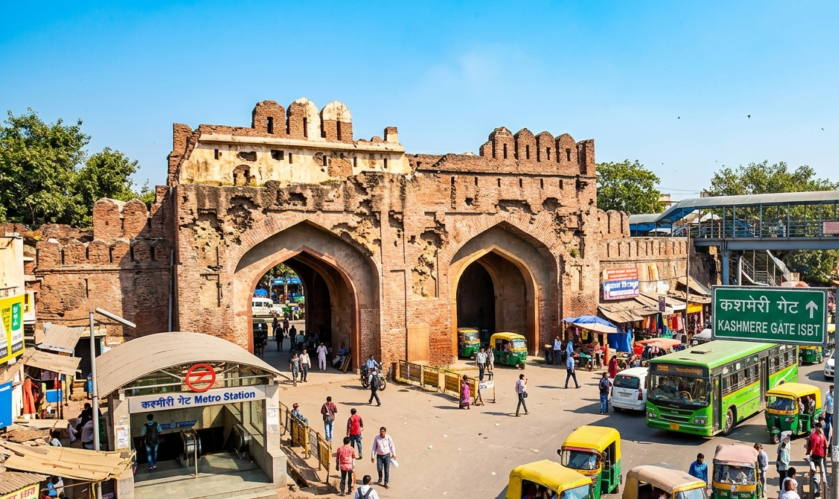
- Photography Spots :– The bullet and cannon-scarred walls of the historic Kashmiri Gate, the serene lawns of St. James’ Church (housing Fraser’s grand tomb), and the yellow-brick colonial arches are exceptional photography backdrops.
- Local Flavors & Famous Markets :– Being in Old Delhi, visitors can savor the legendary street food at the nearby Paranthe Wali Gali and Natraj Dahi Bhalle in Chandni Chowk. For shopping, the Kashmiri Gate local market, the spare parts market, and the bustling traditional bazaars of Chandni Chowk are unmatched.
Nearby Attractions :-
- St. James’ Church :- The oldest church in Delhi, commissioned by Colonel James Skinner. The churchyard houses the intricately carved tomb of William Fraser, directly linking it to the story of ‘Delhi Jonson’.
- Kashmiri Gate :- A silent witness to the Uprising of 1857, where intense battles took place between Indian freedom fighters and British troops. The structure still bears heavy damage from cannonballs.
- Red Fort (Lal Qila) :- The iconic UNESCO World Heritage site representing the pinnacle of Mughal architecture is located just 2 km away from Kashmiri Gate.
- Yamuna Bazaar :- An ancient riverside settlement along the banks of the Yamuna River, showcasing the old-world charm and early settlement patterns of Delhi.
- Salimgarh Fort :- Adjoining the Red Fort, this older fortress was later used by the British as a high-security prison for freedom fighters, including soldiers of the Indian National Army (INA).
Interesting Facts :-
- The fascinating life of ‘Delhi Jonson’ and William Fraser forms an integral part of William Dalrymple’s acclaimed historical masterpiece, ‘White Mughals’, which details the deep romantic and cultural interactions of the era.
- William Fraser was such a passionate lover of Urdu poetry that he spent vast sums collecting and preserving the Diwans (poetry collections) of contemporary master poets.
- During the Revolt of 1857, Fraser’s strategically built bungalow was converted by the British army into a vital defensive command post due to its sturdy design.
Questions & Answers (Q&A) :-
Question 1:- Who was ‘Delhi Jonson’ in Indian history?
Answer:- ‘Delhi Jonson’ was the popular local name given to the Indian Muslim wife of William Fraser, the British Resident of Delhi, symbolizing the blended Anglo-Indian culture of the early 19th century.
Question 2:– Where can one find the remnants of William Fraser’s life in Delhi?
Answer: The structural remnants of his bungalow and his historical tomb are located in the Kashmiri Gate area of Old Delhi, near St. James’ Church.
Question 3:- Which book extensively covers the era of ‘Delhi Jonson’ and William Fraser?
Answer:- Their lives and the social environment of early 19th-century Delhi are detailed extensively in William Dalrymple’s book ‘White Mughals’.
Author’s Thoughts :-
The tale of ‘Delhi Jonson’ and William Fraser transports us back to a unique transition period in Delhi’s history, where two distinct civilizations met, adapted, and forged a hybrid lifestyle. Beyond the grand fortresses and royal tombs, it is these intensely personal human stories that give Delhi its true character. Standing amidst the historic ruins of Kashmiri Gate, one can almost hear the echoes of a bygone era of grand mushairas, colonial balls, and a shared heritage. If you wish to discover a deeply nuanced and lesser-known chapter of Delhi’s past, exploring this historic corner is highly recommended. “Stay connected with us on this journey through the depths of history and spirituality.”