
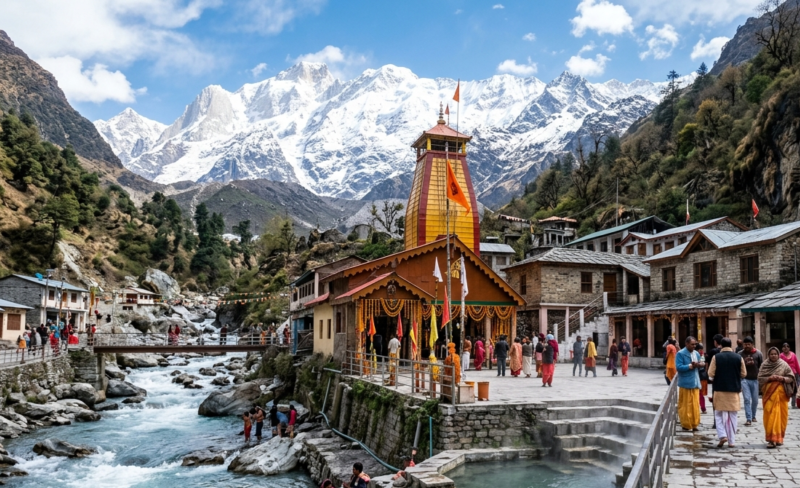
Yamunotri Dham, Uttarakhand :- The Sacred Stream of Kalindi, History, and First Gateway of Char Dham Yatra
Detailed History :-
Cradled in the pristine Garhwal Himalayas within the Uttarkashi district of Uttarakhand, along the western flanks of the majestic Bandarpoonch peak massif, Yamunotri Dham stands as the auspicious first stop of India’s revered Chhota Char Dham pilgrimage. Elevated at an altitude of approximately 3,293 meters (10,804 feet) above sea level, this holy mountain shrine is dedicated to Goddess Yamuna, traditionally revered as the daughter of the Sun God (Surya) and the sister of Yama (the God of Death). According to ancient Puranic chronicles, this challenging terrain was once the hermitage of Sage Asit, who spent his life bathing daily in both the Ganga and Yamuna. In his frail old age, when he could no longer make the journey to the Ganga, a stream of the holy river miraculously manifested right beside Yamuna at this spot for him. Scriptural legends hold that a holy dip in the thermal waters of Yamunotri protects devotees from untimely demise and frees them from the torment of Yamaloka. Historical blueprints indicate that the initial structural temple was commissioned in 1839 by Maharani Guleria Devi of Jaipur. Having suffered extensive damages over time due to severe avalanches and tectonic shifts, the shrine was later systematically reconstructed and reinforced by King Pratap Shah of Tehri Garhwal.
Detailed Architecture :-
The structural composition of the Yamunotri Temple displays a resilient and minimalist blend of the traditional Katyuri hill architecture and classical North Indian temple design. Standing resolutely against raw, vertical mountain cliffs, this remote complex is a true marvel of high-altitude civil engineering.
- The Main Complex and Sanctum :– The primary temple features a multi-tiered colorful Shikhara decorated with intricate wooden eaves and stone carvings. The inner sanctum (Garbhagriha) houses a stunning, highly ornamented image of Goddess Yamuna sculpted out of dark, mirror-polished Shaligram stone. Placed symmetrically beside her is a pristine white marble idol of Mother Ganga.
- Divya Shila (The Divine Rock) :– Positioned prominently outside the main entry steps along the rock face is the ‘Divya Shila’. This massive, sacred rock matrix is worshiped as the literal point of origin of the holy stream on earth. Traditional rituals dictate that pilgrims must pay homage and offer prayers at the Divya Shila before proceeding to the primary altar.
- Surya Kund :– Located adjacent to the primary temple steps is a highly remarkable natural geothermal spring known as ‘Surya Kund‘. The thermal waters inside this stone pool naturally boil at temperatures ranging between 88°C and 90°C. Pilgrims tie raw rice and potatoes in small muslin cloths and submerge them into the bubbling water; within minutes, the food cooks perfectly and is carried back by travelers as the supreme holy prasad.
Travel Guide & Routes :-
- Entry Ticket & Registration :– Access and public Darshan inside the Yamunotri Temple complex are absolutely Free. In accordance with state security mandates, all incoming tourists must systematically complete the Char Dham Online Registration via the official Uttarakhand tourism dashboard to generate their compulsory biometric access passes.
- Visiting Hours & Seasonal Closure :– Due to extreme winter weather and heavy sub-zero snowfall, the temple stays open to the public for only six months a year (opening on the auspicious day of Akshay Tritiya in May and closing on Bhai Dooj in November). During winters, the deity’s daily worship shifts down to Kharsali Village. Daily public operational hours run from 6:00 AM to 12:00 PM and reopen from 4:00 PM to 8:00 PM.
- How to Reach :–
- By Air :– The closest domestic airfield infrastructure ends at Jolly Grant Airport (DED) in Dehradun, situated around 210 km from Jankichatti. Premium commercial and private charter Helicopter Services are operated directly from Dehradun to the Kharsali helipad near the base.
- By Rail :– The primary nearest railway connections end at Rishikesh, Haridwar, and Dehradun. Reliable daily transit buses, state transport carriers, and rental cars ply from these stations via Barkot to reach Jankichatti.
- The Trek Route :– The motorable highway terminates at the baseline camp of Jankichatti. From Jankichatti, a steep, visually stunning 5 to 6 km mountain trek leads to the Yamunotri Temple. For individuals unable to complete the walk on foot, authorized horses, mules, palanquins (dandies), and basket carriers (kandies) are readily available at government-fixed rates.
- Local Flavors & Essential Amenities :– Due to the isolated high-altitude location, local dining options remain limited to simple, wholesome vegetarian North Indian mountain meals, hot lentils, rice, vegetables, instant noodles, and hot spiced tea. The pathways are lined with small local stalls trading in prayer kits, protective chunris, dry fruits, and heavy wooden walking sticks (trekking poles).
- Photography Spots :– To preserve the absolute sanctity of the shrine, recording digital videos or taking photographs inside the inner deity sanctorum is strictly prohibited. Nonetheless, tourists can capture spectacular landscape photos outside in the open courtyard against the jagged pine cliffs, amidst the rising geothermal steam clouds of Surya Kund, or beside the crystal-clear icy rocks of the cascading Yamuna River.
Nearby Attractions :-
- Kharsali Village :– Located very close to Jankichatti, this scenic mountain hamlet serves as the official winter seat of Goddess Yamuna. It also houses an ancient, unique three-storied stone temple dedicated to Lord Shani Dev, showcasing brilliant wooden architecture.
- Saptrishi Kund :– Situated a highly challenging and hazardous 10 km trek further up from the main temple, this glacial lake is the true geographical origin of the Yamuna River. Reaching it requires heavy mountaineering endurance and mandatory local guides.
- Hanuman Chitty :– Located 13 km prior to the shrine, this serene riverside spot marks the confluence of the Hanuman Ganga and Yamuna rivers, featuring an old temple dedicated to Lord Hanuman.
- Barkot :– A highly popular, picturesque hill station on the highway route to Yamunotri. Boasting panoramic views of snow-clad peaks, it serves as the primary night-halt destination for most pilgrims.
Interesting Facts :-
- The Self-Cooking Holy Spring :– The extreme thermal temperature of Surya Kund serves as a natural kitchen for pilgrims. Cooking rice and potatoes directly in a geothermal hot spring without any fuel or fire remains an absolute wonder for both visiting scientists and devotees.
- The Origin of the Name Kalindi :– The Bandarpoonch peak massif was historically known in ancient texts as ‘Kalind Parvat’. Because the river originates directly from its glacial roots, the Yamuna is profoundly addressed across India as ‘Kalindi’.
- The Celestial Sibling Bond :– According to ancient mythology, Goddess Yamuna and Lord Shani Dev are siblings, both born to Lord Surya. This beautiful cosmic connection is why Shani Dev’s ancient seat stands at Kharsali, and custom dictates that he symbolically comes down to escort his sister to her winter home on Bhai Dooj.
Important Questions and Answer :-
Question 1:- How challenging is the trek from Jankichatti to Yamunotri and how much time does it take?
Answer:– The 5-6 km trek from Jankichatti involves a continuous steep incline. However, the entire path is well-paved, wide, and lined with security railings for safety. A person with average fitness levels typically takes around 3 to 4 hours to complete the uphill walk.
Question 2:- Is the journey to Yamunotri Dham safe for young children and elderly citizens?
Answer:– Yes, it is fully organized and safe. For senior citizens or young children who cannot withstand the steep uphill walk, an abundance of horses, mules, and manual palanquins can be hired at the Jankichatti base camp, ensuring a comfortable transit to the temple gates.
Question 3:– Which months are ideal for planning a smooth trip to Yamunotri?
Answer:– The early summer phase from May to June and the post-monsoon autumn stretch from September to October offer the most stable weather. The peak monsoon months of July and August present high landslide vulnerabilities across the fragile mountain loops and should be avoided.
Author’s Thoughts :-
Beginning your Char Dham journey from the pristine thresholds of Yamunotri Dham infuses your inner being with profound spiritual clarity and stamina. Walking along the edge of the deep gorges while the crisp mountain air echoes with the roaring currents of the Yamuna creates an unforgettable sense of adventure. Tasting the hot rice prasad prepared naturally by the earth’s inner heat connects you deeply with the raw, miraculous forces of nature. Yamunotri is a timeless reminder of how beautifully ancient Indian traditions teach us to revere and protect the natural elements as living embodiments of the divine.
“Where the rugged mountain peaks open a path for the first stream of Kalindi to flow, the sacred steps to ultimate spiritual liberation begin.”