
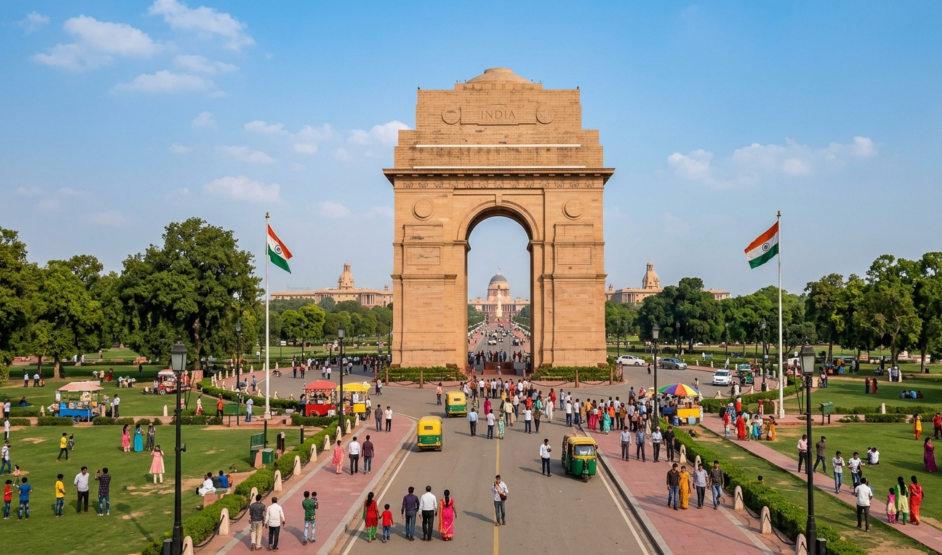
India Gate Delhi :- Complete History and Architecture
Located at the heart of New Delhi on the Kartavya Path (formerly Rajpath), India Gate stands as India’s most iconic and majestic national monument. This grand war memorial is not only the definitive landmark of Delhi but also a living testament to the supreme sacrifice and indomitable courage of the nation’s soldiers. Every year, the spectacular Republic Day Parade (26th January) passes through this historic avenue, showcasing India’s military might and rich cultural heritage to the world.
Detailed History
The history of India Gate is deeply rooted in the events of the First World War. It was commissioned by the British government to honor the memory of over 84,000 soldiers of the British Indian Army who lost their lives between 1914 and 1921 during the First World War and the Third Anglo-Afghan War.
The foundation stone of this monumental arch was laid on February 10, 1921, by the Duke of Connaught. The construction spanned a decade, and it was formally inaugurated on February 12, 1931, by the then Viceroy of India, Lord Irwin. Initially, it was revered as the ‘All India War Memorial’.
Following the Indo-Pakistani War of 1971, a new memorial structure consisting of a black marble plinth with a reversed rifle capped by a soldier’s helmet, flanked by four eternal flames, was added under the archway. This was known as the ‘Amar Jawan Jyoti’ (Flame of the Immortal Soldier). In January 2022, this eternal flame was merged with the main flame at the newly constructed National War Memorial located just a short distance behind the structure. Furthermore, the canopy behind India Gate now proudly houses a grand monolithic granite statue of Netaji Subhas Chandra Bose, celebrating a legendary hero of India’s freedom struggle.
Detailed Architecture
The architecture of India Gate is a brilliant synthesis of classical European triumphal arch design and traditional Indian structural elements. The detailed overview of its exterior and interior architecture is as follows.
Exterior Architecture
- Triumphal Arch Layout :– The design of India Gate is heavily inspired by the famous Arc de Triomphe in Paris. It features a massive, soaring archway with a total height of 42 meters (approximately 138 feet).
- Premium Masonry :– The structure is built using high-quality red and pale pink sandstones brought from Bharatpur. The stone texturing lends the monument a natural warmth and a commanding presence during the daytime.
- The Concave Summit :– Atop the crest of the arch lies a shallow dome-like bowl. In earlier times, this bowl was filled with burning oil on significant national anniversaries to signify remembrance from afar.
Interior Architecture :-
- Inscriptions of the Fallen :– The most profound and emotional attribute of India Gate is the inscription covering its surfaces. The exterior and interior walls are meticulously carved with the names of over 13,000 individual soldiers who died serving on the battlefronts.
- Dedication Message :– Facing the avenues, the top of the archway on both sides bears a solemn English inscription dedicating the monument to the fallen heroes of the Indian armies.
- Refined Cornices :– The arches are bounded by intricate, layered moldings and classical artistic details that reinforce its structural density while offering clean geometric lines.
Travel Guide & Routes
India Gate is a premier public gathering space and tourist attraction in the capital. If you plan to visit, here is all the essential information regarding tickets, timings, and transportation.
- Ticket (Entry Fee) :– Entry to the India Gate complex and its surrounding lawns is completely Free of charge for both domestic and international visitors.
- Visiting Time :– The monument precinct is accessible 24/7 throughout the year. However, the most rewarding time to visit is during the evening hours (6:00 PM to 10:00 PM) when the entire monument is dramatically illuminated in the tricolor tints of the Indian flag.
- Photography Spots :– A straight axial shot from Kartavya Path captures the full symmetrical scale of India Gate. The radiating fountains illuminated at night and the angles near the Netaji Subhas Chandra Bose canopy also offer highly cinematic backdrops.
- Local Food :– The vast manicured lawns surrounding the monument are dotted with local street vendors. Sampling the local spiced Alu Chaat, Bhelpuri, ice golas, and the legendary late-night ice creams and chuskis is a quintessential Delhi experience. Nearby Pandara Road and Khan Market house premium dining establishments famous for authentic North Indian Mughlai delicacies.
- Nearby Markets :– The affluent Khan Market is nearby for fine shopping, while the historical commercial hub of Connaught Place (CP) and the street boutiques of Janpath Market are just a few minutes away by auto.
How to Reach :-
- By Metro :– The most convenient metro station is ‘Central Secretariat’ (interchange for Yellow and Violet Lines) and ‘Supreme Court’ (Blue Line). The monument is roughly a 1-kilometer walk or a brief e-rickshaw ride away from these stations.
- By Bus :– Central Delhi is extensively serviced by DTC buses. Any bus heading toward Central Secretariat, Rajpath, or Patiala House Courts will drop you within walking distance of the lawns.
- By Air :– The Indira Gandhi International Airport (IGI) sits approximately 14 kilometers away from the central monument.
- By Rail :– New Delhi Railway Station is merely 4 kilometers away, and Hazrat Nizamuddin Railway Station is located about 5 kilometers from India Gate.
Nearby Attractions
- National War Memorial :– Located right behind India Gate, this vast state-of-the-art monument honors post-independence martyrs through its structural concentric circles.
- Netaji Subhas Chandra Bose Canopy :– Standing directly behind the main arch, this grand structure features a magnificent 28-foot monolithic granite statue of Netaji.
- Kartavya Path :– A beautifully redeveloped three-kilometer ceremonial boulevard connecting India Gate to Rashtrapati Bhavan, lined with lawns and water canals.
- Children’s Park :– Situated right next to the India Gate complex, this is an expansive, beautifully landscaped playground featuring modern swings and recreational spaces for families.
- National Gallery of Modern Art (NGMA) :– Located near the India Gate hexagon, this palace-turned-museum houses a spectacular repository of premier modern and contemporary Indian art.
- Rashtrapati Bhavan :– Positioned at the western end of Kartavya Path, it is the colossal and architecturally brilliant official residence of the President of India.
Interesting Facts
- The Lutyens Architectural Legacy :– The structure was designed by Sir Edwin Lutyens, the chief architect of New Delhi, who modeled it on classical Roman triumphal arches while maintaining a clean, minimalist profile suitable for the capital’s central axis.
- The Tricolor Illumination :– Every single evening, advanced architectural floodlights illuminate India Gate in saffron, white, and green, turning the stone arch into a glowing symbol of national pride.
- Inclusive Memorialization :– Beyond the combat lines, the massive walls also respect and carry the etched names of numerous non-combatant support staff and medics who died during foreign deployments.
Important Questions and Answer :-
Question 1:- Where exactly is India Gate located in Delhi?
Answer:– India Gate is located at the eastern terminus of the ceremonial axis called Kartavya Path (formerly Rajpath) in the heart of New Delhi.
Question 2:– What is the height of India Gate and who was its architect?
Answer:– India Gate stands 42 meters (138 feet) tall and its master design was drawn by the legendary British architect Sir Edwin Lutyens.
Question 3:- Where has the Amar Jawan Jyoti been moved?
Answer:– The historic flame of the Amar Jawan Jyoti was ceremonially merged in January 2022 with the eternal flame at the adjacent National War Memorial.
Question 4:– When is the best time of day to experience India Gate?
Answer:– While the lawns are open all day, visiting after dusk allows you to see the brilliant tricolor lighting, enjoy the cool evening breeze, and experience the lively atmosphere of Delhi’s favorite evening promenade.
Author’s Thoughts
India Gate is far more than an architectural landmark of hewn stone; it is the spiritual heartbeat of New Delhi and a permanent shrine of national gratitude. Standing at the base of this massive arch and reading the endless columns of etched names forces one to reflect deeply on the human cost of peace. Amidst the rapid urbanization of Delhi, the expansive green lawns offer a democratic breathing space where people from all walks of life gather together. It serves as a continuous reminder that our contemporary freedom rests securely on the foundations of past heroism. A journey to the capital remains incomplete without pausing to pay homage before this spectacular triumphal arch.
“Standing tall and proud on the canvas of Kartavya Path, this majestic triumphal arch continues to echo the timeless ballad of India’s immortal heroes into the open skies.”