
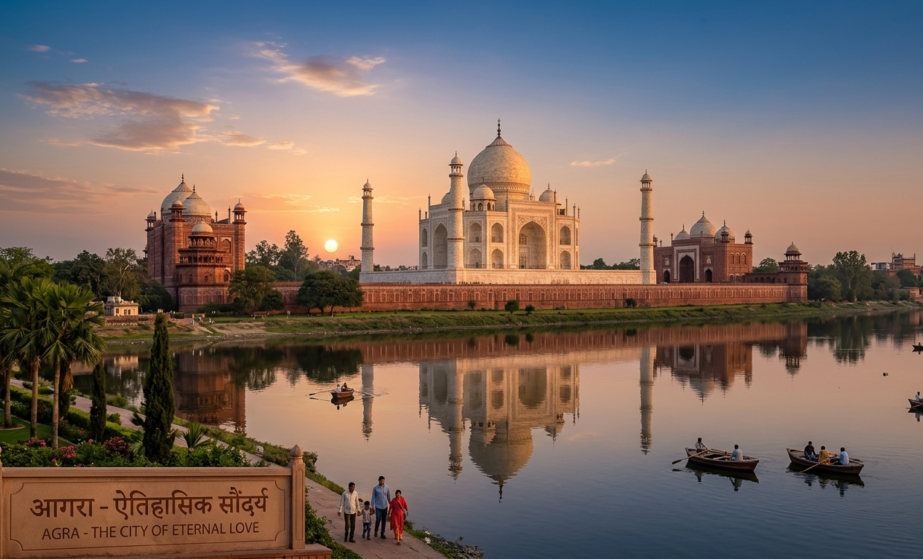
Detailed History
Founded in the year 1504 on the banks of the Yamuna River, the historic and world-famous city is ‘Agra’. According to historical evidence, Sultan Sikandar Lodi, the second ruler of the Lodi dynasty of the Delhi Sultanate, established the city of Agra in 1504 AD. Sikandar Lodi chose this strategic location to strengthen his empire, control the trade routes of Northern India, and keep a watchful eye on the rulers of Rajputana. Later in 1506, he completely shifted his capital from Delhi to Agra.
The Golden Era of the Mughal Empire and Renaming :–
After Sikandar Lodi, his son Ibrahim Lodi ruled here, who was defeated in 1526 at the First Battle of Panipat by the Mughal Emperor Babur, laying the foundation of the Mughal Empire in India. The actual golden era of Agra began with the arrival of the Mughals. During the reign of the great Mughal Emperor Akbar, this city was named ‘Akbarabad’ and it remained the primary capital of the Mughal Empire for a long period. Under the reigns of Emperors Akbar, Jahangir, and Shah Jahan, there was an unprecedented development of art, architecture, commerce, and culture here. Shah Jahan later shifted his capital to Delhi (Shahjahanabad) in 1649, but the historical significance of Agra always remained absolute.
Detailed Architecture
The architecture and structural layout of Agra are globally renowned for magnificent Mughal Architecture, Indo-Islamic styles, and the magical use of red sandstone and white marble.
Interior and Exterior Design :-
- Agra Fort :– Situated on the banks of the Yamuna River, the Agra Fort was a highly powerful military garrison and a royal residence. Built by Emperor Akbar in 1565, the exterior architecture of the fort features massive red sandstone double-layered walls and high battlements, reflecting its impenetrable security. In contrast, the interior layout inside the fort is extremely delicate and artistic, housing the Jahangiri Mahal, Diwan-i-Aam, Diwan-i-Khas, and the exquisitely beautiful ‘Nagina Masjid’ and ‘Sheesh Mahal’ made of white marble. Intricate carvings, Pietra Dura inlay work, and a magnificent network of fountains are crafted within the fort complex.
- Taj Mahal :– Commissioned by Shah Jahan in memory of his beloved wife Mumtaz Mahal, this wonder of the world is the pinnacle of architecture. Its exterior design is completely symmetrical, featuring a massive main dome flanked by four high minarets at the corners. The interior architecture of the Taj Mahal, crafted from white Makrana marble, is adorned with exquisite inlay work of semi-precious gemstones, giving an ethereal beauty to its central sanctum and main cenotaphs.
Travel Guide & Routes
Being one of the most popular tourist destinations in the world, the travel guide and routes to reach Agra are highly seamless.
Entry Ticket and Timings :–
- Ticket :– The entry ticket for the Agra Fort is approximately 50 INR for Indian citizens and 650 INR for foreigners. The main ticket for the Taj Mahal is 50 INR for Indians (an additional ticket of 200 INR is required to enter the main dome area).
- Timings :– Agra Fort is open daily from 06:00 AM to 06:00 PM. The Taj Mahal remains open from sunrise to sunset, but note that the Taj Mahal is closed to tourists every Friday.
How to Reach :–
- By Air :– The nearest major international airport is Indira Gandhi International Airport (IGI) in New Delhi, which is about 220 km away from Agra. Direct expressways and trains are available from Delhi to Agra.
- By Rail :– ‘Agra Cantt’ (AGC) and ‘Raja Ki Mandi’ are the primary railway stations here. Premium trains like Vande Bharat, Gatimaan Express, and Shatabdi Express run regularly from major cities across the country like Delhi, Mumbai, Kolkata, and Chennai. Prepaid taxis, autos, and e-rickshaws are easily accessible from the railway station to travel around the city.
- By Road :– Coming from Delhi and Noida, the ‘Yamuna Expressway’ is the most magnificent and fastest route, reaching Agra in just about 3 hours. Apart from this, the ‘Agra-Lucknow Expressway’ connecting Lucknow to Agra is also world-class.
Photography Spots :–
- Mehtab Bagh :– Located across the Yamuna River, this garden offers a stunning back-view of the Taj Mahal during sunset.
- Musamman Burj inside Agra Fort :– This is the very tower where Shah Jahan was imprisoned during his final days, offering a poignant and beautifully framed view of the Taj Mahal.
Local Flavors and Famous Markets :–
- Local Flavors :– The moment Agra is mentioned, the famous ‘Agra ka Petha’ instantly comes to mind. Apart from this, a morning breakfast of piping hot Bedmi Puri, Kachori-Sabzi, and Jalebi is highly popular here. The chaat available at Sadar Bazar is also very famous.
- Famous Markets :– For purchasing handicrafts, leather goods, and small marble replicas, ‘Sadar Bazar’ and ‘Kinari Bazar’ are the most prominent and vibrant markets.
Interesting Facts
- Babur’s First Garden :– The founder of the Mughal Empire, Babur, laid out India’s first formal Persian-style garden, ‘Aram Bagh’, right on the banks of the Yamuna River in Agra.
- Imprisonment of Shah Jahan :– When Shah Jahan’s son Aurangzeb seized power, he placed his father Shah Jahan under house arrest inside the Musamman Burj of Agra Fort, where Shah Jahan spent his last days merely gazing at the Taj Mahal.
- Inception of Din-i-Ilahi :– Emperor Akbar started a new syncretic faith called ‘Din-i-Ilahi’, combining the good aspects of all religions, from this historic city of Agra.
- Birthplace of Radha Soami Faith :– Agra was not just a hub for the Mughals, but the world-famous ‘Radha Soami Faith’ was also founded and initiated in this city (Dayalbagh).
Important Questions and Answer :-
Question 1:- Who founded the city of Agra in the year 1504?
Answer:– The city of Agra was founded in the year 1504 by Sultan Sikandar Lodi, the ruler of the Lodi dynasty of the Delhi Sultanate.
Question 2:- By what name was Agra known during the time of the Mughals?
Answer:– During the Mughal era, from the time of Emperor Akbar, Agra was officially known as ‘Akbarabad’ and served as the capital of the empire.
Question 3:– On the banks of which river is the Agra Fort situated and who built it?
Answer:– The Agra Fort is situated on the western bank of the Yamuna River. The construction of its grand red sandstone massive ramparts was started by Emperor Akbar in 1565.
Question 4:– On which day is the Taj Mahal closed for tourists?
Answer:– The Taj Mahal remains completely closed to general tourists every Friday, as only the afternoon Friday prayers are permitted inside the complex on that day.
“The timeless saga frozen on the waves of the Yamuna, penned by Sikandar Lodi and made immortal in white marble by the Mughals, is none other than Agra.”