
Detailed History
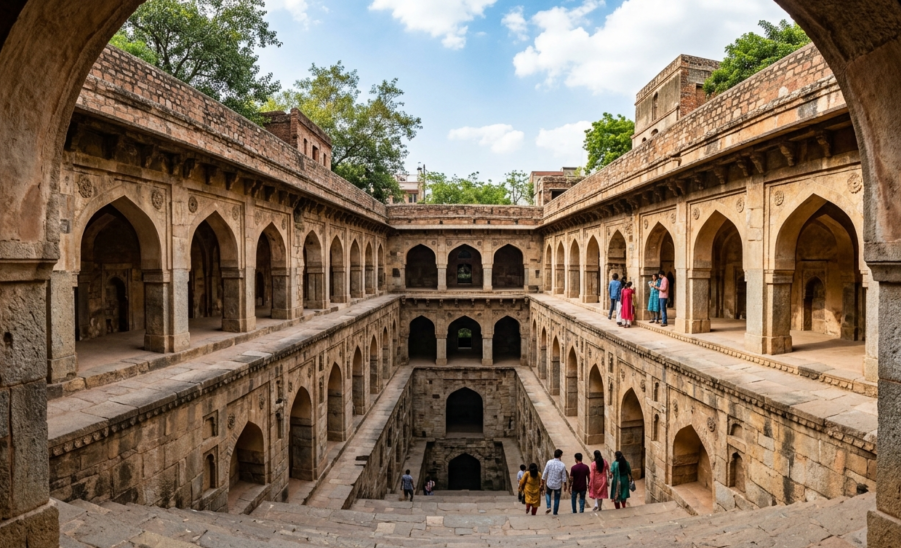
Located near Connaught Place in Central Delhi, Agrasen ki Baoli is one of the most famous, visually stunning, and intriguing stepwells in India. The historical origins of this monument are shrouded in two distinct narratives. According to popular cultural beliefs and mythology, the stepwell was originally constructed during the Mahabharata era by the legendary King Agrasen of the Solar Dynasty, who is revered as the progenitor of the Agrawal community. However, the architectural structure that stands today was extensively rebuilt and restored during the 14th century, aligning with the Tughlaq or Lodi dynasties. Designed as a traditional water reservoir and a cool summer retreat for travelers, this stepwell is a masterful specimen of ancient Indian hydrology and engineering. It has been protected as a monument of national importance by the Archaeological Survey of India (ASI) since the 1970s. In modern times, its unique design, peaceful aura, and urban legends have made it highly popular among youth, photographers, and global travelers.
Detailed Architecture
The architectural layout of Agrasen ki Baoli is extraordinary, utilizing a subterranean design that carves downward into the earth rather than building upward.
- Exterior & Interior Layout :– The stepwell measures approximately 60 meters in length and 15 meters in width. It features a grand flight of 103 steps crafted from sturdy red sandstone, descending deep into the earth across three distinct tiers or levels. Flanking both sides of the steps are symmetrical, arched corridors and small chambers. These alcoves were historically used as resting places for weary travelers, merchants, and sages seeking shade from the scorching Delhi heat. The detailed geometry of these arches strongly reflects the functional style of Islamic architecture from the Sultanate period.
- The Well and Reservoir :– At the far northern end of the structure lies a deep, circular brick well, which is interconnected with the main reservoir through a subterranean passage. During monsoons, as the water table rose, the lower tiers of the steps would submerge. The massive stone walls were systematically engineered to insulate the lower levels, ensuring that the temperature dropped significantly as one walked deeper into the stepwell.
Travel Guide & Routes
- Ticket and Fees :– Entry to Agrasen ki Baoli is completely Free for everyone. There are no fees for general sightseeing or photography.
- Visiting Time :– The monument is open to visitors daily from 9:00 AM to 5:30 PM. Visiting during the late morning or early afternoon allows you to witness the dramatic play of shadows across the symmetrical stone steps.
- How to Reach :–
- By Metro :– The nearest metro options are ‘Barakhamba Road Metro Station’ (Blue Line) and ‘Janpath Metro Station’ (Violet Line). Tucked away on Hailey Road, the stepwell is a pleasant 5-10 minute walk from either of these stations.
- By Road :– Situated right in the heart of central Delhi next to Connaught Place, it is highly accessible. You can easily book a cab, hail an auto-rickshaw, or take a local bus to reach ‘Hailey Lane’.
- Photography Spots :– Capturing the profound symmetry of the 103 steps from the top platform looking downward is a classic frame. The golden light filtering through the ancient arches and looking upward from the mid-levels toward the open sky provide fantastic backdrops for photography and video reels. The site gained immense mainstream popularity after being prominently featured in major Bollywood films like PK and Sultan.
- Local Food :– While there are no food stalls inside the quiet lane of the monument, the bustling Connaught Place and the famous Bengali Market are within walking distance. Bengali Market is legendary across Delhi for its premium chaat, chole bhature, and traditional sweets.
- Famous Markets :– You can easily combine your visit with a shopping spree at the nearby Janpath Market (renowned for ethnic clothes and handicrafts), the underground Palika Bazaar, or the upscale retail showrooms of Connaught Place.
Important Questions and Answer :-
Question 1:- Who originally built Agrasen ki Baoli?
Answer:- According to local lore, it was originally built by the ancient King Agrasen during the Mahabharata period, and it was later reconstructed and renovated during the 14th century under the rule of the Tughlaq or Lodi dynasties.
Question 2:- How many steps does Agrasen ki Baoli have and what are its dimensions?
Answer:- The stepwell features a total of 103 neatly carved sandstone steps descending into the reservoir. It is about 60 meters long and 15 meters wide.
Question 3:- Is Agrasen ki Baoli actually haunted?
Answer:- There are several spooky urban legends claiming that the well was once filled with mysterious ‘black water’ that hypnotized visitors into jumping in. However, these are merely fictional internet myths. In reality, it is a perfectly safe, peaceful, and beautifully preserved historical landmark.
Author’s Thoughts (Personal Perspective)
Tucked away inside a quiet, shaded alley just a few hundred meters from the towering glass skyscrapers and relentless traffic of Connaught Place, Agrasen ki Baoli feels like a magical time portal. In my view, this location is far more than an ancient water-harvesting structure; it is a profound testament to how beautifully our ancestors married utility with sublime artistic design. As you descend its 103 stone steps, the frantic sounds of modern Delhi begin to fade away, replaced by a deep, enigmatic silence that wraps around you. The experience is both awe-inspiring and slightly surreal. While movies and internet forums have romanticized it with ‘haunted’ rumors, sitting there in a quiet moment reveals no malice—only a deep sense of reverence for ancient craftsmanship. It remains one of the finest spots in Delhi to steal away from the rush of daily life and connect with the quiet depth of history.
Interesting Facts
- Agrasen ki Baoli is one of the very few ancient stepwells in the world that remains hidden right in the middle of a massive, hyper-modern metropolitan city center.
- Due to its deep, enclosed architectural design, sound waves echo uniquely inside the reservoir, which likely contributed to the birth of the local ghost stories and myths over time.
- In ancient times, stepwells were not just water sources; they served as vital social hubs where community meetings were held, and where women gathered to socialize away from the harsh daytime heat.
“Agrasen ki Baoli is a deep, silent well of history hidden within Delhi’s concrete jungle, where every descending step whispers an untold story of the eras gone by.”