
Detailed History
The Jama Masjid of Delhi is one of the largest and most magnificent mosques in India. Its construction was initiated by the Mughal Emperor Shah Jahan in the year 1650 and was completed in 1656. Around 5,000 laborers, artisans, and stone-carvers worked relentlessly for 6 years to build this massive structure. At that time, the cost of its construction was approximately 1 million rupees (10 Lakhs). Shah Jahan named it ‘Masjid-e-Jahan Numa‘, which translates to ‘the mosque that commands a view of the world‘. The first Imam of this mosque was Syed Abdul Ghafoor Shah Bukhari from Bukhara (Uzbekistan), who was personally invited by Shah Jahan. This mosque stands as a living testimony to the grandeur of the Mughals and their profound love for architecture.
Detailed Architecture
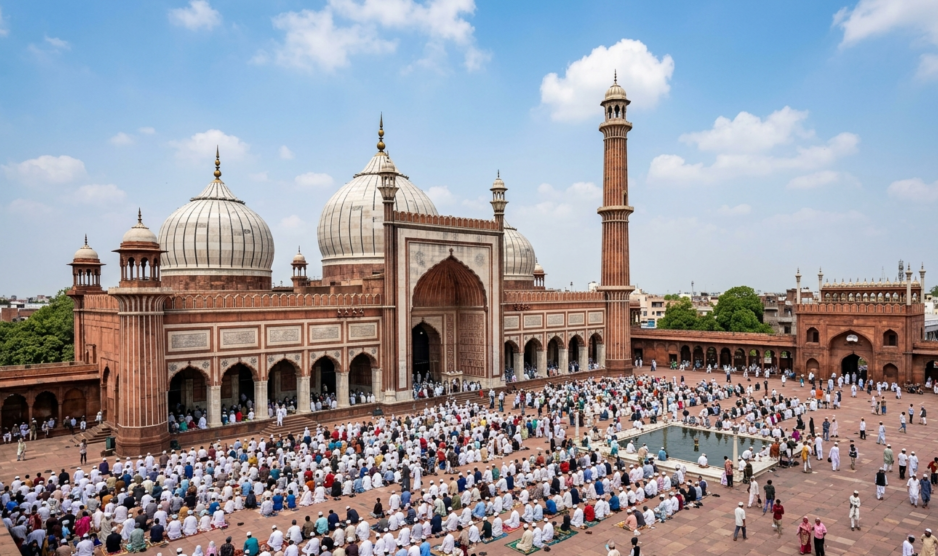
Jama Masjid is an unmatched masterpiece of Mughal architecture, constructed with a stunning combination of red sandstone and white marble.
- Exterior Architecture :– The mosque is situated on a high elevated platform, which can be reached via grand flights of stairs from three sides (East, North, and South). The Eastern gate was known as the ‘Shahi Darwaza‘ (Royal Gate), which was reserved exclusively for the Emperor. The mosque features three massive domes decorated with alternate stripes of white and black marble, topped with golden spires. Two monumental minarets, standing 40 meters high and containing 130 steps each, flank the structure at both corners.
- Interior Architecture :– The main prayer hall is immensely spacious, capable of accommodating around 25,000 worshippers at a time. The floor is beautifully laid with 899 black and white marble borders, mimicking the shape of individual Muslim prayer mats (Musalla). At the center of the vast courtyard lies a beautiful marble tank (Hauz) meant for Wudu (ablution). The walls inside feature intricate carvings and inscriptions of holy Quranic verses.
Travel Guide & Routes
- Ticket and Fees :– Entry to the Jama Masjid is completely Free. However, if you wish to carry a camera or use your smartphone for photography inside, a fee of ₹300 is applicable. A separate ticket of around ₹70 is required to climb the minaret.
- Visiting Time :– The mosque is open to tourists from 7:00 AM to 12:00 PM, and from 1:30 PM to 6:30 PM. Tourists are not allowed inside during prayer times.
- How to Reach :–
- By Metro :– The most convenient way is the Delhi Metro. You can deboard at the ‘Jama Masjid Metro Station’ on the Violet Line, from where the mosque is just a 2-3 minute walk. Alternatively, ‘Chandni Chowk‘ station on the Yellow Line is also nearby.
- By Road :– You can take an auto, cab, or DTC bus from any part of Delhi to reach Daryaganj or Chandni Chowk in Old Delhi, and then walk or take a cycle rickshaw to the mosque.
- Photography Spots :– The center of the vast courtyard offers a perfect frame of the main domes and minarets. The top of the minaret provides a panoramic bird’s-eye view of Old Delhi and the Red Fort. Capturing the reflection of the mosque in the ablution pool during a golden sunset is highly recommended.
- Local Food :– Right opposite Gate No. 1 of the mosque lies the famous Matia Mahal bazaar, world-renowned for its delectable non-vegetarian delicacies like Karim’s Korma, Aslam’s Butter Chicken, Al-Jawahar’s Kebabs, and desserts like Shahi Tukda. For vegetarians, the legendary ‘Paranthe Wali Gali’ in Chandni Chowk is just a short distance away.
- Famous Markets :– The mosque is surrounded by historic markets such as Chandni Chowk, Meena Bazaar, and Dariba Kalan (famous for jewelry), where you can shop for traditional clothes, attar (perfumes), handicrafts, and spices.
Holika’s Thoughts / Cultural Perspective on Festivals
The area surrounding Jama Masjid and Old Delhi is the greatest symbol of India’s ‘Ganga-Jamuni Tehzeeb‘ (cultural syncretism and unity). Just as the festive spirit peaks here during Eid, the atmosphere around this historic monument during the holy festival of Holi is equally unique. Holi is a festival that celebrates the victory of good over evil and inspires people to embrace each other by forgetting mutual differences. When people from diverse communities come together to celebrate festivals in the squares of Old Delhi, the scene beautifully defines India’s unity in diversity. The ancient walls of Jama Masjid have stood as silent witnesses to this timeless brotherhood and communal harmony for centuries.
Interesting Facts
- The finest artisans of that era were brought together to build Jama Masjid, and the unique stones used in its construction were sourced from various distant regions.
- Relics of the Prophet Muhammad, including his footprints impressed on a marble slab and a strand of his beard hair, are safely preserved inside the main prayer hall.
- The acoustic design of the mosque was engineered so effectively that even before the invention of loudspeakers, the voice of the main Imam leading the prayers could clearly reach thousands of worshippers gathered across the vast courtyard.
Important Questions and Answer :-
Question 1:- Who built the Jama Masjid and when?
Answer:- The Mughal Emperor Shah Jahan commissioned the construction of the Jama Masjid in 1650, and it was completed in 1656.
Question 2:- How many people can offer prayers together at the Jama Masjid?
Answer:- Approximately 25,000 people can accommodate and offer prayers simultaneously in the vast courtyard and prayer hall of the mosque.
Question 3:- Is there an entry fee for visiting Jama Masjid?
Answer:- No, entry to the Jama Masjid is absolutely free. However, additional charges apply for photography and for climbing the minaret.
“Jama Masjid is not merely a structure of stones, but the beating heart of Old Delhi and a living chapter of India’s glorious history.”