
Cathedral Church of the Redemption Delhi :- The Symmetrical Symphony of Roman Architecture and Forgotten Colonial Quietude
When travelers conceptualize the heritage grid of New Delhi, their minds instantly drift toward sprawling Mughal brick fortresses, ancient sandstone minarets, or gold-plated temples. However, the capital houses an equally captivating, pristine facet rooted deeply in early 20th-century European masonry. Positioned elegantly within the high-security administrative core of Lutyens’ Delhi, immediately north of the Parliament House and Rashtrapati Bhavan on Church Road, the ‘Cathedral Church of the Redemption’ stands as an architectural triumph. Celebrated for its unique structural layout, profound political heritage, and immense psychological quietude, it remains one of the finest and historically significant operational cathedrals in India. In this comprehensive blog, we will step through its glorious genesis, complex Romanesque design, and complete visitor roadmap.
Detailed History
The historical timeline of the Cathedral Church of the Redemption is fundamentally bound to the foundational layout of New Delhi as the seat of imperial governance during the British Raj.
- The Imperial Genesis :– Following the capital shift from Calcutta to Delhi in 1911, the expanding British officer corps and the resident Viceroy required a core central place of worship. The ground-breaking for this grand cathedral commenced in 1927, and the structure was meticulously brought to life over four years, opening its doors officially for public worship on January 18, 1931.
- The Vice-Regal Patronage :– During the late colonial era, this sanctuary served as the official church of the Viceroy of India. The then Viceroy, Lord Irwin, was profoundly committed to its execution. He not only facilitated heavy institutional funding but also gifted the cathedral its most prized asset—the grand, historical multi-tiered Pipe Organ—in 1931, which is still utilized today.
- The Theological Etymology :– The term ‘Redemption’ in Christian theology embodies spiritual liberation, atonement, and salvation. Today, the cathedral functions as the programmatic headquarters of the Delhi Diocese of the Church of North India (CNI).
Detailed Architecture :-
The structural blueprint of this cathedral is highly anomalous for India; it deliberately shuns the typical soaring, pointed Gothic spires of British India in favor of absolute geometric restraint. It was conceptualized by the celebrated British architect Henry Medd, a close associate of Edwin Lutyens, who won the competitive imperial design bid.
- Exterior Architectural Layout :–
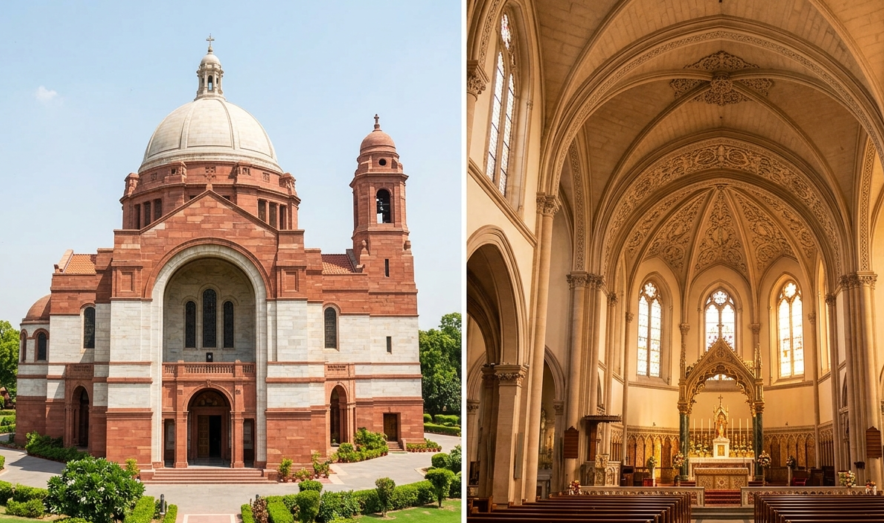
- Palladian and Romanesque Typology :– The exterior is heavily inspired by the classic Palladian and Romanesque architectural movements of Italy. Constructed utilizing a specialized blend of pale plaster, white concrete, and red sandstone trimmings at the base, its flat, curved monolithic walls emit an aura of immense structural gravity and clean minimalism.
- The Central Monumental Dome :– The entire framework is anchored by a massive, low-sprung central dome. This masterfully engineered feature acts as a natural thermodynamic shield, keeping the interior ambient temperatures remarkably cool during blazing North Indian summers without artificial ventilation.
- Interior Architectural Layout :–
- The Vaulted Arches and Heavy Columns :– Upon passing through the vestibules, the visitor is met with vast, sweeping semi-circular brick arches and monumental columns that frame the central nave. The interior layout is explicitly modeled after the world-famous Il Redentore church designed by Andrea Palladio in Venice, Italy.
- The Chiaroscuro Light Effect :– Henry Medd cleverly configured the high clerestory windows and recessed arches so that harsh direct sunlight never breaches the core spaces. Instead, ambient light gently bounces off the soft plaster walls, illuminating the central nave in a soft, meditative glow.
- The High Altar :– The focal high altar is backed by exquisite, delicate stained-glass artwork and intricate reredos paintings illustrating the nativity and life of Jesus Christ.
Travel Guide & Routes :-
For international heritage enthusiasts, modern architects, and secular travelers looking to explore this quiet structural sanctuary, the practical travel map is sequenced below:
- Ticket :– Entry into the Cathedral Church of the Redemption is completely Free of charge. No tickets or digital passes are issued.
- Visiting Time :– The cathedral grounds and prayer halls are generally open to tourists daily from 09:00 AM to 05:00 PM. (Please note that on Sundays, the core prayer hall may temporarily restrict casual sightseeing during the active morning liturgical services).
- Code of Conduct & Etiquette :– As this remains an active, highly respected house of worship, visitors must adhere to strict internal protocols:
- Maintain complete silence once inside the central nave.
- The use of mobile phones for loud phone calls or audio playback is strictly prohibited inside the hall.
- Dress modestly and respectfully when visiting the premises.
- How to Reach :–
- By Metro :– The absolute closest transit option is the ‘Central Secretariat’ Metro Station, an intersection node for the Yellow and Violet Lines. From the station exit, the cathedral is a quick 5-minute auto-rickshaw ride or a brief 15-minute walk through the avenues. ‘Shivaji Stadium’ (Airport Line) is also highly accessible.
- By Bus :– Given its immediate proximity to the Parliament and the Central Secretariat complexes, any DTC bus routing through North Avenues or the Secretariat ring drops passengers near the entry gates.
- By Road/Cab :– You can seamlessly hail app-based cabs or auto-rickshaws directly to ‘Cathedral Church of the Redemption, Church Road’. Located right behind the North Avenue administrative block, the approach roads are pristine, highly secure, and feature minimal traffic. Secure roadside parking spots are managed adjacent to the outer boundary.
Photography Spots, Local Flavors, and Famous Markets
- Photography Spots :–
- The Main Portico Approach :– Standing near the western courtyard entry lets you capture the grand, symmetric sweep of the Roman multi-foil arch against the pale concrete facade.
- The Manicured Lawns :– The cathedral is enveloped by expansive, perfectly curated emerald grass lawns. This angle offers a striking landscape frame capturing the entire flat-roofed Palladian geometry against mature banyan trees.
- (Crucial Restriction Note :– Flash photography, moving videography, and commercial filming are strictly banned during active Sunday morning services out of respect for the congregation. Casual photography is permissible during weekdays).
- Local Flavors :– Because the cathedral is nestled entirely within the elite, high-security residential lutyens zone, commercial street food vendors are legally banned right outside the gates. However, a quick 5 to 10-minute drive connects you to Gole Market or the inner rings of Connaught Place, offering historic sweet shops, authentic North Indian kebabs, and modern bistros.
- Famous Market :– The site offers swift access to the premium Connaught Place (CP) retail sector. Additionally, travelers can explore Janpath Market for affordable bohemian attire, junk jewelry, and curios, or browse the regional handicrafts at the state emporiums lining Baba Kharak Singh Marg.
Nearby Attractions :-
Maximize your central Delhi exploration by pairing your cathedral walk with these highly proximate iconic landmarks.
- Rashtrapati Bhavan & Amrit Udyan :– The monumental official palace of the President of India, located just minutes away.
- The New Parliament House (Sansad Bhavan) :– The vanguard architectural masterpiece of India’s democracy, situated within walking distance.
- Gurudwara Bangla Sahib :– The magnificent, gold-domed spiritual Sikh shrine centered around a sprawling sacred pool, located 1.5 kilometers away.
- Laxminarayan Temple (Birla Mandir) :– The striking Nagara-style red sandstone Hindu temple complex located on Mandir Marg.
Interesting Facts :-
- The structural acoustics of the cathedral were engineered so flawlessly by Henry Medd that the central hall requires no modern electronic microphones. The curvature of the brick arches amplifies the vocal pitch of the Choir perfectly to every single pew in the hall.
- The grand Pipe Organ gifted by Lord Irwin is completely operational. During major annual liturgies, its deep, booming acoustic resonance completely fills the multi-tiered brick hall.
- The Christmas Grandeur :– Every year on December 24 and 25, the cathedral transforms into a festive visual marvel. The Midnight Mass service attracts thousands of global citizens who gather to light candles, sing carols, and celebrate the nativity under the lit dome.
Important Questions and Answer :-
Question 1:- Are non-Christians and secular international travelers allowed to enter the cathedral during prayer hours?
Answer:- Yes, absolutely. The cathedral operates under an open-door philosophy. Anyone, regardless of national origin, religious belief, or orientation, can enter to sit, meditate, or appreciate the structural design, provided they maintain internal silence.
Question 2:– What is the absolute best time to visit to experience the church at its finest?
Answer:- If you wish to photograph the architecture in absolute isolation, weekday mornings are ideal. However, if you wish to hear the historical pipe organ and experience choral music, visiting during Sunday morning service (typically starting around 09:00 AM) or on Christmas Eve is recommended.
Question 3:– Is public vehicle parking safe and available at the church location?
Answer:- Yes, because the church is situated inside a quiet, elite VVIP zone, parking is exceptionally safe and readily available along the dedicated curbside bays directly outside the main gates.
Author’s Perspective :-
From my perspective, the Cathedral Church of the Redemption is a hidden structural jewel waiting to be discovered inside the high-security grid of New Delhi. It offers a stunning physical contrast—while outside its walls lies the hyper-charged political engine of the country, inside its heavy doors lies an ocean of absolute stillness. Henry Medd’s genius shines through the deliberate absence of over-the-top ornamentation; the beauty of this church rests entirely in its clean masonry lines, its sweeping silent arches, and the dramatic way soft light enters the central nave. If you wish to experience a completely different, highly sophisticated historic dimension of Delhi far removed from the standard tourist crowds, a quiet walk down Church Road to this Romanesque sanctuary is an absolute necessity.
S“Resting with Palladian elegance right at the edge of India’s democratic core, this pale concrete sanctuary remains an immortal monument where absolute structural minimalism meets the deep, soulful silence of history.”