
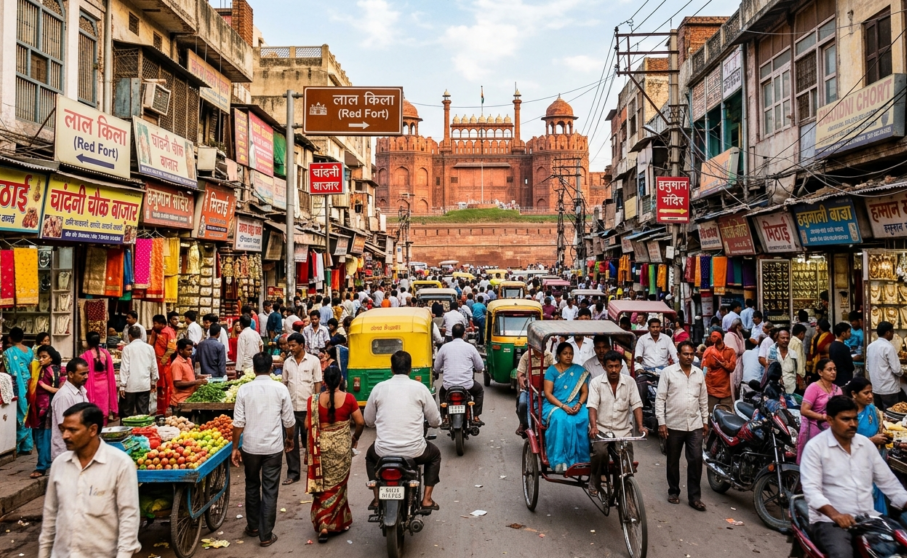
Chandni Chowk, Delhi :- The Vibrant Epicenter of Heritage, Culture, and Culinary Legacy
Nestled in the beating heart of Old Delhi, Chandni Chowk is far more than a mere chaotic marketplace; it is living history unfurling before your eyes. Intricate, labyrinthine alleys, the rich aroma of roasting spices, remnants of majestic Mughal architecture, and an endless stream of shoppers define its unique identity. Following its landmark comprehensive redevelopment, this legendary corridor stretching from the Red Fort to the Fatehpuri Masjid has transformed into a gorgeous, pedestrian-friendly heritage boulevard where 17th-century charm effortlessly meets modern urban planning.
Detailed History
The history of Chandni Chowk spans nearly four centuries, intimately woven into the golden era of the Mughal Empire.
- Establishment and Conception :– In 1650, when the Mughal Emperor Shah Jahan decided to shift his imperial capital from Agra to Delhi and established the walled city of ‘Shahjahanabad’, this grand commercial avenue was constructed. The master plan of this historic market was meticulously conceptualized and designed by Shah Jahan’s highly intellectual and architecturally gifted eldest daughter, Princess Jahanara Begum.
- The Etymology of Moonlit Square :– Originally, a large square reflection pool graced the center of the avenue, fed by a canal system known as ‘Nahar-e-Bahisht’ that drew fresh water from the Yamuna River. On clear nights, when the full moon cast its luminous reflection upon the serene waters, the entire market area gleamed like silver. This enchanting phenomenon earned it the poetic name ‘Chandni Chowk’ (The Moonlight Square).
- A Witness to Epochs :– The historic boulevard has borne witness to grand imperial Mughal processions, devastating foreign sackings like that of Persian invader Nadir Shah, and the paradigm-shifting Revolt of 1857. Under British administration, the central pool was dismantled to build the iconic ‘Town Hall’ and an ornate Clock Tower (Ghantaghar).
Detailed Architecture
The layout of Chandni Chowk represents a stellar example of classical Mughal urban design, beautifully revitalized with contemporary aesthetics.
- The Revamped Heritage Street :– Stretching 1.3 kilometers from the Lahori Gate of the Red Fort to the Fatehpuri Masjid, this street is a pedestrian wonderland. Motorized vehicles are prohibited on this central spine from 9:00 AM to 9:00 PM daily. This restriction opens up wide plazas paved with red sandstone, flanked by manicured green planters, and elegant stone benches.
- The Fusion Architectural Fabric :– The streetscape boasts an electric architectural timeline. At one terminus stands the majestic 17th-century Fatehpuri Masjid built of red sandstone, while across the lane sits the Victorian-era colonial ‘Town Hall’—which is being conserved and repurposed into an immersive digital museum showcasing the legacy of Delhi.
- Historic Havelis :– Branching off the main thoroughfare are dense residential-commercial alleyways (katras) that screen grand historical mansions (havelis). Noteworthy mentions include ‘Haveli Dharampura’ (exquisitely restored into an award-winning boutique heritage hotel and fine-dining space) and ‘Bhagirath Palace’ (originally the palatial mansion of the powerful 18th-century ruler Begum Samru, now functioning as a sprawling wholesale node).
Travel Guide & Routes
To navigate the dazzling landscape of Chandni Chowk smoothly, here is the essential logistical travel checklist arranged in a perfect sequence:
- Visiting & Market Timings :–
- While the avenue itself remains accessible at all hours, the commercial shops and wholesale bazaars operate primarily from 10:00 AM to 08:00 PM.
- Important Note :– The retail market of Chandni Chowk is strictly closed on Sundays. However, traditional street food joints and the festive Sunday sidewalk flea market remain highly active.
.
- Ticket Prices :– Exploring the public heritage corridor of Chandni Chowk is entirely Free. No tickets or entry fees are required.
- How to Reach :–
- By Metro (The Most Recommended Mode) :– The absolute best way to avoid traffic is the Delhi Metro network. Commuters can deboard at either the Chandni Chowk Metro Station (Yellow Line) or the Red Fort Metro Station (Violet Line). Both entry/exit gates open up right onto the primary heritage walkway.
- By Road/Cabs :– Travelers can hire local cabs or take DTC buses to the Red Fort or Old Delhi Railway Station dropping terminals. From there, walkers can approach the pedestrian-only zone.
- By Train :– The Old Delhi Railway Station sits immediately adjacent to the market grid, a brief 5-minute walk or cycle-rickshaw ride away.
.
- Photography Spots :–
- The Fatehpuri Masjid Vista :– Capturing the symmetry of the central boulevard culminating at the grand dome of the historical mosque makes for a postcard-perfect frame.
- Naughara Lane :– Tucked deep within Kinari Bazar, this hidden lane consists of a row of nine intensely vibrant, beautifully preserved 18th-century mansions belonging to the Jain community, famous for architectural imagery and Instagram portraits.
- Khari Baoli Roof-Decks :– Panoramic shots from the top floors of the spice warehouses capture a kaleidoscopic, colorful view of the bustling markets below.
.
- Local Flavors (The Legendary Culinary Stops) :– Old Delhi is widely regarded as the street food capital of India. Do not miss tasting these iconic culinary preparations:
- Paranthe Wali Gali :– A legendary narrow lane serving an array of unique stuffed flatbreads (ranging from cashew-nuts to sweet rabri fillings) deep-fried to crisp perfection in pure clarified butter (desi ghee).
- Natraj Dahi Bhalla :– Operating near Bhai Mati Das Ch चौक, world-famous for its ultra-velvety, soft lentil dumplings drizzled with spiced yogurt and tangy chutneys.
- Old Famous Jelebi Wala :– Located near the Central Baptist Church, known for serving thick, piping-hot, syrup-laden jalebis paired with creamy condensed milk (rabri).
- Giani’s di Hatti :– Famed for its legendary thick Rabri Faluda, the ultimate traditional dessert to cool off.
.
- Famous Specialized Bazaars :– Chandni Chowk is a conglomeration of hyper-specialized wholesale markets:
- Dariba Kalan :– The historic avenue for exquisite silver ornaments, custom jewelry, and authentic traditional Indian perfumes (Attar).
- Kinari Bazar :– The ultimate wholesale hub for wedding wear, intricately embroidered borders (gota-patti), and festive craft trimmings.
- Nai Sarak :– Famous nationwide for textbooks, competitive literature, and traditional handloom sarees.
- Khari Baoli :– Universally crowned as Asia’s largest wholesale hub for exotic dry fruits, herbs, and spices.
.
Nearby Attractions
You can conveniently explore these iconic monuments located within a brief walking radius of the market.
- The Red Fort (Lal Qila) :– Located directly opposite the Eastern gateway of Chandni Chowk, this stunning sandstone fort serves as the symbol of India’s sovereign independence.
- Jama Masjid :– Built by Emperor Shah Jahan, India’s largest and structurally grandest historical mosque is just a 10-minute walk through the surrounding alleys.
- Gurudwara Sis Ganj Sahib :– Standing right on the main street, this sacred Sikh shrine marks the exact site where Guru Teg Bahadur ji attained martyrdom under the orders of Aurangzeb.
- Shri Digambar Jain Lal Mandir :– Delhi’s oldest operational Jain temple, situated right near the Red Fort intersection, famous for its historic charity-run bird hospital.
- Gauri Shankar Temple :– A highly revered 800-year-old historic Shiva temple featuring an ancient lingam, sitting right beside the Jain temple.
Interesting Facts
- Global Maritime Trade Center :– In its absolute prime, the central avenues of Chandni Chowk hosted elite silver merchants and caravan traders arriving all the way from China, Turkey, and Europe to barter precious goods.
- Cinematic Backdrop :– The matchless old-world texture of Chandni Chowk has inspired major cinematic blockbusters, including Hollywood and Bollywood favorites like ‘Delhi-6′, ‘Chandni Chowk to China’, and ‘Bajrangi Bhaijaan’.
- The Inter-Faith Avenue :– Chandni Chowk remains one of the finest global specimens of secular co-existence. Within a stretch of less than a kilometer, a Jain Temple, a Hindu Temple, a Sikh Gurudwara, a Christian Church, and a Muslim Mosque stand shoulder-to-shoulder in complete peace and harmony.
Important Questions and Answer :-
Question 1:– Can I drive my personal car or hire a cab into the main Chandni Chowk street?
Answer:– No, under the strict municipal urban renewal guidelines, all private cars, cabs, and commercial motor vehicles are completely restricted on the main street between Red Fort and Fatehpuri Masjid from 09:00 AM to 09:00 PM. Visitors must park their vehicles at designated multi-level car parks nearby (such as Gandhi Maidan or the modern Omaxe Chowk parking lot) and proceed on foot or hire an eco-friendly e-rickshaw.
Question 2:- Which day is optimal for exploring Chandni Chowk comfortably?
Answer:– If your primary focus is architectural photography, heritage walking, and enjoying the legendary street food joints without immense crowds, Sunday is the absolute best time to visit as the retail shops remain shut. However, if your goal is extensive wholesale wedding or textile shopping, plan your trip between Monday and Saturday.
Question 3:– Is authentic vegetarian food prepared without onions and garlic (Jain Food) easily available?
Answer:– Yes, almost all legendary food establishments, including the historic eateries in Paranthe Wali Gali, adhere to strict traditional vegetarian preparation standards and readily customize plates without onion or garlic upon request.
Author’s Thoughts
In my perspective, Chandni Chowk is not just a dense commercial market corridor; it is a time machine that lets you walk side-by-side with 17th-century India. Before the massive pedestrianization drive, navigating this stretch was an absolute test of patience due to a chaotic mesh of hanging electrical wires, bumper-to-bumper traffic jams, and choked walkways. The subterranean integration of high-voltage cables and the vast red-sandstone pedestrian plazas have single-handedly restored its pristine Mughal glory. The authentic heartbeat of Chandni Chowk, however, still resides deep within its inner alleys—unless you stray away from the main avenue to discover the quiet steps of a hidden katra or an old haveli gateway, you haven’t truly met the soul of Shahjahanabad. It demands patience and a willing spirit, but in return, it rewards you with memories that linger for a lifetime.
S“Holding a mirror to the rise and fall of empires, wrapped in the intoxicating aroma of heritage spices—that is the immortal magic of Delhi’s Chandni Chowk.”