
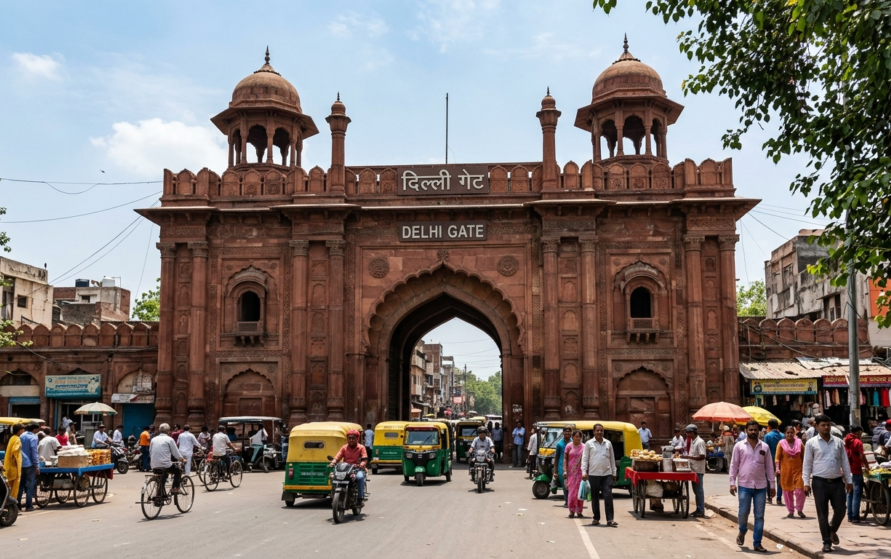
The Saga of Historic Delhi Gate :- History, Architecture, and Complete Travel Guide
Detailed History :-
Delhi Gate is an extremely important and magnificent historical monument located in Delhi, the capital of India. It was constructed in 1638 by Emperor Shah Jahan, one of the most famous visionaries and architects of the Mughal Empire. When Emperor Shah Jahan decided to shift his capital from Agra to Delhi, he founded a grand walled city on the banks of the Yamuna River, known as ‘Shahjahanabad‘ (present-day Old Delhi). To fortify the security of this new and prosperous city, a high and wide rampart (fortification wall) was constructed around it. A total of 14 main gates were built in this massive security wall for entry and exit into the city, among which the ‘Delhi Gate‘ was the most prominent and strategically vital.
This gate was named ‘Delhi Gate’ because it faced south towards the older cities of Delhi (such as Mehrauli, Siri, and Tughlaqabad). From a historical perspective, this gate has been very significant; it was through this route that the royal cavalcades of Mughal emperors, generals, and foreign dignitaries entered toward the Red Fort and Jama Masjid. During the British regime, this gate also witnessed many historical and bloody events of the First War of Independence in 1857 from very close quarters. Today, this gate stands firm amid the busy traffic of modern Delhi as a living witness to the glorious and royal past of Old Delhi.
Detailed Architecture :-
The architecture of Delhi Gate presents a wonderful example of the strength, grandeur, and excellent artistic skill of Mughal architecture. Its unmatched structure can be deeply understood through the following points.
- Construction Material and Color :– In the construction of this mammoth historical gate, locally available and highly durable ‘Red Sandstone’ was primarily used. A special mortar and lime of that era were used to bind the stones together, which has kept it intact even after centuries.
- Exterior Architecture :– The exterior of Delhi Gate is designed in a highly aggressive and impenetrable defensive style. Two massive and heavy semi-circular bastions are built on either side of the gate, which were used for guarding and keeping an eye on enemies. Beautiful battlements (embrasures) are made on the topmost part of the gate, behind which soldiers could hide and attack enemies with archery or firearms. Its entry archway is quite high and regal. Right next to it, stone-carved elephant statues also enhance its royal prestige.
- Interior Architecture :– Upon entering through the gate, you will see arched guard rooms and checkpoints where armed soldiers were stationed round the clock. The panels of its huge main gate were made of very heavy and strong wood, fitted with large, sharp iron spikes so that enemy war elephants could not break the doors even by ramming them with their heads. The interior part still looks very well-organized and attractive in terms of architecture.
Travel Guide & Routes :-
If you are planning to visit this historical heritage and feel its history, a complete travel guide is provided below.
- Entry Fee :– There is no fee of any kind to view Delhi Gate from outside, enjoy its architecture, and take photographs. It is completely Free for tourists.
- Visiting Time :– This monument is located right in the middle of a major public road in Delhi, so it remains open 24 hours a day and seven days a week. However, the time from 06:00 AM to 06:00 PM is considered best to view it closely and take excellent photographs. At night, when modern lights are turned on, its view is worth watching.
- How to Reach :– Being located in the center of Delhi, reaching here is extremely simple and convenient:
- By Metro :– Delhi Metro is the best mode of transport to reach here. The ‘Delhi Gate’ metro station, located on the Violet Line of Delhi Metro, is the nearest station. As soon as you exit the gate of this station, this historical heritage will appear right in front of you.
- By Bus & Auto :– Direct DTC buses ply to Delhi Gate intersection from all major parts of Delhi. Apart from this, you can also easily reach here in a short time by taking an auto-rickshaw, cab, or local e-rickshaw directly from New Delhi Railway Station or Old Delhi Railway Station.
- Photography Spots :– The entire grandeur of this gate can be captured on camera from the small lush green parks built in front of the gate and from the divider of the main road. The architecture blooms when the first ray of the morning sun falls on its red stones, making it the best time for photography.
- Local Food :– The spicy and delicious culinary journey of Old Delhi starts right near Delhi Gate. You can go to the world-famous Mughlai food stalls in the markets of Jama Masjid and Daryaganj, located just a short distance from here, and relish dishes like Chicken Korma, Mutton Kebabs, Shahi Biryani, hot Khamiri Roti, Shahi Tukda, and Phirni.
- Famous Markets :– Right next to Delhi Gate, the famous ‘Sunday Book Market’ of Daryaganj takes place, where all kinds of old and new books from India and abroad are available at very cheap rates. Additionally, Asia’s largest wholesale market ‘Chandni Chowk’, the famous cloth market ‘Meena Bazaar’, and ‘Lajpat Rai Market’ for electronics are located nearby, where you can indulge in a lot of shopping.
Nearby Attractions :-
During your visit to Delhi Gate, you can also explore these major historical and sightseeing spots located in its vicinity.
- Red Fort :– Located just 2.5 kilometers away from Delhi Gate, this is a UNESCO World Heritage Site that served as the main seat of Mughal power.
- Jama Masjid :– One of the largest and most magnificent mosques in India, known for its massive architecture and minarets offering beautiful views of Delhi.
- Feroz Shah Kotla Fort :– Located very close to Delhi Gate, this 14th-century fort is a symbol of Tughlaq architecture, where the famous Ashokan Pillar is also established.
- Raj Ghat :– The memorial site of the Father of the Nation, Mahatma Gandhi, is situated very close to Delhi Gate amidst a peaceful and beautiful garden.
- National Gandhi Museum :– This is an excellent place to see rare artifacts, items, and photographs related to the life, philosophy, and freedom struggle of Mahatma Gandhi.
Interesting Facts :-
- The gate located at the northern end of Shahjahanabad city was called ‘Kashmiri Gate’ because it led towards Kashmir, and this gate at the southern end was called ‘Delhi Gate’ because it led out of Old Delhi towards the then main city of Delhi.
- The structure and architecture of Delhi Gate match Kashmiri Gate to a great extent, which is why historians often refer to these two gates as ‘twin brothers’.
- During the British colonial period, this gate was made a major border check-post to collect tax (octroi) on commercial goods entering the city.
- Slight marks of bullets and attacks can still be seen on the ramparts of the gate, which occurred during various wars and rebellions in history.
Important Questions and Answer :-
Question 1:– What is the historical significance of Delhi Gate?
Answer:- The historical significance of Delhi Gate is that it was the main southern entrance to ‘Shahjahanabad’, the city established by Mughal Emperor Shah Jahan. It was a major hub for city security and royal movements.
Question 2:– Which is the nearest metro station to Delhi Gate?
Answer:- The nearest metro station to Delhi Gate is the ‘Delhi Gate Metro Station’ itself, which is located on the Violet Line of the Delhi Metro.
Question 3:- Is entry inside the Delhi Gate permitted?
Answer:- At present, from the perspective of security and conservation, tourists are not allowed to go inside the rooms or on top of the roof of the gate. Tourists can view it from the outside and take photographs around it.
Question 4:– What is the difference between Delhi Gate and India Gate?
Answer:- Delhi Gate is a city security gateway built by Mughal Emperor Shah Jahan in the 17th century, whereas India Gate is a national war memorial built by the British government in the 20th century in memory of the martyred Indian soldiers of World War I.
Author’s Thoughts :-
Delhi Gate is not just an old structure made of stones and mortar; it is a living saga of Delhi’s transforming history. When you stand beneath the massive arch of this gate, somewhere amidst the horns of modern vehicles, you can still feel the echo of galloping horses and royal proclamations of the Mughal era. It is fascinating to see how an ancient defensive gate today marks its presence as a crossroads, dividing the traffic of modern Delhi into two halves. If you truly want to understand the soul of Delhi and its history, there can be no better place than Delhi Gate to begin your exploration of Old Delhi. In my opinion, the tranquility of the morning and the illumination at night here will both give you a feeling of a different world altogether.
“Emerging from the formidable walls of history and standing at the crossroads of modernity, Delhi Gate still narrates the immortal saga of Shahjahanabad’s royal era.”