
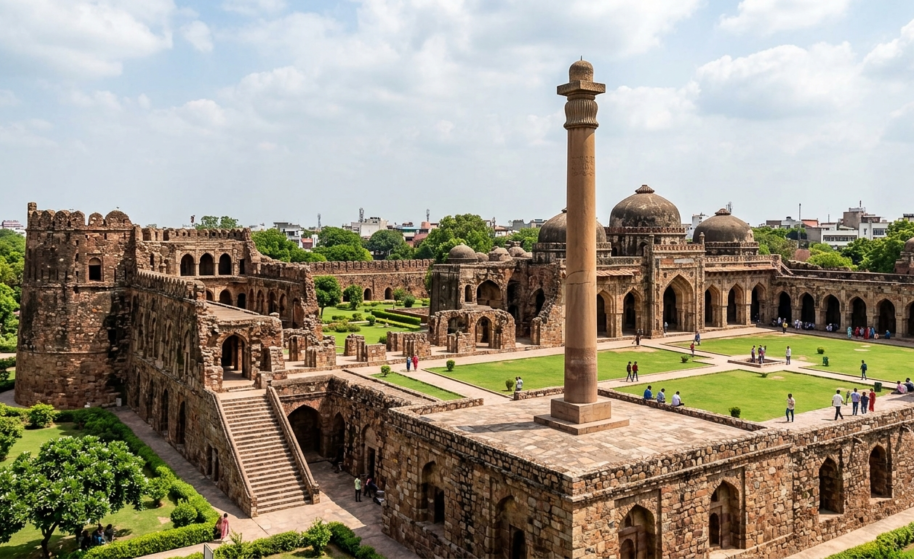
Feroz Shah Kotla Delhi: Complete History and Architecture
Located on Bahadur Shah Zafar Marg in New Delhi, Feroz Shah Kotla (often historically referred to as ‘Afrosa Kotla‘ or the city of Firozabad) is one of the most historic and mystifying forts in Delhi. Built in the 14th century, this fort served as the primary administrative heart and royal residence of ‘Firozabad‘, the fifth city of Delhi. Today, this location is globally renowned for its majestic historical ruins, an ancient pillar containing Ashokan edicts, and local folklore regarding the habitation of ‘Jinnats‘ (Genies).
Detailed History
The construction of Feroz Shah Kotla was commissioned in 1354 AD by Sultan Firoz Shah Tughlaq of the Tughlaq dynasty. During his reign, the Sultan established the fifth city of Delhi along the banks of the Yamuna River, naming it ‘Firozabad’. The word ‘Kotla’ literally translates to a ‘fort’ or ‘citadel‘.
The primary catalyst for building this fort was a severe water scarcity in the previous Tughlaq capital of Tughlaqabad. To counter this, Firoz Shah Tughlaq decided to shift his capital to the banks of the perennial Yamuna River. In its glory days, this citadel was a symbol of opulence, housing grand palaces, massive mosques, multi-storeyed madrasas, and lush gardens. When the fierce invader Timur Lang attacked Delhi in 1398 AD, he was so captivated by the beauty of this fort and its congregational mosque that he captured local artisans to replicate a similar structure in his home city of Samarkand.
Detailed Architecture
The architecture of Feroz Shah Kotla is a stellar representation of the massive, sturdy, and utilitarian style characteristic of the Tughlaq era. A detailed breakdown of its exterior and interior layout is as follows.
Exterior Architecture
- Sturdy Ramparts and Walls :– The perimeter walls of the fort are remarkably tall and thick, built using locally sourced dull grey quartzite stones and lime mortar. Though major sections lie in ruins today, its colossal gateways and circular bastions still exhibit its defensive military prowess.
- Three-Tiered Pyramidal Structure :– The most captivating architectural element visible from the outside is a three-storeyed stepped pyramidal structure, upon the crest of which the famous Ashokan Pillar is proudly mounted.
Interior Architecture
- The Ashokan Pillar :– The crown jewel of this fort is a 23-meter-high polished sandstone Ashokan Pillar. Sultan Firoz Shah Tughlaq transported this pillar with immense care from Topra near Ambala (Haryana) to Delhi via the Yamuna River using massive conjoined boats. The golden-brown monolithic column features seven Buddhist edicts inscribed by Emperor Ashoka in the 300s BC using the Prakrit language and Brahmi script.
- Jami Masjid (The Congregational Mosque) :– Situated within the complex is the grand two-storeyed Jami Masjid, which was one of the largest mosques of its time in Delhi. Built entirely of local stone, it once featured a massive open courtyard lined with elegant arcaded cloisters. It is the historic spot where Timur Lang offered his prayers.
- Circular Baoli (Stepwell) :– Adjoining the mosque is a unique Circular Baoli. Unlike other stepwells in Delhi which are typically square or rectangular, this structure is entirely circular with a large well at its core. It is surrounded by subterranean chambers and concentric steps where the royal family would retreat to escape the scorching summer heat.
- Mysterious Catacombs :– Beneath the primary structures lie dark, interconnected underground cells and chambers where locals routinely gather today to light candles and incense.
Travel Guide & Routes
If you are planning a tour of the Feroz Shah Kotla fort, here is the comprehensive information detailing tickets, timings, and transit routes:
- Ticket (Entry Fee) :– The entry fee for Indian citizens is ₹25, whereas foreign nationals are charged ₹300. Entry is completely free for children below the age of 15. (Booking online might yield slight discounts).
- Visiting Time :– The fort complex is open to visitors from 6:00 AM to 6:00 PM. Spending 2 to 3 hours is highly recommended to properly explore the entire complex.
- Opening and Closing Days :– It remains open on all days of the week. However, Thursday sees an extraordinary influx of locals, devotees, and believers due to cultural traditions.
- Photography Spots :– The Ashokan Pillar perched atop the three-storeyed monument offers a dramatic silhouette against the open sky. Additionally, the ancient stone arches of the Jami Masjid and the architectural lines of the Circular Baoli (entry down into the stepwell may be restricted for safety, but it looks splendid from the viewing decks) serve as great photography spots.
- Local Food :– The fort area is close to Daryaganj and Old Delhi. You can head to nearby Daryaganj to sample legendary Chole Bhature, classic Mughlai curries, and the tangy street chaat of Old Delhi.
- Nearby Markets :– The closest shopping hubs are the Daryaganj Sunday Book Market (operational only on Sundays) and the historic shopping alleys of Chandni Chowk and Meena Bazaar for textiles and crafts.
How to Reach :-
- By Metro :– The nearest metro stations are ‘Delhi Gate’ and ‘ITO’ (Violet Line). The fort is situated at a manageable distance of 800 meters to 1 kilometer from these stations, which can easily be covered on foot or by hopping onto an e-rickshaw.
- By Bus :– Any bus operating via Bahadur Shah Zafar Marg or stopping near the Ambedkar Stadium will drop you right outside the Feroz Shah Kotla precinct.
- By Air :– The Indira Gandhi International Airport (IGI) is roughly 18 kilometers away from the monument.
- By Rail :– New Delhi Railway Station is merely 4 kilometers away, while Old Delhi Railway Station is approximately 5 kilometers from the site.
Interesting Facts
- Abode of the Jinns :– According to deep-rooted local folklore, the dark alcoves and ruins of this fort are inhabited by benevolent spirits called ‘Jinns’. Every Thursday, thousands of people gather here, pasting written letters addressed to the Jinns, lighting candles, and offering milk and grains to seek solutions to their grievances.
- Inspiration for Timur :– Deeply moved by the grand design of the Jami Masjid inside this fort, Timur Lang took architectural inspiration and master builders back to Samarkand (Uzbekistan) to construct the world-famous Bibi-Khanym Mosque.
- Transporting the Pillar :– To transport the massive Ashokan monolith without breaking it, the Sultan had it wrapped in silk and reeds, laid on a specially constructed 42-wheeled carriage, and pulled by hundreds of men to the riverbank.
- The Cricket Stadium Connection :– The world-famous cricket stadium located directly adjacent to this historical fort was formerly named the ‘Feroz Shah Kotla Stadium’ before being renamed the Arun Jaitley Stadium.
Important Questions and Answer :-
Question 1:– Where is Feroz Shah Kotla located?
Answer:– Feroz Shah Kotla is located on Bahadur Shah Zafar Marg in New Delhi, right next to Vikram Nagar and the Arun Jaitley Cricket Stadium.
Question 2:- What is the history of the ancient pillar standing inside the fort?
Answer:– It is a 3rd-century BC monolithic pillar of Emperor Ashoka. Sultan Firoz Shah Tughlaq brought it safely from Topra in Haryana and installed it atop a custom-built three-storeyed building within his citadel.
Question 3:– Why is Feroz Shah Kotla heavily crowded on Thursdays?
A: Local beliefs dictate that invisible Jinns reside in the ancient catacombs of this fort who fulfill human wishes. People visit on Thursdays to offer prayers, light lamps, and submit letters listing their problems.
Question 4:– Is entry permitted inside the Circular Baoli?
Answer:– Due to structural safety and preservation mandates, entry directly down into the steps of the circular baoli is currently barred, but visitors can view its entire expanse perfectly from the barricaded upper perimeter.
Author’s Thoughts :-
Feroz Shah Kotla is not merely a collection of decaying walls; it is a fascinating junction in Delhi’s historic timeline where archaeology perfectly blends with mysticism and popular faith. On one hand, the Ashokan pillar stands as a proud testament to India’s ancient ethical and imperial golden age, while on the other, the ruins of the Jami Masjid whisper tales of the Tughlaq sultanate. Beyond the cold facts of history, the scent of burning incense drifting through the air and the handwritten letters tucked into the crevices of the stones give this place an otherworldly, spiritual aura. For anyone wishing to experience the intersection of medieval engineering with living cultural mythologies, a walk through Feroz Shah Kotla will leave an everlasting impression on the soul.
“Woven with the stones of antiquity and the threads of human prayers, Feroz Shah Kotla stands in quiet dignity, guarding the grandeur of the past and the mysteries of the unseen.”