
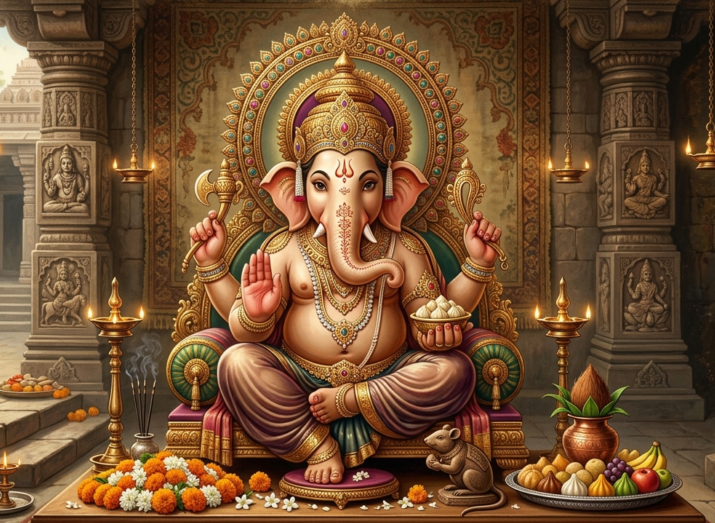
Ganesh Chaturthi :- A Grand Festival of Devotion, Tradition, and Celebration
Detailed History
Ganesh Chaturthi, also known as Vinayaka Chaturthi, is a deeply revered and vibrant Hindu festival. It falls on the fourth day (Chaturthi) of the bright fortnight (Shukla Paksha) in the Hindu month of Bhadrapada. According to mythology, this auspicious day marks the birth of Lord Ganesha, the elephant-headed deity who is worshiped as the remover of obstacles (Vighnaharta) and the bestower of prosperity and wisdom.
Historically, the tradition of worshiping Lord Ganesha spans centuries. Chhatrapati Shivaji Maharaj initiated public celebrations to promote culture and nationalism during the Maratha Empire. Later, in 1893, the Indian freedom fighter Lokmanya Bal Gangadhar Tilak revived it as a grand public event. He transformed the private home worship into a massive community celebration to unite people against British colonial rule. Today, it is celebrated with immense fervor across India and by the global Indian diaspora.
Detailed Architecture
The architectural beauty of Puja Pandals and Ganesha Idols during this festival is a testament to fine Indian craftsmanship.
- Pandal Architecture :– In cities like Mumbai and Pune, temporary structures (pandals) are crafted as replicas of famous Indian temples, royal palaces, or mythological themes. Pandals like Lalbaugcha Raja feature elaborate carvings using wood, eco-friendly materials, and grand lighting setups.
- Idol Craftsmanship :– Sculptors begin designing idols months in advance. The idols depict Lord Ganesha in diverse postures—blessing devotees, seated on royal thrones, or playing musical instruments.
- Eco-Friendly Clay Usage :– Modern celebrations emphasize idols made from Shadu Mati (natural clay), painted with natural dyes, and adorned with traditional attire, crowns, and pearl garlands.
Travel Guide & Routes
If you wish to experience the grandest celebration of Ganesh Chaturthi, Mumbai and Pune in Maharashtra are the ultimate destinations.
- Visiting Timings :– Most public pandals remain open for devotees from 06:00 AM to 11:00 PM, while major iconic pandals operate round the clock.
- Ticket & Entry :– Entry to all pandals is free of cost. However, long queues are expected for both general viewing (Mukh Darshan) and prayer offerings (Navas Darshan).
- How to Reach :–
- By Air :– Chhatrapati Shivaji Maharaj International Airport (Mumbai) and Pune Airport are the closest air hubs.
- By Rail :– Major railway stations include Mumbai Central, CSMT, and Pune Junction, which connect to all parts of India.
- By Road :– Local transportation like local trains, BEST buses, taxis, and auto-rickshaws are readily available.
- Photography Spots :– Lalbaug in Mumbai, Girgaon Chowpatty (on immersion day), Dagdusheth Halwai Temple in Pune, and decorated street pandals offer excellent photo opportunities.
- Local Cuisine :– Modak (steamed rice-flour dumplings filled with jaggery and coconut) is the primary offering. Don’t miss trying Puran Poli, Motichoor Ladoo, and Sheera.
- Famous Markets :– Dadar Market and Crawford Market in Mumbai, as well as Tulshibaug in Pune, are famous for purchasing puja essentials, decorations, and sweets.
Interesting Facts
- Freedom Movement Role :– Lokmanya Tilak used public Ganesh celebrations as a clever tool to bypass British laws banning political gatherings.
- First Worshipped Deity :– In Hindu tradition, Lord Ganesha must be invoked first before performing any sacred ritual or starting a new venture.
- Significance of 21 :– Offering 21 Modaks and 21 blades of Durva grass is considered highly auspicious during the puja.
- Immersion (Visarjan) :– The 10-day festival concludes on Anant Chaturdashi with the immersion of idols in water, symbolizing the cycle of creation and dissolution.
Important Questions and Answer :-
Question 1:- Why is Ganesh Chaturthi celebrated?
Answer:- It is celebrated as the birth anniversary of Lord Ganesha, the deity of wisdom, prosperity, and good fortune.
Question 2:- What is the significance of Ganesh Visarjan?
Answer:- Visarjan symbolizes that physical form eventually merges back into nature. It represents the emotional farewell to Lord Ganesha as he returns to Mount Kailash.
Question 3:- Why are Modaks offered to Lord Ganesha?
Answer:- Modaks are believed to be Lord Ganesha’s favorite sweet, symbolizing the sweetness of spiritual knowledge and bliss.
Author’s Thoughts
Ganesh Chaturthi is more than a religious festival; it is a celebration of unity, art, and community spirit. The chant of ‘Ganpati Bappa Morya’ fills every heart with devotion and positivity. It reminds us that no matter how big an obstacle is, it can be overcome with patience, wisdom, and faith. Let us pledge to celebrate this festival using eco-friendly idols to protect our mother Earth.
“May the divine arrival of Lord Ganesha illuminate your life with endless wisdom, prosperity, and happiness.”