
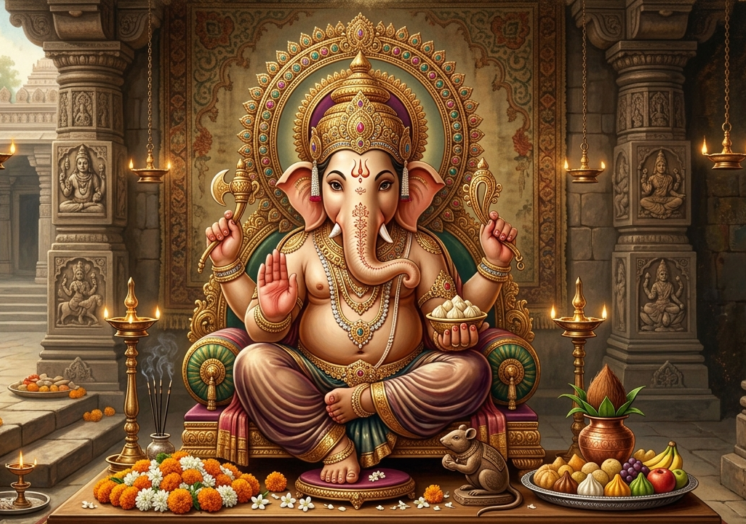
Why is Ganesh Chaturthi Celebrated?
The festival of Ganesh Chaturthi is primarily celebrated as the birth anniversary of Lord Ganesha. According to the Hindu calendar, Lord Ganesha—the deity of wisdom, prosperity, and the remover of obstacles—manifested on the Chaturthi date of the Shukla Paksha in the month of Bhadrapada.
1. Mythological Legend and Origin :-
According to mythological beliefs, Goddess Parvati created the form of a young boy using the herbal paste (a mix of sandalwood and turmeric) from her body and breathed life into him. Goddess Parvati appointed him as her guard and commanded him not to allow anyone inside.
When Lord Shiva arrived, the young boy Ganesha stopped him from entering. Enraged by this, Lord Shiva severed the boy’s head with his trident. Seeing Goddess Parvati deeply grieved, Lord Shiva restored the boy’s life by attaching the head of an elephant (Gaja) to his body. The deities blessed Lord Ganesha with the boons of being “Pratham Pujya” (the first to be worshiped) and “Vighnaharta” (the remover of all obstacles).
2. Social and Historical Significance :-
Beyond its religious aspect, this festival carries great historical and social importance. In 1893, freedom fighter Lokmanya Bal Gangadhar Tilak transformed the private celebration of Ganesh Utsav into a grand public event. He used this festival as a mass movement to bring people together on a common platform against British colonial rule, igniting national consciousness and social solidarity.
Today, this festival is celebrated with immense devotion, joy, and cultural pride not only in India but all across the globe. During this 10-day-long festival, idols of Lord Ganesha are consecrated in homes and pandals, and on the day of Anant Chaturdashi, he is given a heartfelt farewell through ritual immersion (Visarjan).