
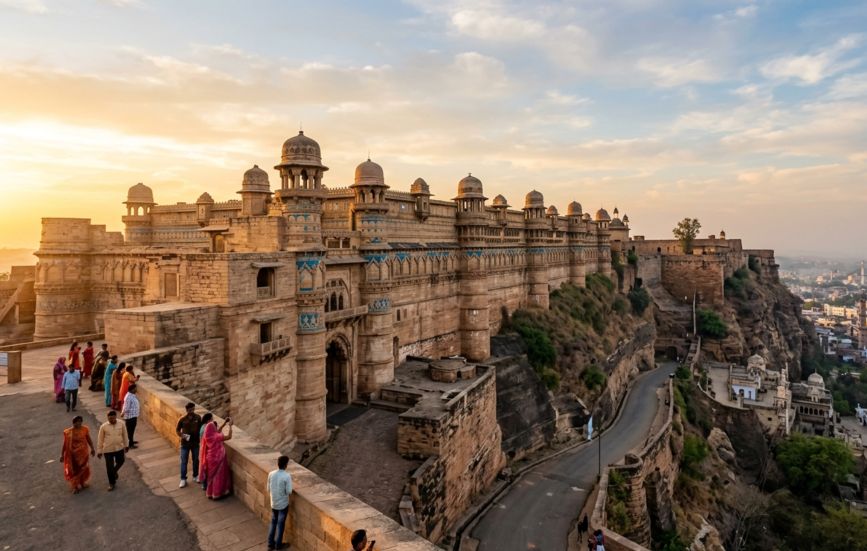
Gwalior Fort, Gwalior :- A Complete Guide
Following the grand historical monuments of Uttar Pradesh, Delhi, and Rajasthan, let us turn towards Madhya Pradesh, where the historic city of Gwalior anchors one of the largest and most strategically significant forts in India—Gwalior Fort. Perched high upon an isolated, precipitous sandstone hill called Gopachal, its sheer structural grandeur and invincibility led Mughal Emperor Babur to describe it as “The Pearl in the Necklace of the Castles of Hind.” Blending Rajput, Tomar, and Mughal architectural configurations, this fort stands as a living witness to centuries of imperial Indian history.
Detailed History :-
The historical roots of Gwalior Fort are ancient and glorious. While the exact timeline of its initial construction remains a subject of historical debate, local folklore and inscriptions credit its foundation to King Suraj Sen during the 3rd or 4th century AD. Legend has it that the king was cured of a deadly leprosy affliction by a revered hermit named ‘Gwalipa‘, who offered him holy water from a secluded pond (now known as Suraj Kund). In deep gratitude, the king named the settlement ‘Gwalior‘ after the sage and fortified the hill.
Over the subsequent centuries, this strategic bastion witnessed the rise and fall of multiple dynasties, including the Hunas, Gurjara-Pratiharas, Tomars, Lodhis, Mughals, Marathas (Scindias), and the British. The fort experienced its architectural and cultural golden era during the 15th century under the reign of Maharaja Man Singh Tomar. In modern history, the fort holds legendary significance as it was from this very stronghold that Rani Lakshmibai of Jhansi launched her fierce, final stand against British forces during the First War of Indian Independence in 1857.
Detailed Architecture :-
Spanning roughly 3 kilometers along the hilltop, the structural design of Gwalior Fort is a masterful fusion of military defense layouts and artistic stonework. Constructed primarily of solid sandstone, the complex is broadly categorized into protective outer ramparts and internal royal palaces.
- The Main Gateways :– The fort is accessible via two distinct transit routes. The northeastern route, starting from the ‘Gwalior Gate‘ (Ladha Gate), requires navigating through a sequence of six historic defensive gates. The western route opens at the ‘Urvai Gate‘, providing a smoother incline paved directly for vehicular access.
- Man Mandir Palace :– Erected by Raja Man Singh Tomar, this palace is the architectural crown of the fort. Its massive outer walls are beautifully embellished with vibrant blue, yellow, and green enameled ceramic tiles depicting ducks, elephants, and peacocks that retain their brilliance to this day. Beneath the palace lie dark, multi-tiered subterranean vaults that the Mughals later converted into a high-security prison, where Emperor Aurangzeb incarcerated his nephew Suleiman Shikoh.
- Gujari Mahal :– This palace was custom-built by Raja Man Singh for his beloved queen, Mrignayani, belonging to the Gujar clan. Engineered with immense structural resilience, this palace has been systematically converted into a premier Archaeological Museum, housing the globally acclaimed ‘Shalabhanjika’ sculpture, often hailed as the ‘Mona Lisa of India’.
- Sas-Bahu and Teli Ka Mandir Shrines :– These temples are architectural masterpieces within the fort perimeter. The 11th-century Sas-Bahu Temple (originally Sahastrabahu, dedicated to Lord Vishnu) is celebrated for its deep, multi-layered stone carvings. Conversely, the 8th-century Teli Ka Mandir features an unusual blend of North Indian (Nagara) and South Indian (Dravidian) structural styles, standing proud as the tallest monument on the fort grounds.
- Rock-Cut Jain Colossi at Gopachal & Urvai :– Along the rock cliffs of the Urvai ascent, visitors encounter monumental Jain Tirthankara figures carved directly into the living rock face. The collection features a towering 47-foot-tall monolith of Lord Parshvanath, sculpted during the peak of the Tomar dynasty in the 15th century.
Travel Guide & Routes :-
Tickets & Entry :–
- For Indian Citizens :– ₹25 per individual (for entering the core palace zones).
- For Foreign Nationals :– ₹300 per individual.
- Museum (Gujari Mahal) Ticket :– ₹10 per individual.
- Camera/Photography Fee :– Standard photography using smartphones or digital cameras is completely free of charge.
Timings :–
- Visiting Hours :– Open daily from 06:00 AM to 05:30 PM.
- Operational Days :– The fort remains open to tourists 365 days a year. A spectacular Sound and Light Show is hosted on the lawns during the evenings.
How to Reach :–
- By Railway :– Gwalior Junction is centrally connected to all metropolitan and tier-1 Indian cities. The railway station is situated just 4 kilometers away from the base of the fort, where local transport options are plenty.
- By Air :– Gwalior’s Rajmata Vijaya Raje Scindia Airport is located roughly 10 kilometers away from the fort, with app-based cabs operating smoothly from the arrival gates.
- By Road/E-rikshaw :– Commuters can easily hail local autos or e-rickshaws from prime city squares up to the western Urvai Gate. Hiring a private cab or a dedicated auto-rickshaw to head up the steep incline is highly recommended, as the pedestrian gradient is considerably steep.
Photography Spots :–
- The Outer Facade of Man Mandir Palace :– Capturing the iconic sandstone walls accented by turquoise tile mosaics and elephant borders.
- The Ornate Pillar Complexes of Sas-Bahu Temple :– Where early morning sunlight streams through the stone screens, creating dramatic lighting for architectural frames.
- The Fort Parapets :– Offering breathtaking aerial vistas of the entire sprawling cityscape of Gwalior below.
Local Food & Shopping :–
- Local Cuisines :– Gwalior is a paradise for traditional street food lovers. When visiting the markets near the fort base, sampling the legendary Bedhai (crisp lentil-stuffed puris served with spicy potato curry), fresh Poha-Jalebi, and the city’s globally famous winter dessert, Gajak, is an absolute must.
- Famous Markets :– Situated right below the hill, ‘Maharaj Bada’ is the prime lifestyle and shopping hub of Gwalior. It is highly famous for traditional handloom Chanderi and Maheshwari sarees, authentic leather craftwork, and traditional Indian textiles.
Interesting Facts :-
- The Oldest Written Inscription of ‘Zero’ :– Inside the small 9th-century Chaturbhuj Temple located along the fort’s eastern access pathway, an inscription features one of the oldest recorded and physically surviving depictions of the mathematical symbol ‘Zero’ (0) in human history.
- The Mughal Imperial Dungeon :– During the Mughal era, the fort functioned as an elite maximum-security imperial prison where royal captives were routinely drugged with slow-acting opium-infused water to systematically degrade their physical and mental capacities.
- Gurudwara Data Bandi Chhor :– The fort holds immense spiritual significance for Sikhs; it was here that Mughal Emperor Jahangir imprisoned the sixth Sikh Guru, Guru Hargobind Sahib Ji. Upon his eventual release, the Guru successfully negotiated the liberation of 52 captive Hindu kings, commemorated by a beautiful, expansive Gurudwara on the hill.
Important Questions and Answer :-
Question 1:– Why is Gwalior Fort universally acclaimed as the “Pearl among Forts”?
Answer:- Its massive impregnable defenses, vast strategic elevation, and the striking blue enameled tile mosaics decorating the exterior walls of its palaces led Mughal Emperor Babur to crown it as a distinct pearl in the armor of Indian military fortifications.
Question 2:– Are private passenger vehicles permitted to drive up to the fort summit?
Answer:- Yes, the western approach via the Urvai Gate features a fully asphalted, well-maintained mountain road that permits cars, motorcycles, and local auto-rickshaws to drive straight up to the main ticket booth of the palace complexes.
Question 3:- What makes the evening Sound and Light Show at Gwalior Fort a must-watch?
Answer:- Narrated in the deep, cinematic baritone of superstar Amitabh Bachchan, the show dynamically brings to life the fort’s rich history, the royal romance of Raja Man Singh and Queen Mrignayani, and the historic battles fought across its ramparts.
“Standing proud upon the rugged cliffs of Gopachal Hill, Gwalior Fort remains a majestic sentinel of India’s military valor, royal romances, and timeless architectural brilliance that refuses to fade under the mist of centuries.”