
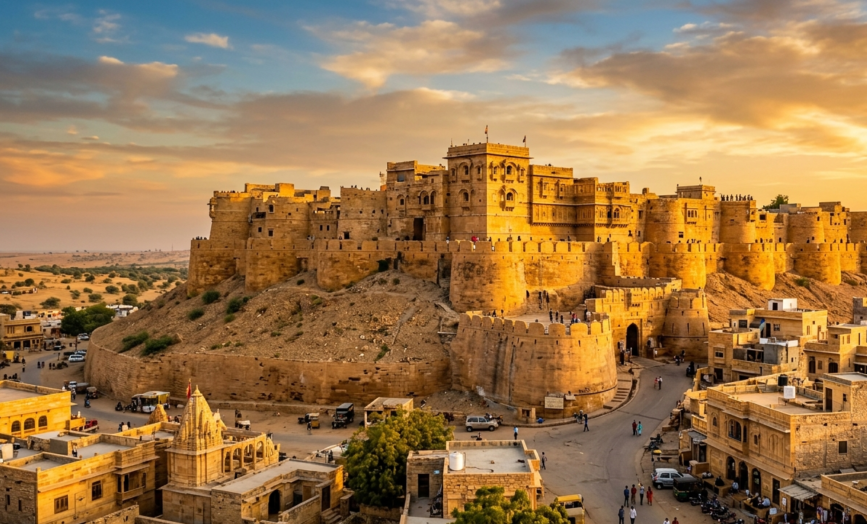
Jaisalmer Fort (Sonar Qila), Jaisalmer :- A Complete Guide
Following the historic Red Fort of Delhi, let us redirect our gaze toward the desert jewel of Rajasthan, often referred to as the ‘Rose of the Desert‘. Proudly perched on the Trikuta Hill amidst the expansive Thar Desert, Sonar Qila (also known as Jaisalmer Fort) stands as one of the largest and most astonishing fortifications in the world. Constructed entirely of golden-yellow sandstone, the fortress shimmers like pure gold under the blazing sun, rightfully earning its titles: ‘Sonar Qila‘ or ‘The Golden Fort‘. Remarkably, it is one of the very few surviving ‘Living Forts‘ across the globe, housing nearly one-fourth of the old city’s population within its historic walls. In 2013, UNESCO designated it a World Heritage Site.
Detailed History :-
The historical lineage of Sonar Qila is deeply intertwined with tales of unparalleled courage, chivalry, and Rajput sovereignty. The construction of this monumental fort was initiated on July 12, 1156, by the Bhati Rajput ruler, Rawal Jaisal. Prior to this development, the Bhati capital was centered at Lodhruva, a location highly vulnerable to external onslaughts. Recognizing the immense strategic advantage of the isolated Trikuta hillock, Rawal Jaisal laid the foundation stone of this legendary citadel, giving birth to the city of ‘Jaisalmer‘.
Strategically located along the ancient and prosperous ‘Silk Road‘ trade route, the fort emerged as a thriving commercial and cultural oasis. Throughout its tumultuous history, the fort faced multiple fierce sieges and military blockades, witnessing three tragic historic ‘Jauhars’ (where royal Rajput women valiantly embraced fire to safeguard their honor from invading forces). Braving centuries of imperial friction, the fort continues to stand tall as an eternal symbol of Marwar’s resilient past.
Detailed Architecture :-
Spanning approximately 1,500 feet in length and 750 feet in width, the fort’s layout is a brilliant manifestation of medieval military engineering and artistic stone masonry. The most groundbreaking architectural feature of this massive fortress is that no mortar, lime, or cement was used in its construction; instead, massive blocks of yellow stone were meticulously interlocked using a precise structural groove system.
- Defensive Ramparts and the 99 Bastions :– The fort is fortified by double and triple-layered stone walls. Its imposing exterior perimeter is defined by 99 massive stone bastions, 92 of which were added or reinforced by later rulers. These bastions encircle the hill like a giant crown.
- The Royal Gateways :– To reach the inner palace courtyards, visitors must navigate through four successive, high-security structural gateways called Akshai Pol, Suraj Pol, Ganesh Pol, and Hawa Pol. The approach pathways are intentionally curved to prevent enemy war elephants from gaining momentum for a direct ramming attack.
- The Raj Mahal (Fort Palace) :– The crowning jewel of the interior is the seven-story-tall Maharawal Palace. Its high facades, balconies, and projecting jharokhas (windows) feature deep, gossamer stone lattices carved so finely that the sandstone resembles delicate woodwork.
- The Heritage Jain Temples :– Nestled inside the fort is a cluster of seven intricately carved Jain temples dating from the 12th to the 15th centuries. Sculpted out of golden stone using the legendary Dilwara architectural style, these shrines, dedicated to Tirthankaras like Lord Parshvanath and Sambhavanath, are celebrated globally for their artistic precision.
Travel Guide & Routes :-
Tickets & Entry :–
- Fort Ground Entry :– Since it is a completely functional living township, accessing the residential streets and general markets of the fort is completely free of charge.
- Fort Palace Museum Ticket :– ₹100 for Indian Nationals and ₹500 for Foreign Nationals (which includes an interactive audio guide).
- Jain Temple Entry :– ₹20 to ₹50 per individual.
- Camera/Photography Fee :– Carrying smartphones or digital cameras inside the core museum galleries incurs a charge ranging between ₹100 and ₹250.
Timings :–
- Operational Hours :– The Fort Palace Museum and Jain Shrines remain open from 09:00 AM to 06:00 PM daily. However, the fort perimeter streets remain open 24/7 for residents and general visitors.
- Operational Days :– The complex welcomes tourists 365 days a year.
How to Reach :–
- By Railway :– Jaisalmer Railway Station is directly connected via express trains to metropolitan hubs like Delhi, Jaipur, and Jodhpur. The fort is situated a mere 2 kilometers away from the station gates.
- By Road/E-rikshaw :– The central interstate bus terminal is in close proximity to the hill base. Commuters can easily hail local auto-rickshaws or eco-friendly e-rickshaws from any part of the city to reach the main entrance gate (Akshai Pol) quickly and affordably.
- By Air :– Jodhpur Airport serves as a major gateway, while Jodhpur Domestic Airport is located 12 kilometers away from the city center, offering smooth cab operations.
Photography Spots :–
- From the Banks of Gadisar Lake :– Capturing the distant reflection of the glowing Golden Fort rising over the calm morning waters creates a magical cinematic landscape.
- The Bastion Sunset Points :– Watching the sunset from the fort ramparts when the fading rays strike the yellow sandstone, turning the entire fort into a shimmering block of solid gold.
- The Jharokhas of Hawa Pol :– Perfect for capturing close-up portrait shots against the backdrop of ancient royal stone lattices.
Local Food & Shopping :–
- Local Cuisines :– After exploring the fort lanes, trying the city’s iconic, ultra-creamy ‘Makhaniya Lassi’ is highly recommended. Traditional Rajasthani royal platters featuring Dal-Baati-Churma, Ker-Sangri (desert beans), and Gatte ki Sabzi can be savored at various rooftop heritage restaurants that offer panoramic views of the fort.
- Famous Markets :– The bustling traditional bazaars within and just outside the fort gates, such as Sadar Bazar, Bhatia Bazar, and Pansari Bazar, are legendary. They are highly popular for yellow sandstone artifacts, embroidered camel-leather Mojris (footwear), vibrant Bandhej textiles, and hand-crafted leather goods.
Interesting Facts :-
- Satyajit Ray’s Cinematic Tribute :– The legendary Indian filmmaker Satyajit Ray was so spellbound by the fortress that he authored a famous mystery novel titled ‘Sonar Kella’ (The Golden Fortress) and later directed an iconic, award-winning movie of the same name, catapulting this fort onto the global tourism map.
- Mortarless Interlocking Architecture :– The giant structural walls of Sonar Qila hold together without a single ounce of mortar, lime, or cement; the stone slabs are carved into perfect geometric slots and grooved into place like a giant puzzle.
- The Vaulted Gyan Bhandar Library :– Hidden deep underneath the subterranean vaults of the fort’s Jain temples lies ‘Gyan Bhandar’, a highly secure, centuries-old library that preserves incredibly rare, ancient palm-leaf manuscripts in immaculate condition.
Important Questions and Answer :-
Question 1:– What exactly makes Jaisalmer’s Sonar Qila a unique ‘Living Fort’?
Answer:- Unlike most historical forts that function strictly as vacant public monuments, Sonar Qila is an active, living ecosystem. Nearly 25% of Jaisalmer’s local population resides permanently inside the fort, operating ancestral homes, homestays, spice shops, and multi-cuisine cafes within the historic walls.
Question 2:– Is winter considered the absolute best season to plan a journey to Jaisalmer?
Answer:- Yes, because Jaisalmer is positioned deep within the arid landscape of the Thar Desert, summer temperatures routinely breach a punishing 45°C. The winter months between October and March offer exceptionally pleasant, cool weather perfect for sightseeing.
Question 3:– Are commercial tourist cars or traveler vans allowed inside the fort?
Answer:- No, the interior residential alleyways of the fort are extremely narrow, steep, and winding. Heavy vehicles are strictly barred from entering; only local two-wheelers and compact auto-rickshaws can navigate inside, making walking the finest way to explore.
“Draped in a golden shroud of sandstone amidst the endless ripples of the Thar Desert, Sonar Qila stands as a magnificent living canvas of Rajput valor, interlocking architectural wonder, and a golden chapter of timeless history.”