
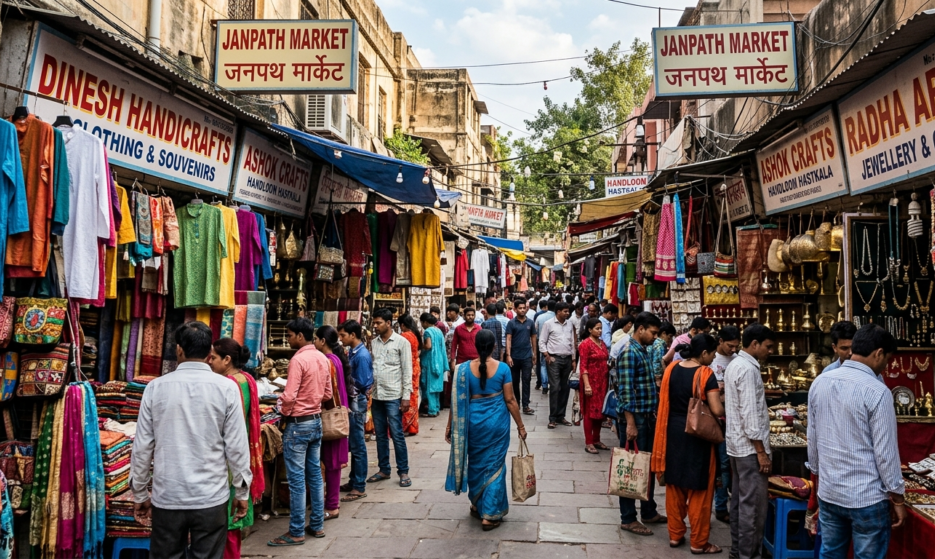
Janpath Market, New Delhi :- The Historic Soul of Capital’s Street Shopping and Cultural Confluence
Situated directly adjacent to the historic colonnades of Connaught Place in the heart of Lutyens’ Delhi, Janpath Market stands as one of the oldest, most vibrant, and historically rich commercial corridors in the capital. Literally translating to “The People’s Path,” Janpath is far more than a conventional shopping avenue; it is a profound cultural artery where vintage antiquities, esoteric Tibetan crafts, and contemporary high-street fashion seamlessly merge. For anyone wishing to touch the authentic urban pulse of New Delhi while discovering one-of-a-kind treasures, Janpath remains an absolute sanctuary.
Detailed History
The operational and spatial lineage of Janpath Market is deeply embedded in the grand architectural design of British New Delhi.
- Colonial Nomenclature and Genesis :– During the British Raj, when Sir Edwin Lutyens was executing the blueprint for the new imperial capital, this grand north-south axis was designated as ‘Queensway’. Following India’s independence in 1947, the avenue was aptly renamed ‘Janpath’ to mirror democratic ideals. This iconic path run perpendicular to Rajpath (now Kartavya Path), intersecting the core power corridors of the nation.
- The Influx of Refugees and Tibetan Artisans :– In the early 1950s, following the partition of the subcontinent, the government allotted small commercial parcels along this avenue to displaced merchant families from Pakistan. Later, in 1959, following the geopolitical shifts in Tibet, numerous Tibetan refugees and master craftsmen settled here, establishing the legendary ‘Tibetan Market’ segment which introduced a distinct cultural aesthetic to Delhi’s retail landscape.
- Evolution into a Global Retail Node :– Over the subsequent decades, Janpath evolved from a localized cluster of makeshift kiosks into a world-renowned open-air street market. Today, it serves as a primary destination for international dignitaries, diplomats, and global travelers looking to explore authentic Indian heritage, textiles, and artisanal crafts.
Detailed Architecture
The spatial layout of Janpath Market follows a distinct linear street grid (Linear Street Layout), offering a fascinating juxtaposition of structured neo-classical showrooms and dense, organic pavement stalls.
- Spatial Matrix and Segmented Layout :– The commercial strip runs along Janpath Road and is structurally categorized into five distinct thematic zones. The western edge is anchored by the massive white pillars, deep verandahs, and soaring arches of colonial-era masonry housing premium showrooms, while the eastern fringes are lined with tightly packed, semi-permanent open-air kiosks.
- Key Visual Segments :–
- The Tibetan Market Cluster :– A dense, high-proximity row of small shops dominated by dark wood panels, brass hanging racks, and a distinct aroma of incense, capturing an old-world Himalayan aesthetic.
- The Gujarati and Rajasthani Artisanal Lane :– The most visually arresting, highly saturated segment of the market, where walls and pavements are completely draped in multi-colored mirror-work fabrics, intensive hand-embroidery, and traditional patchwork textiles.
- The Central Street Apparel Rows :– An open-format street layout packed with metal clothing racks, vertical accessory hangings, and contemporary street fashion.
- Environmental Context :– The entire pedestrian walkway is flanked by ancient, deep-rooted canopy trees that provide a natural microclimate shield during intense Delhi summers. The exterior display architecture relies heavily on visual maximizing—where brass lamps, heavy metallic necklaces, vintage clocks, and intricate wooden masks are suspended over the avenues, creating an immersive, museum-like walking experience.
Travel Guide & Routes
To plan a highly efficient, organized, and structurally logical exploration through the pathways of Janpath Market, refer to this detailed travel index.
- Market Timings :–
- The retail complex is operational from 11:00 AM to 09:00 PM daily.
- Weekly Holiday :– Janpath Market is officially closed on Sundays. While the permanent showrooms, heritage stores, and the Tibetan Market segment remain completely shut on Sundays, a few independent street vendors and Gujarati textile sellers occasionally mount informal pavement displays during the late evening hours.
- Entry Fee :–
- Access to this public historic commercial district is completely Free of Charge.
- How to Reach :–
- By Metro (The Most Recommended Node) :– The market is directly serviced by the Janpath Metro Station, located on the Violet Line. Alternatively, the city’s largest multi-level metro interchange, Rajiv Chowk Metro Station (Blue Line/Yellow Line), is located just a brief 5 to 7-minute pedestrian walk from the northern entrance of Janpath.
- By Road/Bus :– Situated at the absolute geographic center of New Delhi, it is highly accessible via app-based cabs, local auto-rickshaws, and numerous DTC buses routing through the Connaught Place and Janpath outer terminals.
- Photography Spots :–
- The Gujarati Lane Tapestries :– The intense geometric patterns, reflective mirror surfaces, and rich, hand-dyed indigos of the hanging textiles offer an exceptionally high-contrast backdrop for street portraiture.
- The Vintage Curio Displays :– The dense arrangements of tarnished silver jewelry, old monocles, antique compasses, and raw brass statuettes provide ideal frames for macro and antique-style photography.
- The Tibetan Artifact Frontages :– The intricate iconography of Buddhist thangka paintings, bronze prayer wheels, and rows of colorful turquoise and coral beads catch natural light beautifully for rich cultural frames.
- Local Flavors (Iconic Food Stops) :– To supplement your retail exploration, Janpath hosts several legendary multi-generational culinary nodes:
- Depaul’s :– No visit to Janpath is complete without experiencing this legendary establishment, world-famous for its signature glass-bottled Cold Coffee paired with crisp paneer sandwiches. It has remained an absolute rite of passage for Delhi students for decades.
- The Tibetan Nook :– Tucked away near the handicraft rows, these micro-stalls serve steaming hot, authentic Himalayan momos and rich, comforting bowls of Thukpa noodle soup.
- Main Street Chaat Counters :– Famous across the central district for dishing out crisp, fiery aloo kachoris, iced golgappas, and tangy, spice-infused bhalla-papri chaat.
- Famous Specialized Items to Shop :–
- Himalayan & Tibetan Handicrafts :– Authentic ceremonial singing bowls, heavy brass deity structures, handcrafted incense holders, and intricate silver trinkets.
- Vintage Curios & Antiquities :– Retro pocket watches, mechanical gramophones, historic coins, old-form nautical compasses, and genuine leather-bound journals.
- Regional Heritage Textiles :– Intricately embroidered Gujarati chaniya-cholis, Rajasthani block-print tunics, mirror-work wall hangings, and heavy Jaipuri bedspreads.
- High-Street Western Apparel :– Distressed contemporary denims, casual linen shirts, bohemian summer dresses, and current seasonal sunglasses.
Nearby Attractions
Thanks to its strategic geographic placement within the historic core of New Delhi, a tour of Janpath Market can be effortlessly combined with these iconic landmarks.
- Connaught Place (CP) :– Located immediately at the northern terminus of Janpath, this grand Georgian-style circular financial district is celebrated for its heritage corporate architecture, upscale restaurants, and central park.
- Jantar Mantar :– Situated just 1 kilometer away, this extraordinary 18th-century open-air equinoctial observatory was constructed by Maharaja Jai Singh II of Jaipur to chart astronomical tables.
- Gurudwara Bangla Sahib :– Located roughly 1.5 kilometers away, this majestic golden-domed Sikh shrine is renowned for its vast, serene holy pool (Sarovar) and its massive community kitchen (Langar) that feeds tens of thousands daily.
- National Museum :– Situated 1.8 kilometers down the southern stretch of Janpath Road, this premier institution houses an unparalleled repository of India’s historical treasures, spanning from the Indus Valley Civilization to rare archaeological artifacts.
Interesting Facts
- The Diplomatic Shopping Hub :– Due to its close proximity to Chanakyapuri (the diplomatic enclave) and major luxury heritage hotels in Central Delhi, Janpath acts as the primary street retail node for foreign diplomats, global tourists, and international flight crews looking for authentic Indian souvenirs.
- The Premium Surplus Matrix :– While it shares similarities with markets like Sarojini Nagar regarding export surplus garments, Janpath is highly regarded for sourcing higher-grade apparel production overruns, which typically exhibit superior fabric quality and fewer structural flaws.
- Acoustic Meditation Instruments :– The market is one of the largest retail centers for authentic Tibetan Singing Bowls. When rubbed with a wooden mallet, these specialized alloy bowls emit sustained, deep harmonic frequencies utilized worldwide for sonic therapy, mindfulness, and deep meditation practices.
Important Questions and Answer
Question 1:- Is intensive bargaining a mandatory requirement when shopping at Janpath Market?
Answer:– Yes, active negotiation is an absolute prerequisite when dealing with the open-air pavement stalls, the street apparel rows, and the Gujarati textile sellers. Vendors frequently quote inflated initial figures—particularly to international travelers. Experienced shoppers can comfortably negotiate the final price down by 40% to 50%. However, the established, indoor antique showrooms and government-approved craft emporiums maintain strict fixed-price regimes.
Question 2:– What is the most strategic time of day to plan an optimal excursion to Janpath?
Answer:– The ideal time window is during the late afternoon from 03:00 PM to 07:00 PM. During this period, the intense ambient heat subsides, the natural lighting accents the colorful street displays perfectly, and the market atmosphere reaches its peak cultural vibrancy.
Question 3:- Are digital UPI payment applications universally accepted, or is physical cash required?
Answer:– A vast majority of permanent shopkeepers and established kiosk operators readily accept UPI transactions (such as Google Pay, PhonePe, and Paytm). However, for low-value purchases within the high-density Gujarati lane or from independent pavement vendors, physical cash remains highly preferred. Furthermore, due to the high density of structural concrete in Central Delhi, cellular networks can occasionally experience lag, making it wise to carry a base reserve of physical cash.
Author’s Thoughts
From an analytical perspective, Janpath Market is far more than a high-velocity retail corridor; it serves as a fascinating living bridge that spans the gap between imperial colonial architecture and raw, democratic street expression. While one turn reveals the sweeping, pristine white arches of Connaught Place, a single step onto the pavements of Janpath plunges you into an organic sensory explosion of rich rustic dyes, metallic clattering of antique brass, and the soothing hum of Himalayan singing bowls. The true architectural and cultural genius of this market rests in its absolute diversity—it is a space where an individual can source a cutting-edge contemporary high-street jacket on one rack, and unearth a centuries-old maritime compass on the very next stall. It resists the sterile, monotone nature of modern shopping malls, offering instead an earthy, tactile encounter with living history. For anyone seeking to experience how Delhi gracefully balances its complex historical layers with modern urban life, a walk down Janpath is an unmissable pilgrimage.
S“Where the grand symmetry of Lutyens’ Delhi dissolves into a kaleidoscopic maze of ancient curios, rich regional weaves, and timeless street charm—that is the enduring magic of Janpath Market.”