
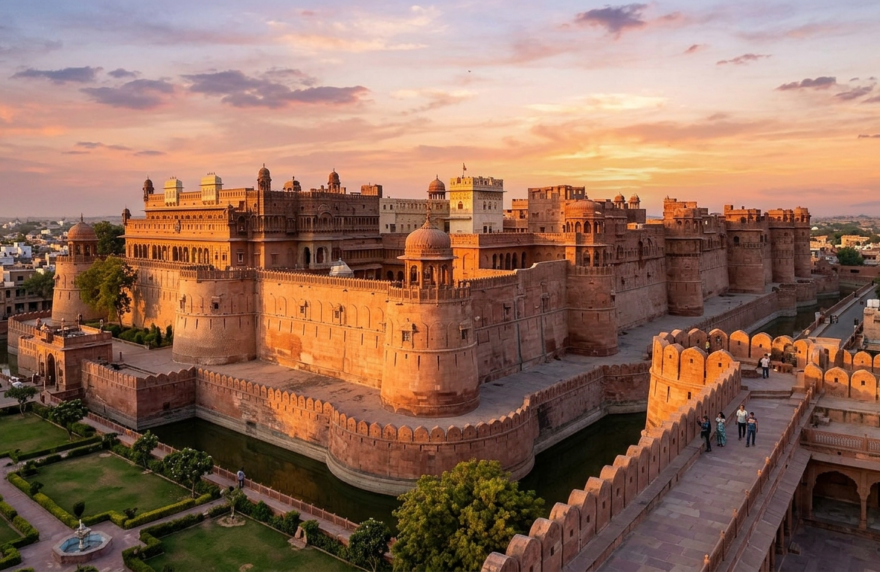
Junagarh Fort :- The Peerless Heritage of Bikaner
Detailed History
Unlike many other forts in Rajasthan, Junagarh Fort is not built on a hilltop but on flat ground. It is often referred to as ‘Zamin ka Zevar‘ (Jewel of the Earth). Its construction was carried out between 1589 and 1594 by Raja Rai Singh of Bikaner, who was a high-ranking general in the army of Mughal Emperor Akbar. The most remarkable feature of this fort is that despite several invasions throughout history, no external invader was ever able to fully conquer it. Originally known as ‘Bikaner Fort‘, it was renamed ‘Junagarh‘ (Old Fort) in the 20th century when the rulers moved to the new Lalgarh Palace.
Detailed Architecture
Exterior Architecture :– The fort is constructed from red sandstone and carved marble. Its outer walls span 986 meters and feature 37 bastions built for defense. The main entrances are called ‘Karan Pol‘ and ‘Suraj Pol‘. Suraj Pol bears the ‘Rai Singh Prashasti‘, a stone inscription praising Raja Rai Singh.
Interior Architecture :– The palaces inside the fort are renowned for their delicate carvings and vibrant paintings:
- Anup Mahal :– Known for its extensive gold leaf work and glass decorations. It served as the coronation chamber for the rulers of Bikaner.
- Badal Mahal :– The walls are painted with blue clouds and lightning, designed to evoke the feeling of the monsoon during hot summers.
- Phool Mahal :– Features floral motifs and carvings so intricate that they still look fresh today.
- Gaj Mandir :– Built by Raja Gaj Singh, this palace is famous for its ivory work and beautiful balconies (Jharokhas).
Travel Guide & Routes
- Ticket :– Approximately ₹50 for Indian tourists and ₹300 for foreign tourists. Additional fees apply for cameras and the museum.
- Visiting Time :– 10:00 AM to 4:30 PM.
- How to Reach :– The fort is just 2 km away from Bikaner Railway Station. You can easily reach it by auto or e-rickshaw. Bikaner is well-connected by road and rail to Jaipur and Delhi.
- Photography Spots :– The blue walls of Badal Mahal, the golden work of Anup Mahal, and the elephant statues at the entrance.
- Local Taste :– A visit to Bikaner is incomplete without trying the famous ‘Bikaneri Bhujia’, ‘Rasgullas’, and ‘Ghevar’.
- Famous Market :– ‘Kote Gate‘ is the primary market where you can buy camel hide products (Usta Art) and traditional Rajasthani Mojaris.
Author’s Perspective :-
In terms of interior decoration, Junagarh Fort stands far ahead of many other Rajasthani forts. While others symbolize war and power, Junagarh mesmerizes with its artistry and luxury. Its museum is one of the best-organized in India, and seeing the DH-9 DE Havilland aircraft from World War I preserved there is a truly unique experience.
Interesting Facts
- Junagarh Fort houses a very old elevator, which reflects the modernization efforts of the era.
- The ceiling of the ‘Ganga Niwas‘ hall features wooden carvings that are held together without the use of a single nail.
Important Questions and Answer :-
Question 1:- What was the original name of Junagarh Fort?
Answer:- It was originally known as ‘Bikaner Fort’.
Question 2:- Why is this fort called ‘Zamin ka Zevar’?
Answer:- Because it is situated on flat land and its architectural beauty makes it shine like a jewel.
“If you wish to see the magic of carvings on desert sand, Junagarh is a must-visit.”