
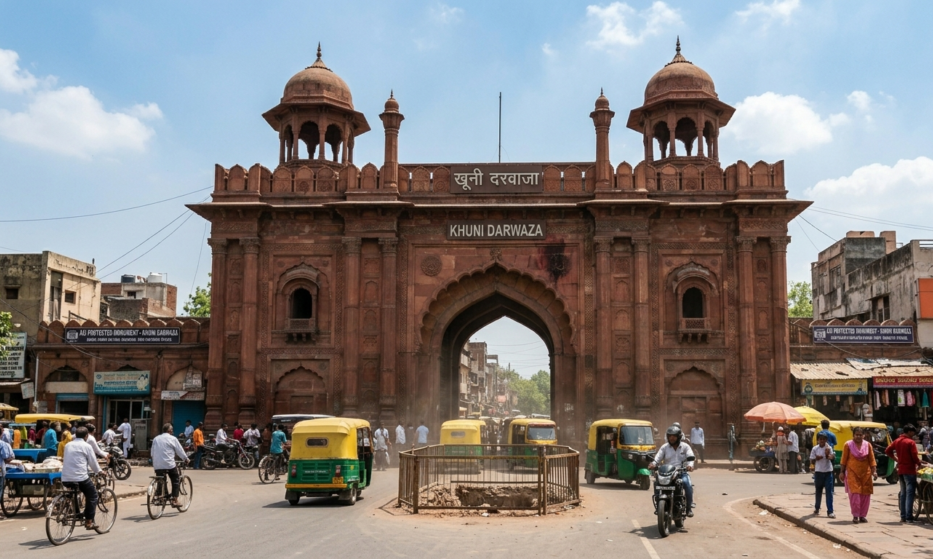
The Saga of Historic Khooni Darwaza :- History, Architecture, and Complete Travel Guide
Detailed History :-
Khooni Darwaza (The Bloody Gate), also known as ‘Lal Darwaza‘, is a prominent monument encapsulating one of the most mysterious, historic, and eerie pasts of Delhi. This historical gateway is located on Bahadur Shah Zafar Marg, right next to the Feroz Shah Kotla Fort. The gate was constructed in the 16th century by Sher Shah Suri, the founder of the Suri Dynasty. After defeating Humayun and seizing control of Delhi, Sher Shah Suri established his new city named ‘Shergarh‘ (the area around present-day Old Fort and its vicinity). Khooni Darwaza served as a primary entrance to this fortified city of Shergarh.
The prefix ‘Khooni’ (Bloody) was attached to this gate due to several tragic and gruesome historical events that unfolded here. From the Mughal era to the British Raj, this gate became a site for major massacres and executions of princes:
- The Mughal Emperor Jahangir ordered the execution of two sons of Abdul Rahim Khan-i-Khana (one of Akbar’s Navratnas) and left their bodies to rot at this gate because they had supported a rebellion against him.
- Aurangzeb, after defeating his elder brother Dara Shikoh in the war of succession, displayed his severed head at this very gate to the public.
- The most talked-about and final bloody chapter of this gate is associated with the First War of Indian Independence in 1857. British Captain William Hodson captured two sons (Mirza Mughal and Mirza Khizr Sultan) and a grandson (Mirza Abu Bakr) of the last Mughal Emperor Bahadur Shah Zafar from Humayun’s Tomb. While escorting them to the Red Fort, Hodson stopped his carriage near this gate. Without any trial, he shot the three Mughal princes in cold blood and displayed their corpses in front of this gate for three days. Following this brutal event, the structure was permanently named ‘Khooni Darwaza’.
Detailed Architecture :-
The architecture of Khooni Darwaza is a highly robust and excellent example of Suri and Afghan architectural styles. Its structural design is a unique blend of security and grandeur.
- Construction Material :– Quartzite stone and local red sandstone were primarily used to build this massive three-story structure. Owing to the durability of these stones, the building stands as firm as ever even after centuries.
- Exterior Architecture :– Khooni Darwaza stands at a height of approximately 15.5 meters (51 feet). It is a three-story structure featuring internal staircases to access the upper levels. The façade boasts beautiful arched windows and balconies reflecting traditional Afghan architecture. Its ramparts and battlements were crafted to be exceptionally strong, allowing soldiers to securely keep a vigil on incoming enemies.
- Interior Architecture :– The interior comprises arched guard rooms and sentry posts on different floors. The stone staircases are remarkably narrow. The heavy wooden panels of its main gateway were built to be extremely sturdy, remaining completely barred during times of war. The color and texture of this building evoke a profound sense of gravity and history.
Travel Guide & Routes :-
If you wish to experience this deep chapter of Delhi’s history up close, here is a complete travel guide.
- Entry Fee :– There is no fee of any kind to view Khooni Darwaza from the outside and take photographs. It is entirely Free for all tourists.
- Visiting Time :– Situated by the side of a main road, it can be viewed from outside 24 hours a day. However, due to safety reasons, the Archaeological Survey of India has restricted entry into the interior chambers and staircases. The best time to visit and photograph it is from 07:00 AM to 06:00 PM.
- How to Reach :– Being centrally located in Delhi, reaching here is highly convenient:
- By Metro :– The nearest metro station is ‘Delhi Gate’ on the Violet Line. The monument is just 500 meters away from the metro station, from where you can walk or take an e-rickshaw in under 2 minutes. Alternatively, ‘Pragati Maidan’ (Supreme Court) metro station on the Blue Line is also close by.
- By Bus & Auto :– Positioned on Bahadur Shah Zafar Marg, direct buses from all corners of Delhi are readily available. You can also comfortably reach here by booking a cab or taking an auto-rickshaw directly from New Delhi Railway Station.
- Photography Spots :– The entire perspective of this three-story structure can be captured beautifully from the pavement across the main road. The morning light beautifully highlights the finer details of its rugged stone masonry.
- Local Food :– The nearby localities of Daryaganj and Mandi House house several excellent restaurants and cafes. For those yearning for the authentic culinary legacy of Old Delhi, the legendary food lanes near Jama Masjid are just 1.5 km away, offering stellar Mutton Kebabs, Chicken Korma, and Shahi Tukda.
- Famous Markets :– The famous Daryaganj Book Market and Sunday Market are located in close proximity. Furthermore, ‘Chandni Chowk’ and ‘Connaught Place’ (CP) are excellent nearby options for extensive shopping.
Nearby Attractions :-
While planning a trip to Khooni Darwaza, you can comfortably add these prominent nearby attractions to your itinerary.
- Feroz Shah Kotla Fort :– This 14th-century historical fort sits right across the road from Khooni Darwaza, housing the ancient Ashokan Pillar and the mysterious Jami Masjid.
- Raj Ghat :– The peaceful memorial site of the Father of the Nation, Mahatma Gandhi, is situated just 1.5 kilometers away on the banks of the Yamuna River.
- National Gandhi Museum :– A magnificent place located nearby displaying documents, photographs, and artifacts associated with Gandhiji’s life and the freedom struggle.
- Shankar’s International Dolls Museum :– Extremely popular among children and art enthusiasts, located just a few steps away at Nehru House.
- Red Fort and Jama Masjid :– These iconic global heritage sites are barely a 10-minute drive away from the gate.
Interesting Facts :-
- Although its entire history was written with the blood of Mughal royalty, Khooni Darwaza was actually commissioned by an Afghan ruler, Sher Shah Suri, rather than the Mughals.
- During the partition of India in 1947, this gate again witnessed large-scale violence and riots, where several refugees lost their lives near its walls.
- Local folklore and urban legends often suggest that the spirits of the three slaughtered Mughal princes still linger around the gate. However, science and the archaeological department do not validate such supernatural claims.
- Until the year 2002, visitors were allowed to access the upper storeys of the gate, but entry inside was permanently barred following a security incident.
Important Questions and Answer :-
Question 1:- Why was Khooni Darwaza named ‘The Bloody Gate’?
Answer:- It earned the name ‘Khooni Darwaza’ due to the numerous gruesome executions and massacres that took place here throughout history. The most notable event was the cold-blooded shooting of Bahadur Shah Zafar’s two sons and a grandson by British Captain Hodson in 1857.
Question 2:– Where is Khooni Darwaza located?
Answer:- Khooni Darwaza is located on Bahadur Shah Zafar Marg in New Delhi, close to the Feroz Shah Kotla Cricket Stadium and the Delhi Gate Metro Station.
Question 3:– Can tourists go inside Khooni Darwaza?
Answer:- No, currently the Archaeological Survey of India (ASI) has prohibited public entry inside the chambers or onto the roof for safety and structural conservation. It can only be appreciated from the outside.
Question 4:– Who built Khooni Darwaza and when?
Answer:- Khooni Darwaza was built in the 16th century (around the 1540s) by the ruler Sher Shah Suri as a gateway to his newly founded city of ‘Shergarh’.
Author’s Thoughts :-
Khooni Darwaza is one of those rare monuments in Delhi that is recognized not for its architectural opulence, but for its dark, crimson history. Standing before this monolithic stone structure fills one with a strange stillness and gravity. It stands as a reminder that Delhi has not only witnessed the splendor of kings and the luxury of palaces, but also an immense amount of bloodshed for the transition of power. Today, it rests in the middle of a bustling highway where thousands of vehicles zip past every hour, yet its silent walls scream the stories of a ruthless past. If you wish to truly perceive the raw history of Delhi, pausing to observe this solemn monument from outside will leave an indelible impression on your mind.
“Enduring the cruel blows of time and cradling the blood-stained pages of history, Khooni Darwaza stands resolute, like a deep unhealed wound of the past on the chest of modern Delhi.”