
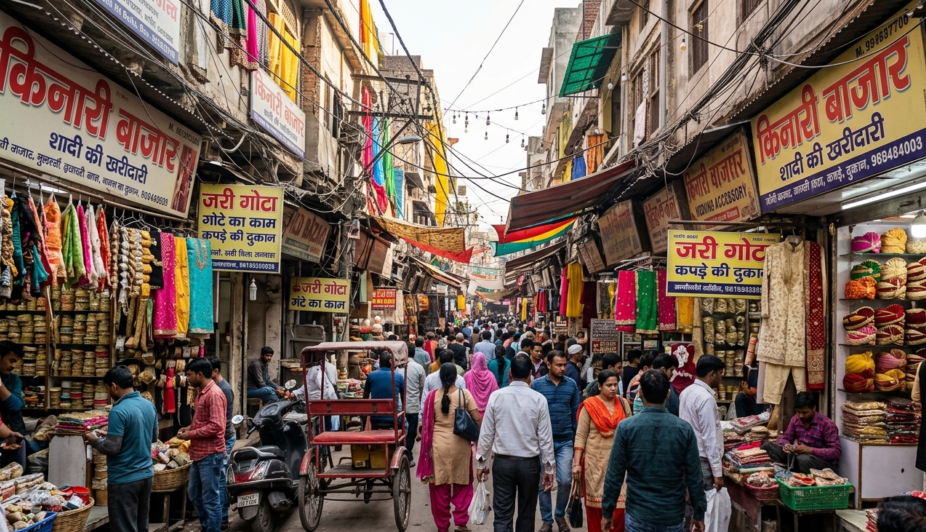
The Glittering Heart of Old Delhi :- Kinari Bazar
Deep within the narrow lanes of Old Delhi lies a completely magical world. Amidst the relentless hustle of the Red Fort and Chandni Chowk, there is a particular lane globally renowned for its shimmer, colorful threads, and exquisite wedding trousseau essentials. We know it as ‘Kinari Bazar’. Whether it is a grand Indian wedding or a festive celebration, no preparation in Delhi is ever deemed complete without a trip to this market. In this blog, let us dive deep into the history, unique charm, and entire travel guide of this historic market.
Detailed History
The legacy of Kinari Bazar is directly intertwined with the Mughal era and the creation of Chandni Chowk.
- Mughal Origins :– The market was established in the 17th century during the reign of the Mughal Emperor Shah Jahan, when he founded his grand new capital, ‘Shahjahanabad’ (now Old Delhi).
- The Choice of Royalty :– Originally, this market developed specifically to cater to the royal attire of kings, queens, and courtiers of the Mughal court. Master craftsmen specialized in gold and silver hand-embroidery (Zardozi and Gota-Kinari) set up their workshops around this very locality.
- The Etymology :– The beautiful ornamental borders, laces, and trimmings affixed to the edges of traditional garments are called ‘Kinari’ in Hindi/Urdu. Since this market became the absolute epicenter for these decorative edgings, it earned the permanent moniker ‘Kinari Bazar’.
Detailed Market Overview & Layout
Kinari Bazar is by no means a modern, spacious mall; rather, it is a narrow, labyrinthine alleyway of Old Delhi lined with hundreds of tightly packed shops.
- An Ocean of Colors and Sparkle :– The moment you step into these slender lanes, your eyes will be dazzled by the pure shimmer of the market. Golden and silver laces hanging outside shops, vibrant borders, and strands of beads lend a perennial festive vibe to the alley.
- One-Stop Wedding Destination :– This market is India’s largest wholesale and retail hub for traditional wedding accessories. Here, you can find groom’s sehras (wedding veils), safas (turbans), currency-note garlands, intricately embroidered lehengas, sherwanis, decorative platters, and shagun envelopes at incredibly budget-friendly rates.
- Traditional Crafts & Gota-Patti :– The shops here still preserve ancient styles, offering Rajasthani Gota-Patti, Zardozi patches, Chikankari motifs, tassels (latkans), and fancy buttons that can instantly elevate any ordinary fabric into a royal masterpiece.
- The Hub of Wholesale Trade :– This market remains the top destination for fashion designers, boutique owners, and textile merchants from across India looking for unique raw materials.
Travel Guide & Routes
If you plan to experience the vibrant pulse of Kinari Bazar, keep these essential details in mind.
- Tickets :– Since it is an open, public commercial market, there is no entry fee or ticket required. It is completely Free.
- Market Timings :– Kinari Bazar generally operates from 11:30 AM to 8:00 PM. Please note that the market remains completely Closed on Sundays. It experiences heavy footfall during the peak festive and wedding seasons.
- How to Reach :–
- By Metro :– The nearest metro stations are ‘Chandni Chowk’ (Yellow Line) and ‘Red Fort’ (Violet Line). From the metro exit, you can walk through the iconic Paranthe Wali Gali to walk directly into Kinari Bazar.
- By Road :– Because the alley is exceptionally narrow, no cars or auto-rickshaws can enter the market. You must get down on the main Chandni Chowk road and cover the remaining distance on foot or via an e-rickshaw up to the entrance of the lane.
Photography Spots
Kinari Bazar is a visual goldmine for street photography enthusiasts looking for popping contrasts.
- The Hanging Lace Displace :– A candid shot framed through the hanging golden and shimmering laces outside the shops looks exceptionally artistic and lively.
- The Turban Stacks :– Close-up shots of the vibrant, stacked traditional Rajasthani and Mughal-style wedding turbans bring wonderful textures to your frames.
- The Chaos of the Alleys :– Laborers carrying heavy wholesale bundles on their heads, buyers bargaining passionately, and the historic wooden windows of old buildings overhead beautifully capture the true spirit of Old Delhi.
Local Food & Famous Markets
When you need a break from shopping and walking through Kinari Bazar, make sure to treat yourself to Old Delhi’s legendary street food.
- Local Food :–
- Paranthe Wali Gali :– Located right adjacent to Kinari Bazar, this lane is world-famous for its piping hot, deep-fried paranthas served with a variety of unique stuffings like rabri, cashews, and mint.
- Old Famous Jalebi Wala :– Situated at the main junction, their thick, extra-juicy jalebis served straight out of the kadhai with fresh rabri are heavenly.
- Natraj Dahi Bhalle :– Located on the main road, serving the softest and most flavor-packed dahi bhallas in town.
- Famous Markets :–
- Dariba Kalan :– Located right next to Kinari Bazar, this historic lane is famous for pure silver jewelry and authentic traditional Indian perfumes (Attar).
- Katra Neel :– Another historic wholesale market dedicated entirely to clothing and fabrics.
- Nai Sarak :– Asia’s largest wholesale hub for books and stationery, located nearby.
Nearby Attractions
You can easily pair your shopping trip to Kinari Bazar with visits to these iconic landmarks.
- Red Fort (Lal Qila) :– Located barely a 10-15 minute walk away from the market area.
- Jama Masjid :– A short rickshaw ride will take you directly to the steps of this grand Mughal mosque.
- Gauri Shankar Temple & Gurudwara Sis Ganj Sahib :– Prominent, historic places of worship located right on the main Chandni Chowk road.
Interesting Facts
- The Designer’s Paradise :– Teams of India’s leading celebrity fashion designers (like Manish Malhotra or Sabyasachi) frequently visit Kinari Bazar to source raw materials, borders, and specialized laces for their high-end collections.
- Theatrical Costumes :– Most of the grand crowns, swords, and royal costumes worn by actors in Delhi’s legendary Ramlilas and historic theater plays are crafted right inside this market.
- Generations of Legacy :– Several establishments here are more than 100 to 150 years old, currently managed by the fourth or fifth generation of the same family of merchants.
Important Questions and Answer :-
Question 1:- What is Kinari Bazar most famous for?
Answer:– Kinari Bazar is predominantly famous for wedding accessories (turbans, sehras, shagun envelopes), intricate lace borders, Gota-Patti materials, Zardozi trimmings, and traditional festive decorations.
Question 2:– On which day does Kinari Bazar remain closed?
Answer:– The market is strictly closed on Sundays every week.
Question 3:- Which is the best metro station to reach Kinari Bazar?
Answer:– The nearest metro stations are ‘Chandni Chowk’ on the Yellow Line and ‘Red Fort’ on the Violet Line.
Question 4:– Can we take vehicles inside Kinari Bazar?
Answer:– No, the lanes of Kinari Bazar are extremely narrow; even navigating a two-wheeler is highly difficult. The entire market can only be explored comfortably on foot.
Author’s Thoughts :-
Walking through the cramped, buzzing alleys of Kinari Bazar feels like walking right into the center of a grand Indian festival. At first glance, the sheer volume of the crowd might overwhelm you, but the moment you stop to notice the intricate golden threads, glass beads, and shiny laces, you realize that the royal opulence of Mughal India is very much alive here. This market stands as proof that no matter how massive modern mall culture grows, the true soul of Indian weddings and festivals still beats within these heritage lanes. It isn’t just a shopping lane; it is a shimmering archive of India’s craftsmanship and the unyielding spirit of Old Delhi.
“Amidst the roar of Chandni Chowk, the narrow alleys of Kinari Bazar, adorned with golden threads and glittering laces, continue to breathe life and color into the dreams of every Indian wedding.”