
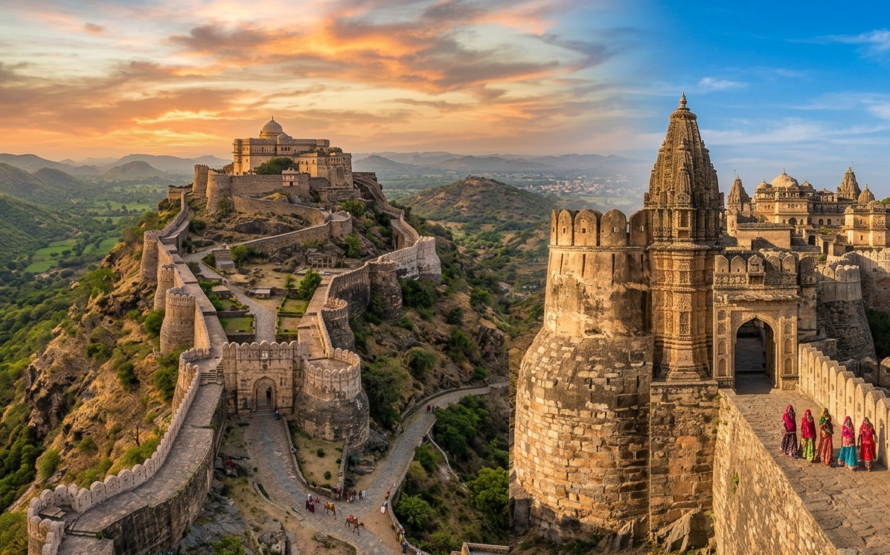
Kumbhalgarh Fort, Rajsamand
Following the invincible mud battlements of Bharatpur’s Lohagarh Fort, let us redirect our steps toward the awe-inspiring and colossal pride of Mewar, whose defensive architecture leaves the entire world spellbound. Situated amidst the rugged and inaccessible folds of the Aravalli Range in the Rajsamand district of Rajasthan, Kumbhalgarh Fort is a historical jewel that boasts the second-longest continuous wall in the world. Erected by the visionary Rajput sovereign Maharana Kumbha, this fortress served as the strategic baseline capital of Mewar during times of distress. In 2013, UNESCO inscribed it as a World Heritage Site under the ‘Hill Forts of Rajasthan‘ series.
Detailed History :-
The historical chronicle of Kumbhalgarh Fort is deeply intertwined with unparalleled chivalry, profound sacrifices, and the ultimate pride of the Mewar Kingdom. This monumental stronghold was commissioned during the 15th century (between 1443 and 1458 AD) by the illustrious ruler Maharan Kumbha. The master architect behind this structural marvel was the renowned strategist ‘Mandan‘, who gave it a highly unique, multi-layered defensive configuration. Positioned at such a commanding elevation, breaching this fortress via direct conventional warfare was deemed virtually impossible.
Throughout its existence, the fort functioned as a secure sanctuary for the rulers of Mewar. Whenever the capital of Chittorgarh faced external sieges, the royal bloodline retreated here for safety. One of the greatest acts of fidelity in Indian history unfolded near these ramparts, where the noble nursemaid Panna Dhai sacrificed her own son, Chandan, to save the infant Prince Udai Singh (father of Maharana Pratap) and smuggled him to safety inside this very fortress. Furthermore, this citadel stands proud as the birthplace of legendary warrior Maharana Pratap, born on May 9, 1540, within the elevated chambers of the ‘Badal Mahal’. Over its long military lifespan, the fort fell only once to a massive combined coalition of Mughal, Amber, and Marwar forces, owing strictly to a catastrophic contamination of its internal water reservoirs.
Detailed Architecture :-
Perched at an altitude of roughly 1,100 meters (3,600 feet) above sea level and encircled by thirteen protective mountain peaks of the Aravallis, the architectural layout of Kumbhalgarh Fort is an absolute masterpiece of medieval military engineering.
- The Great Wall of India :– The crowning glory of this fortress is its massive and sweeping perimeter wall. Extending across a length of 36 kilometers, this continuous rampart stands second only to the Great Wall of China. The stone masonry is extraordinarily wide, engineered specifically so that eight horses can gallop abreast along its top course.
- The Strategic Gateways :– The approach to the core palaces is guarded by seven massive, heavily reinforced gates (Pols), with Aret Pol, Halla Pol, Hanuman Pol, and Ram Pol acting as the prime defensive checkposts. Hanuman Pol proudly features a sacred idol of Lord Hanuman brought directly from Mandore by Maharana Kumbha.
- Katargarh (The Inner Citadel) :– Crowning the absolute summit of the hill is an independent inner fortress known as ‘Katargarh’. This served as the high-security private residence of Maharana Kumbha. It rises so vertically that looking up at it from the base is dizzying. Commenting on its sheer height, the Mughal chronicler Abul Fazl wrote. “The fort is built at such a dizzying height that if one looks up at it from the base, the turban falls off from one’s head.”
- Badal Mahal (The Palace of Clouds) :– Situated at the highest tier of Katargarh, this palace is celebrated for its pastel-hued wall frescoes and exquisite Rajput stone work. During the monsoon months, low-hanging rain clouds routinely drift through the open pavilion arches and into the royal rooms.
- The Ancient Temples :– The sprawling inner plateau features a rich complex of over 360 ancient temples, out of which more than 300 are highly detailed heritage Jain shrines, while the remaining are dedicated to Hindu deities. Among them, the ‘Neelkanth Mahadev Temple’ is prominent, housing a monolithic black marble Shiva Lingam of extraordinary proportions.
Travel Guide & Routes :-
Tickets & Entry :–
- For Indian Citizens :– ₹40 per individual (Cash) or ₹35 (via digital/online smartphone booking).
- For Foreign Nationals :– ₹600 per individual.
- Camera/Photography Fee :– Normal photography using smartphones or handheld digital cameras is completely free of charge.
- Sound and Light Show :– Catching the evening historical show incurs a separate ticketing charge of ₹100 per individual.
Timings :–
- Visiting Hours :– Open daily from 09:00 AM to 06:00 PM.
- Operational Days :– The complex welcomes global travelers 365 days a year. Every evening after dusk, the massive stone ramparts are dramatically illuminated by thousands of golden floodlights, presenting an unforgettable sight.
How to Reach :–
- By Road (Highly Recommended) :– Kumbhalgarh does not feature a dedicated railway station or airport. It is positioned roughly 85 kilometers from Udaipur and 170 kilometers from Jodhpur. Hiring private app-based cabs or taking Rajasthan State Transport buses from Udaipur remains the smoothest travel option.
- By Railway :– The nearest major railheads are ‘Udaipur City’ and ‘Falna’, which enjoy excellent connections with prominent metropolitan grids. Travelers can alight here and take a comfortable 2-hour taxi ride up into the hills.
- Local Transport/E-rikshaw :– Local jeeps and eco-friendly e-rickshaws are available near the valley parking lots to shuttle tourists to the primary entrance gate (Ram Pol). Since the pathway inside the fort features a steep pedestrian incline, wearing robust, comfortable walking shoes is absolutely necessary.
Photography Spots :–
- The Serpent Paths of the Great Wall :– Capturing the wide landscape view of the 36-kilometer-long stone wall snaking across the rugged mountain crests provides a truly iconic cinematic frame.
- The Balconies of Badal Mahal :– Ideal for capturing panoramic vistas of the deep Aravalli valley and the sprawling wildlife sanctuary stretching out into the horizon.
- The Monolithic Pillars of Neelkanth Mahadev Shrine :– The massive stone pillars and multi-foliated heritage arches offer magnificent depth-of-field frames for portraits.
Local Food & Shopping :–
- Local Cuisines :– After completing the trek up the fort, dining at the local hillside heritage restaurants is a treat. Travelers can sample the fiery Rajasthani Laal Maas (mutton curry cooked with local chilies) or the traditional vegetarian platter comprising Dal-Baati-Churma, Gatte ki Sabzi, and hot Kadhi-Kachori. Savoring hot, thick Rabdi-milk served in earthen clay cups is highly recommended.
- Famous Markets :– Small handicraft stalls are nestled right outside the fort perimeter gates. For extensive lifestyle shopping, tourists can travel down to the main bazaars of Rajsamand or Udaipur to purchase authentic camel-leather Mojris, Bandhej textiles, hand-painted Terracotta items, and traditional Pichwai paintings.
Interesting Facts :-
- The Great Shield of Mewar :– Extending across 36 kilometers of continuous masonry, the outer defense wall of Kumbhalgarh is formally recognized as the longest continuous wall in India and the second-longest on the planet.
- The Giant Embers of the Valley :– To provide visibility for his troops and the local farmers working at the foothills at night, Maharaja Kumbha used to burn massive iron cauldrons packed with 50 kilograms of pure ghee and cotton blankets, illuminating the entire Aravalli basin.
- The Unbreached Citadel :– The physical layout of the fort made it virtually invincible to frontal military strategies. When the alliance forces of Emperor Akbar, Raja Man Singh, and Marwar finally managed to briefly occupy the ramparts, it was only because a critical water crisis emerged after a rogue element poisoned the main stepwells of the fort.
Important Questions and Answer :-
Question 1:– Why is the core citadel of Kumbhalgarh often poetically termed the ‘Eye of Mewar’?
Answer:- The title specifically refers to the sky-piercing ‘Katargarh‘ palace sitting at the absolute summit. From this commanding bird’s-eye vantage point, Maharana Kumbha could carefully monitor the entire geographic layout of Mewar and spot any hostile troop movements miles away.
Question 2:- Is there a wildlife sanctuary exploring option located adjacent to the fort limits?
Answer:- Yes, the fortress is surrounded by the dense ‘Kumbhalgarh Wildlife Sanctuary’, which functions as a major preserve for Indian wolves, leopards, four-horned antelopes (Chousingha), and a vast array of avian species. Visitors can easily book an open-top jeep safari to explore the jungle paths.
Question 3:– How much time and physical stamina does a complete tour of the fort demand?
Answer:- Walking from the main entry gates of Ram Pol up to the highest pavilions of Badal Mahal requires navigating a continuous pedestrian ascent. To comfortably explore the ancient palaces, massive ramparts, and historic temples, a visitor must budget at least 3 to 4 hours of active walking.
S“Perched high upon the rugged Aravalli crests and wrapped in the protective embrace of a 36-kilometer stone wall, Kumbhalgarh Fort stands as an eternal monument to Maharana Kumbha’s strategic genius and the birth of Maharana Pratap’s undying valor.”