
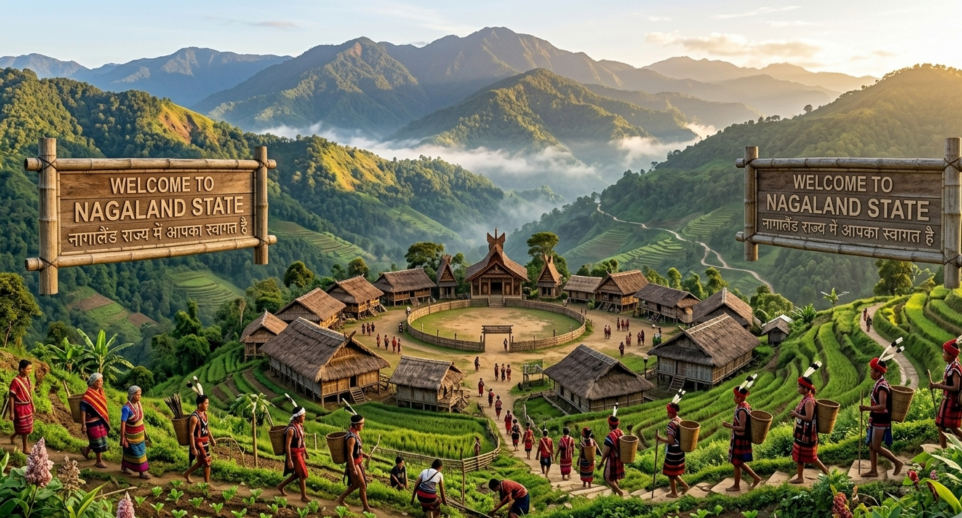
Nagaland :- The Land of Warriors, Rich Tribal Heritage & State of Festivals
Detailed History
Bordered by the international boundary of Myanmar on the easternmost frontier of India, Nagaland is globally celebrated as the ‘Land of Warriors’ and the ‘Land of Festivals’. The historical narrative of Nagaland revolves around the fierce, sovereign, and deeply self-respecting Naga tribes. There are various scholarly perspectives regarding the etymology of the word ‘Naga’; some historians trace it back to the Sanskrit word ‘Naga’ (meaning hill people), while others believe it is derived from the Kachari word ‘Naoga’, which translates to warriors. Prior to British colonial contact, the territory of Nagaland was never conquered or subjugated by any foreign empire, including the powerful Ahoms of Assam or the Mughals of Delhi. The Naga villages functioned as completely autonomous independent republics, where the council of clan elders held absolute and final judicial authority.
In the 19th century, British forces entered these hills under the pretext of safeguarding the lucrative tea plantations of the Assam plains, sparking a series of bloody conflicts with Naga warriors. In 1879, the warriors of the historic ‘Khonoma Village’ staged an indomitable armed resistance against the British army, a milestone recorded as a magnificent chapter of tribal defiance in Indian history. During World War II, Nagaland transformed into a critical epicenter of global military history. In 1944, the monumental ‘Battle of Kohima’ was fought here, often described by military historians as the ‘Stalingrad of the East’. It was on this rugged terrain that the Allied Forces decisively halted the strategic advance of the Imperial Japanese Army, creating a massive turning point in the execution of World War II in South Asia. Post-independence, a prolonged political movement was launched by the Naga people to preserve their distinct cultural identity and secure regional autonomy. Following intense negotiations between Naga leaders and the Government of India, Nagaland was formally inaugurated as the 16th sovereign state of the Indian Union on December 1, 1963.
Detailed Architecture :-
The traditional architecture of Nagaland is an exemplary manifestation of its socio-political matrix, clan-based defensive warfare strategies, and complex mountain topography. Every structural layout houses deep cultural symbolism and tribal pride:
Exterior Architecture:–
- The Traditional Naga Morung :– The ‘Morung’ stands as the ultimate architectural and cultural anchor of Naga society, traditionally serving as a formal educational institution, village guardhouse, and bachelors’ dormitory for young men. The exterior architecture of a Morung is exceptionally grand. The thatched roofs feature a dramatic, steep downward pitch to counter heavy monsoons. The structural highlight is the massive hardwood beams extending past the front façade, crossing each other in a majestic ‘X’ configuration known as Khiho. These grand gables are elaborately carved with relief sculptures of Hornbill birds, human heads (symbolizing ancient warrior status), or the horns of the Mithun (the state animal), representing collective prosperity and valor.
- Traditional Monumental Village Gates :– Designed historically to secure the village perimeter from rival clans, these monumental gates are highly significant. Each gate is painstakingly carved out of a single massive solid tree trunk, decorated with high-relief wood carvings of full-bodied warriors, ancient muskets, traditional spears, and deep Mithun structural contours. The ancient preserved village gates of Khonoma and the curated setups at the Kisama Heritage Village are world-class examples.
Interior Architecture :–
- The interior layout of a classic Naga home or Morung opens into a vast, unpartitioned communal hall. The architectural anchor of the inner room is a heavy stone-lined open hearth (Earth-hearth) that burns continuously to provide warmth and slow-cook meals. The load-bearing interior timber pillars and walls are historically adorned with animal skulls displayed as hunting trophies. Bamboo lofts and slatted wooden racks are engineered directly above the central hearth into the roof trusses, utilize the rising smoke to cure meats and preserve agricultural grain from pests.
Travel Guide & Routes
Mandatory Permits (ILP) :–
- Inner Line Permit (ILP) :– It is absolutely mandatory for all domestic Indian tourists traveling to Nagaland to secure an Inner Line Permit. This can be acquired via the official state online system (ilp.nagaland.gov.in) or physically at the entry desk at Dimapur Railway Station/Airport. International passport holders are now officially exempt from the Protected Area Permit (PAP) regulations but must register at the nearest Foreigners Registration Office (FRO) within 24 hours of entry.
Tickets and Entry Fees:–
- Accessing national historical monuments like the Kohima War Cemetery or the Nagaland State Museum involves a nominal preservation ticket costing between ₹10 and ₹20.
- Entering the Kisama Heritage Village (the permanent site for the Hornbill Festival) costs between ₹20 and ₹50 on regular days, with specialized ticket matrixes operating during the festival block in December.
Timings (Visiting, Opening & Closing Times) :–
- Best Time to Visit :– The winter window spanning from October to March offers comfortable, clear, and crisp mountain conditions. To witness the peak cultural splendor of the state, travelers must book their visit between December 1st and December 10th to experience the world-famous annual ‘Hornbill Festival’.
- Sightseeing Windows :– Standard administrative spaces, museums, and commercial markets open by 09:00 AM and close early by 04:30 PM to 05:00 PM due to the early onset of nightfall in Northeast India. On Sundays, the entire state observes a strict sabbath; all public transit, cafes, and commercial markets remain entirely closed.
How to Reach (Routes) :–
- By Air :– The primary functional aviation gateway into the state is the Dimapur Airport (DMU), which operates routine flights connecting to Kolkata and Guwahati. A secondary airport project near Chümoukedima close to Kohima is undergoing advanced developmental stages. Currently, tourists land at Dimapur and cover the remaining journey to Kohima (approx. 74 km) via road.
- By Rail :– Dimapur Railway Station (DMV) serves as the main broad-gauge rail hub of Nagaland, directly linking the state to national corridors including Guwahati, Kolkata, and New Delhi.
- By Road :– The transit from Dimapur to Kohima is serviced by National Highway 29 (NH-29), a world-class, newly engineered four-lane mountain highway. The distance can be safely covered via private tourist cars or shared tactical taxis within 2 to 3 hours. Kohima also enjoys standard highway connectivity with Assam and Manipur.
Photography Spots, Local Cuisine, and Famous Markets
Photography Spots :–
- Kisama Heritage Village :– Exceptional during the first week of December for capturing high-definition portraits of tribal elders in their magnificent authentic regalia, intricate body art, and vibrant feathered headgear.
- Dzüko Valley :– One of the most visually stunning alpine valleys in India. Ideal during and immediately post-monsoon for capturing expansive, dramatic landscape shots of deep green rolling hills wrapped in low clouds and snaking crystalline streams.
- Khonoma Eco-Village :– Features exceptional terraced farming steps (Terrace Farming) carved into steep mountain slopes, offering rich green landscape compositions, interspersed with ancient stone monuments.
- Kohima War Cemetery :– Yields deeply moving, symmetrical architectural frames of pristine bronze plaques and stepping lawns set against a dramatic hill backdrop.
Local Cuisine :–
- Authentic Naga cuisine focuses heavily on steaming, boiling, and smoking techniques, utilizing almost zero commercial cooking oils. The most iconic cultural delicacy is ‘Pork with Bamboo Shoot’—tender pork slow-cooked with pungent fermented bamboo shoots and local herbs. For vegetarian travelers, ‘Hinkejvu’ (a comforting stew made by boiling colocasia leaves, mustard leaves, and local tubers together) and ‘Galo’ (a wholesome, herb-infused rice and lentil porridge) are highly recommended. No Naga meal is complete without a dash of the legendary ‘Raja Mircha’ (King Chilli / Bhut Jolokia – GI Tag), recognized globally as one of the hottest chili varieties on Earth.
Famous Markets :–
- Local Ground Market (Kohima) :– The definitive cultural marketplace for sourcing authentic Naga handloom merchandise, especially the heavy, geometrically patterned tribal shawls (such as the distinctive Ao or Angami shawls), alongside intricate bamboo-root pipes and woven cane jewelry.
- Hong Kong Market (Dimapur) :– Celebrated across the entire Northeast region as a massive commercial hub for exceptionally affordable imported contemporary fashion apparel, tactical gear, and electronic accessories.
Nearby Attractions
- Dzüko Valley :– Perched at an altitude of over 2,400 meters on the border of Nagaland and Manipur, this valley is a trekker’s paradise, famous for its unique topography and the endemic pale-pink Dzüko Lily which blooms in June and July.
- Khonoma Green Village :– Located 20 km from the capital, this 700-year-old settlement is proudly designated as ‘Asia’s First Green Village’. The community made global headlines by completely banning commercial logging and wildlife hunting, transforming their ancestral hunting grounds into a thriving nature reserve.
- Kohima War Cemetery :– A beautifully maintained Commonwealth war graves site honoring the supreme sacrifice of the British and Indian soldiers who fell during the intense fighting of 1944. The famous moving epitaph inscribed here reads: “When you go home, tell them of us and say, for your tomorrow, we gave our today.”
- Mokokchung :– The official cultural nerve center of Nagaland, dominated by the rich heritage of the ‘Ao Naga’ tribe. Historic nearby settlements like Ungma village offer an authentic, unaltered view into traditional Naga lifestyle systems.
- Touphema Tourist Village :– Situated 40 km north of Kohima, this is a beautifully curated community-run heritage resort village where tourists can check into authentic Naga structural huts to experience rural hospitality.
Important Questions and Answer :-
Question 1:- What is the primary cultural objective behind the celebration of the Hornbill Festival?
Answer:– Organized annually from December 1st to 10th by the State Tourism Department at the Kisama Heritage Village, the Hornbill Festival is designated as the ‘Festival of Festivals’. Its primary objective is to revive, protect, and showcase the collective rich cultural diversity, folk music, traditional dances, culinary arts, and indigenous sports of all 17 major tribes of Nagaland on a single global stage. The festival is named after the Forest Hornbill bird, which features prominently in tribal folklore and headgear.
Question 2:- Why do international military historians place great emphasis on the Battle of Kohima?
Answer:– The Battle of Kohima (April–June 1944) is widely regarded as one of the most brutal close-quarter battles of World War II. It was the absolute high-water mark of the Imperial Japanese Army’s invasion of British India. The stubborn, heroic defense by the Allied troops broke the backbone of the Japanese offensive in Asia. Had Kohima fallen, the road to the plains of Assam and the rest of India would have been wide open to Axis forces.
Question 3:- What role did the ‘Morung’ play in traditional Naga clan society?
Answer:– Historically, the Morung was the socio-educational sanctuary of a Naga village. It operated as a formal training institution for young men, where they transitioned into adulthood. Under the strict mentorship of clan warriors and elders, young boys mastered military combat tactics, hunting techniques, wood carving, civic discipline, and memorized tribal history through oral folklore, ensuring the survival of the tribe’s legacy.
Question 4:- How hot is Nagaland’s famous ‘Raja Mircha’ compared to standard chili peppers?
Answer:– Nagaland’s indigenous ‘Raja Mircha’ (also known as Ghost Pepper or Bhut Jolokia), holding an official GI Tag, is exceptionally hot. On the scientific Scoville Scale used to measure pungency, it registers well over 1,000,000 Scoville Heat Units (SHU). In comparison, a standard Jalapeño pepper measures between 2,500 and 8,000 SHU, making the Raja Mircha over a hundred times hotter.
Question 5:- How can an expert differentiate between different Naga shawls?
Answer:– In Naga culture, a handwoven shawl is a visual identity document. Every tribe has its own mathematically exact weaving grid, color combinations, and symbolic motifs. For instance, an Ao Naga warrior shawl (Tsungkotepsu) features a stark black and red base with a central white band painted with figures of elephants, tigers, and human heads, symbolizing wealth and battlefield success, whereas a Lotha or Angami shawl uses completely different striped sequences to denote the specific socio-economic status of the wearer.
Author’s Thoughts :-
Traveling through Nagaland is like stepping into a living epic poem where modern aspirations shake hands beautifully with a fierce, untamed historical pride. To stand amidst the ancient, mist-covered ridges of Kohima and hear the booming resonance of traditional log drums is to realize that the spirit of the Naga warriors is very much alive, beating strongly beneath the surface of contemporary life. The true genius of this land lies in its remarkable community frameworks; the transformative story of Khonoma village turning from a historic hunting ground into Asia’s premier green eco-sanctuary is a global masterclass in grassroots environmental conservation. Far removed from the predictable, manicured circuits of mass tourism, Nagaland offers a raw, deeply authentic, and emotionally stirring odyssey. It is a land that commands deep respect for its traditions, rewards the traveler with breathtaking alpine landscapes, and leaves you with an indelible sense of wonder that permanently expands your understanding of India’s diverse cultural fabric.
“Within the sharp gables of the ancient Morungs and the heavy wood of village gates, the pride of the warriors stands immortal, while the mist of Dzüko and the rhythm of Hornbill drape the hills in eternal celebration.”