
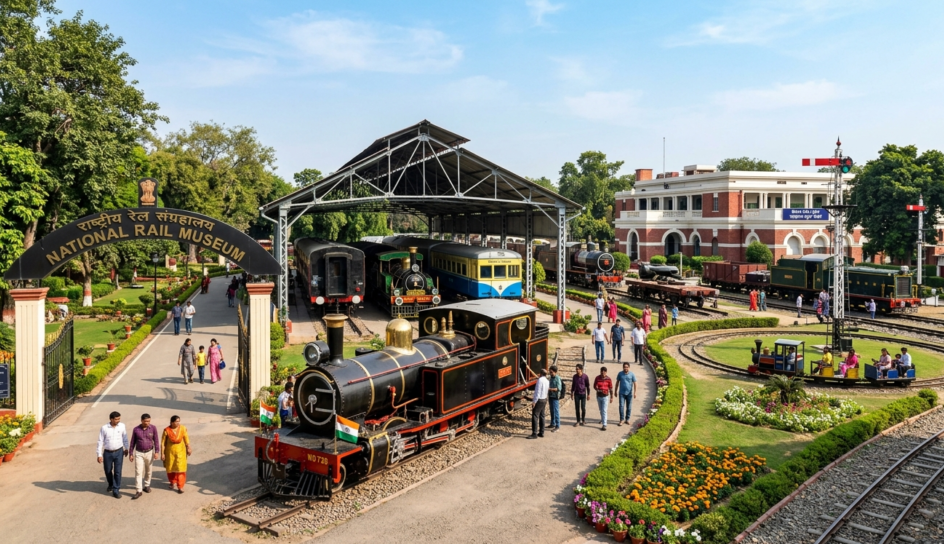
National Rail Museum, New Delhi :- The Grand Living Chronicle of Indian Railways’ Heritage, Vintage Locomotives, and Technological Evolution
Nestled within the lush diplomatic enclave of Chanakyapuri in Lutyens’ Delhi, the National Rail Museum (NRM) stands as India’s premier, most unique, and expansive transportation museum. Far from a conventional static archive, it operates as a sprawling historical time capsule spanning over 11 acres of premium land, beautifully preserving the 170-year-old operational narrative, engineering feats, and royal legacy of the Indian Railways. The museum houses a priceless collection of over 100 real-size historic vintage steam locomotives, majestic royal saloons, and rare signal equipment. Featuring a fully operational heritage toy train and interactive simulation zones, the museum effortlessly bridges the gap between educational technical history and engaging recreation, making it an absolute necessity for historians, families, and transit enthusiasts alike.
Detailed History
The historical trajectory of the National Rail Museum is deeply intertwined with the post-independence movement to preserve India’s monumental industrial and transport architecture.
- Conceptualization and Foundations :– The foundational blueprint to construct a dedicated repository for Indian rail antiquity was first drafted in 1962. Following strict logistical zoning, the foundation stone was formally laid on October 7, 1971, by the then-President of India, V.V. Giri, at the designated site in Chanakyapuri, New Delhi.
- The Grand Inauguration :– Following six years of meticulous restoration work and the complex transshipment of historic heavy engines from remote corners of the subcontinent, the institution was inaugurated as the ‘Transport Museum’ on February 1, 1977, open to the global public. It was subsequently rechristened as the National Rail Museum to reflect its focused national custodial mandate.
- Modern Integration :– Originally established as an open-air yard layout, the complex expanded horizontally to incorporate an advanced multi-media indoor museum gallery, structural toy train networks, and high-fidelity motion simulators under the direct oversight of the Ministry of Railways, Government of India.
Detailed Architecture
The spatial master plan and layout of the National Rail Museum are engineered to replicate a massive, highly authentic operational railway junction and historic locomotive maintenance shed.
- The Open-Air Exhibition Grid (Outdoor Display) :– The core architectural highlight is the sweeping, meticulously laid outdoor yard. Real standard, broad, meter, and narrow gauge tracks are embedded across the landscape, displaying massive historic locomotives. These colossal steel structures are arranged in a precise chronological sequence, allowing visitors to walk parallel to the evolution of heavy transport.
- The Indoor Gallery Edifice :– The primary indoor pavilion features a striking semi-circular architectural shell that mirrors the design of traditional 19th-century railway roundhouses and locomotive loco-sheds. Internally, the building features expansive, continuous galleries flanked by custom glass displays housing delicate antique telegraph machines, vintage brass signaling lanterns, royal ceramic dining sets, and highly intricate working scale models of historic train networks.
- The Mountain Rail Topography :– Encircling the entire outdoor estate is a specialized narrow-gauge track network designed to replicate the challenging engineering layouts of India’s UNESCO World Heritage mountain railways (such as Darjeeling Himalayan or Kalka-Shimla). It features a mini vintage-style station platform, complete with manual signal levers and rustic overhead structures.
Travel Guide & Routes
To plan a highly streamlined, structured, and friction-free navigation through the extensive layout of the National Rail Museum, refer to this detailed operational index.
- Museum Timings :–
- The complex welcomes visitors from 10:00 AM to 05:00 PM daily (The primary ticket counter enforces a strict cutoff at 04:30 PM).
- Weekly Holiday :– The National Rail Museum remains strictly closed on Mondays. It also observes complete closure on designated national public holidays.
- Entry Fee :–
- Weekdays (Tuesday to Friday) :– Adults: ₹50, Children (Ages 3-12): ₹10.
- Weekends & Public Holidays (Saturday & Sunday) :– Adults: ₹100, Children: ₹20.
- Note: Optional rides such as the Joy Train, the 3D Virtual Reality (VR) coach experiences, and the steam locomotive simulator entail separate nominal tickets inside the venue.
- How to Reach :–
- By Metro (The Most Direct & Efficient Mode) :– The absolute closest transit station is the Sir Vishweshwariah Moti Bagh Metro Station on the Pink Line, positioned roughly 1 kilometer away. From the station exit, visitors can execute a brief 5-minute auto-rickshaw ride or a comfortable linear walk to the primary museum gates. Alternatively, the Lok Kalyan Marg Metro Station on the Yellow Line provides an easy connection.
- By Road/Bus :– Nestled deeply within Chanakyapuri, the site is immediately accessible via arterial links like Shanti Path and Ring Road. App-based cabs, local auto-rickshaws, and central DTC buses dropping at the Nyaya Marg stop service the location continuously.
- Photography Framework :–
- General non-commercial photography utilizing personal smartphones is entirely complimentary across the outdoor yard. Specialized professional DSLR equipment or tripods require a dedicated permit fee at the counter.
- Key Photographic Compositions :– Directly in front of the gleaming black boiler of the historic ‘Fairy Queen,’ looking through the ornate wooden jaali frames of the Mysore Royal Saloon, and wide-angle captures of the operating toy train navigating the dense green foliage.
- Culinary Provisions (Local Flavors) :–
- The Rail Coach Restaurant :– A spectacular, themed fine-dining venue built entirely within a refurbished authentic broad-gauge passenger coach inside the complex. The core technological highlight is a miniature model train system that runs along a central track on the dining tables, stopping precisely to deliver appetizers directly to guests. The venue serves a curated selection of North Indian, South Indian, and classic Indo-Chinese options.
- Famous Masterpieces to Witness :–
- The Fairy Queen (1855) :– The undisputed star of the collection; this is officially certified as the world’s oldest functioning steam locomotive still in operational status, proudly holding a permanent spot in the Guinness Book of World Records.
- Patiala State Monorail Trainway (1907) :– A breathtakingly rare, fully restored steam-driven monorail system that operates on a unique single-rail framework, balancing its immense weight on an auxiliary road wheel—the only surviving system of its kind left globally.
- The Royal Saloons :– Impeccably preserved private luxury coaches belonging to the Maharaja of Indore (Holker State) and the Maharaja of Mysore (Wodeyar Dynasty), showcasing rich gold-leaf interior filigree, pristine ivory inlays, and exquisite Edwardian-era furniture systems.
- The Morris Fire Engine (1914) :– A rare steam-powered road fire engine built by Morris Commercial Cars in the UK, standing as the last remaining operational unit globally.
Nearby Attractions
Strategically anchored in the elite Chanakyapuri institutional zone, a trip to the National Rail Museum can be integrated seamlessly with these adjacent destinations:
- Nehru Planetarium & Memorial Museum :– Positioned 3 kilometers north, this historic estate offers world-class astronomical sky shows and rich deep-dives into post-independence history.
- Safdarjung Tomb :– Located 4 kilometers away, it serves as an architectural masterpiece of the late Mughal era, boasting massive symmetry, extensive gardens, and sandstone masonry.
- Sarojini Nagar Market :– Situated barely 2.5 kilometers from the venue, this is Delhi’s absolute premier destination for fast-fashion street shopping and budget apparel retail.
- The Diplomatic Enclave Boulevards :– The wide, heavily forested avenues of Chanakyapuri offer a serene, secure environment for relaxed evening strolls.
Interesting Facts
- Automated Table Delivery :– The museum’s signature Rail Coach Restaurant utilizes a fully automated model train network integrated into the table layout, allowing miniature freight wagons to smoothly ferry snacks and cold drinks directly to your designated table.
- The Living Legend :– The iconic ‘Fairy Queen‘ locomotive is maintained in such exceptional operational health that Indian Railways occasionally deploys it to pull a high-end heritage luxury tourist train from Delhi to Alwar for special seasonal runs.
- Imperial Opulence Frozen in Time :– Peering through the heavy glass viewing windows of the Maharaja Saloons reveals a stunningly preserved world of colonial-era princely privilege, complete with velvet upholstery, specialized vintage fans, and historical Western-style porcelain commodes.
Important Questions and Answer :-
Question 1:– Is the Joy Train ride operational across all opening days of the museum?
Answer:– Yes, the heritage Joy Train operates continuously across all functional days of the museum (Tuesday through Sunday). However, during peak weekend crowds and public holidays, visitors should expect moderate wait times at the indoor ticket kiosk.
Question 2:– Is the physical infrastructure of the museum fully accessible for elderly visitors and wheelchair users?
Answer:– Yes, the National Rail Museum is built on a highly progressive accessibility blueprint. The expansive outdoor asphalt pathways and the primary indoor gallery feature smooth ramp transitions, making it highly convenient for wheelchairs and strollers. However, entering the interior cabins of certain historical train displays involves ascending narrow vintage iron stairs.
Question 3:– What is the optimal time required to experience the entire museum estate comprehensively?
Answer:– Allocating a dedicated time window of 2 to 3 hours is highly recommended to comfortably browse the indoor historical archives, execute the outdoor yard exploration, experience the toy train ride, and enjoy a meal at the unique themed restaurant.
Author’s Thoughts
From an analytical and industrial heritage perspective, the National Rail Museum is a magnificent monument to human engineering that offers a refreshing departure from Delhi’s standard ancient ruins and modern commercial blocks. It stands as a brilliant material testament to how a vast, deeply diverse subcontinent was socio-economically stitched together by iron tracks and steam power. Standing alongside these towering, dark steel titans of the industrial age, one cannot help but feel a profound respect for the multi-generational laborers and visionary engineers who laid tracks across treacherous mountain passes and dense river deltas. The true charm of the museum rests in its ability to present dense technological history through an engaging, highly nostalgic lens. Whether you are an industrial history scholar or simply a traveler looking to escape into a beautifully manicured, historic oasis, the distant steam whistles and rhythmic tracks of Chanakyapuri will offer you a deeply memorable, joyous journey through time.
S“From the rhythmic chug of historic steam boilers to the silent speed of modern mass transit, the absolute soul and engineering heart of the Indian Railways beats here—at the National Rail Museum.”