
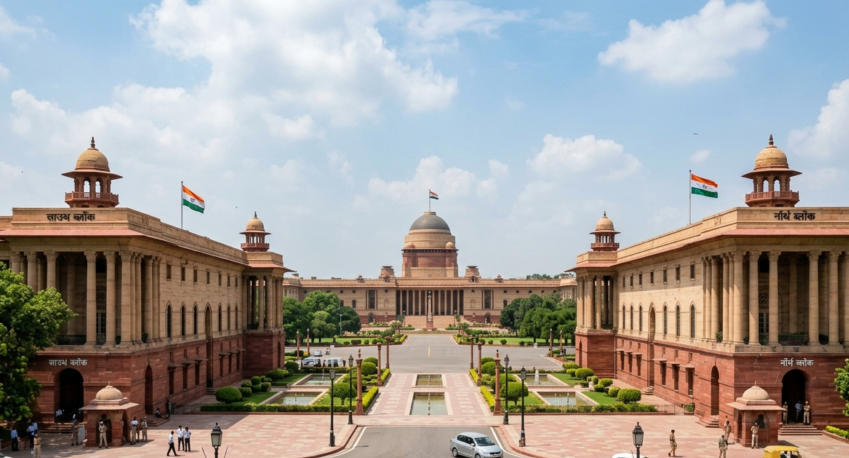
North Block and South Block, Delhi :- The Epicenter of Power and Governance of the Government of India
Detailed History :-
Situated atop the majestic Raisina Hill in New Delhi, the North Block and South Block function as the administrative backbone of the Government of India. The construction of these twin monumental structures was initiated during the British Raj as part of the grand project to shift the capital of India from Calcutta to New Delhi. The design of these edifices was envisioned by the legendary British architects Sir Edwin Lutyens and Sir Herbert Baker, with the primary responsibility for the Secretariat blocks resting with Herbert Baker. Construction commenced in 1911 and culminated in the early 1930s.
Historically referred to as the ‘Secretariat Buildings‘ before Independence, these blocks today stand as the ultimate symbol of India’s sovereignty, political authority, and democratic governance. This is where the country’s most critical policy decisions are forged. The North Block primarily houses the Ministry of Home Affairs and the Ministry of Finance, while the South Block accommodates the Prime Minister’s Office (PMO), the Ministry of Defence, and the Ministry of External Affairs.
Detailed Architecture :-
The architecture of the North and South Blocks represents a masterful blend of Classical European styles and traditional Indian architectural elements, a signature style widely known as ‘Lutyens’ Delhi Architecture’.
- Materials and Colors :– Both of these four-story structures are crafted out of the finest red and cream Dholpur sandstones, lending them an imperial, grave, and dignified aura.
- Indian Architectural Elements :– The blueprint seamlessly incorporates Rajput and Mughal styles, showcased through ornamental jharokhas (balconies), chhatris (pillared pavilions), intricate jalis (stone screens), and massive semi-circular domes. The wide central avenue (Kartavya Path, formerly Rajpath) divides the two blocks and leads straight to Rashtrapati Bhavan. The grand colonnaded entryways, sprawling inner courtyards, high-vaulted arches, and wide corridors reflect the true scale of institutional architecture.
Travel Guide & Routes :-
- Timings and Entry :– Because these buildings house the most sensitive and high-security ministries of the Government of India, the general public and casual tourists are strictly prohibited from entering inside the buildings. Entry is heavily restricted to government personnel and authorized pass holders. However, tourists can freely admire the breathtaking external architecture from the open areas of Vijay Chowk and Kartavya Path. There is no ticket or timing restriction to view them from the outside, and the area remains accessible 24/7. The view in the evening, when the buildings are illuminated with dynamic LED lights, is absolutely spectacular.
- How to Reach :–
- By Metro :– The ‘Central Secretariat’ Metro Station, located on the Yellow Line and Violet Line of the Delhi Metro, is the closest transit point. Stepping out of the station places you within walking distance of Vijay Chowk.
- By Road :– Situated in the exact center of Delhi, this high-profile zone is excellently connected. You can easily arrive here via app-based cabs, auto-rickshaws, e-rickshaws, or numerous DTC buses leading towards India Gate or Central Secretariat.
- Photography Spots :– Capturing the symmetry of the North and South Blocks framing the path to Rashtrapati Bhavan from Vijay Chowk is one of India’s most iconic photographic frames. The twilight hours, especially when the dynamic lighting system is turned on, offer the most magical shots.
- Local Flavors & Famous Markets :– The upscale commercial hub of Connaught Place (CP) and Khan Market are just a few minutes away, offering world-class dining, cafes, and street food. The famous restaurants at Pandara Road are also nearby for those looking to indulge in authentic North Indian delicacies.
Nearby Attractions :-
- Rashtrapati Bhavan :– The official residence of the President of India, located right at the crown of the avenue between the two blocks.
- New Parliament House :– Located a stone’s throw away from the Secretariat complex, presenting the modern face of Indian democracy.
- India Gate & Kartavya Path :– The grand ceremonial boulevard stretches directly from the steps of the blocks down to the historic India Gate and the National War Memorial.
Interesting Facts :-
- The Dominion Columns :– Standing tall at Vijay Chowk right in front of the blocks are four monumental pillars, gifted during the colonial era by four British dominions – Canada, Australia, South Africa, and New Zealand.
- The Irony of Empire :– Herbert Baker originally designed these structures to showcase the eternal permanence and unyielding power of the British Empire over India; ironically, today they serve as the democratic engine of the world’s largest free democracy.
Important Questions and Answer :-
Question 1:- Which ministries are located inside the North Block and South Block respectively?
Answer:- The North Block houses the Ministry of Home Affairs and the Ministry of Finance. The South Block houses the Prime Minister’s Office (PMO), Ministry of Defence, and Ministry of External Affairs.
Question 2:– Can a tourist get an entry pass to see the interiors of the North or South Block?
Answer:- No, due to highly sensitive national security protocols, casual tourist entry is not allowed inside either block. Visitors can only view and photograph their majestic facades from Vijay Chowk and adjacent public spaces.
Author’s Thoughts :-
The pride of Lutyens’ Delhi, the North and South Blocks, are far more than just blocks of sandstones and concrete. Standing at Vijay Chowk on a quiet evening, watching the setting sun dip behind Raisina Hill while these sandstone fortresses light up in the colors of the national flag, fills one with an overwhelming sense of democratic pride. It is a must-visit experience for anyone looking to feel the pulse of India’s capital city.
“Carved in timeless red sandstone upon the heights of Raisina Hill, the North and South Blocks stand as the structural heartbeat of Indian democracy and national sovereignty.”