
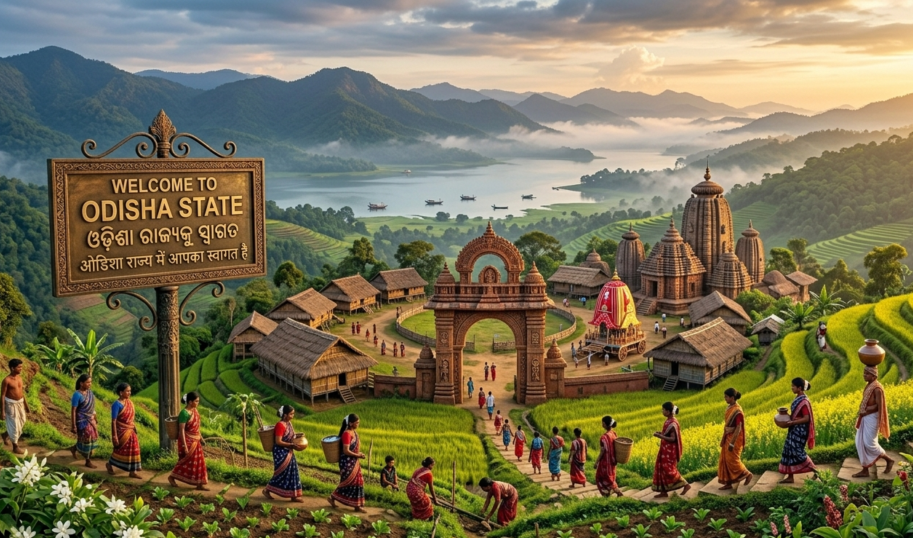
Odisha :- The Sacred Land of Art, Rich Culture, Grand Temples & Boundless Faith
Detailed History
Nestled along the eastern coast of India by the Bay of Bengal, Odisha (formerly Orissa) is a state endowed with a deeply glorious, legendary, and historically transformative past. In ancient times, this sacred topography was renowned as ‘Kalinga’, ‘Utkal’, and ‘Odra Desha’. The historical narrative of Odisha is permanently anchored to the mighty Mauryan Emperor Ashoka and the monumental transformation of his life. Fought in 261 BC along the banks of the Daya River near Bhubaneswar, the ‘Battle of Kalinga’ stands as a watershed event in world history. Shaken by the horrific carnage and immense loss of human life in the war, Emperor Ashoka renounced his policy of military expansionism (Bheri-ghosha) in favor of cultural and spiritual conquest (Dhamma-vijaya), embracing Buddhism. Consequently, Kalinga became the historical epicenter from which Buddhism radiated across Sri Lanka and Southeast Asia.
During the medieval epoch, under the illustrious patronage of the Bhauma-Kara dynasty and subsequently the Eastern Ganga Dynasty, Odisha entered a golden age of monumental stone art and architecture. It was during this prolific era that structural marvels like the Jagannath Temple of Puri and the Sun Temple of Konark were engineered. The region’s sovereign power was also vastly expanded during the ancient era by the legendary Emperor Kharavela of the Mahameghavahana dynasty. Cities like Cuttack and Puri remained centers of political administration and cultural refinement for centuries. In modern history, Odisha achieved a historic milestone on April 1, 1936, by becoming the first state in India to be formed on a strictly linguistic basis. To commemorate this landmark event, April 1st is celebrated universally across the state every year as ‘Utkal Divas’ (Odisha Day).
Detailed Architecture
The ancient architectural language of Odisha is globally classified as the ‘Kalinga Architectural Style’. This style is a highly evolved and distinct regional manifestation of the classic ‘Nagara‘ style of Hindu temple architecture. Structurally, a typical Kalingan temple plan is broadly bisected into two core components—the ‘Deula‘ (the towering principal sanctuary or sanctum sanctorum housing the deity) and the ‘Jagamohana‘ (the massive assembly hall or congregational pavilion for devotees).
Exterior Architecture :–
- Rekha Deula and Pidhà Deula :– In the Kalingan design matrix, the soaring tower over the sanctum sanctorum is called the ‘Rekha Deula’, characterized by a dramatic vertical profile that curves gracefully inward near the top. Positioned directly in front of it is the Jagamohana (assembly porch), styled as a ‘Pidha Deula’, featuring a square base topped with a distinct stepped pyramid roof layout.
- The Sun Temple, Konark :– The absolute zenith of Kalingan structural engineering is the Sun Temple at Konark, a UNESCO World Heritage site. The exterior architecture is conceived as a monumental celestial chariot dedicated to the Sun God (Surya), mounted on 24 intricately carved monolithic stone wheels and pulled by a team of 7 powerful, rearing stone horses. The 24 wheels are architectural sundials that precisely measure the hours of the day based on shadow alignments, showcasing advanced ancient Indian astronomical mathematics. The exterior facades are covered with fine stone sculptures depicting celestial deities, dancers, musicians, courtly processions, and complex erotic reliefs (Mithuna sculptures).
- Shree Jagannath Temple, Puri :– This massive temple complex stands elevated on a fortified hillock known as Niladri, secured by two concentric defensive stone walls—the inner Kuruma Bedha and the outer Meghanada Pacheri. The pinnacle of the principal sanctuary is surmounted by the sacred alloy wheel called the ‘Neelachakra’, flying a holy pennant (Patitapabana) that mysteriously waves against the natural direction of the wind, remaining an unsolved aerodynamic enigma to this day.
Interior Architecture :–
- In stark contrast to the exterior walls, the interior of the sanctum sanctorum (Garbhagriha) is traditionally kept completely plain, dark, and devoid of ornate carvings to ensure that a devotee’s sensory focus remains anchored entirely upon the deity. The internal layout of the Jagamohana features heavy stone columns supporting massive corbeled roofing sections. The architects of Puri and Konark strategically incorporated massive structural iron beams (Iron Beams) into the roof frameworks, proving the advanced state of metallurgical science in medieval Odisha.
Travel Guide & Routes
Mandatory Permits & Entry Regulations :–
- Domestic Indian travelers and international passport holders do not require any specialized inner line permits or protected area documentation to visit Odisha. The entire state is completely open to national and global tourists.
Tickets and Entry Fees :–
- Shree Jagannath Temple (Puri) & Lingaraj Temple (Bhubaneswar) :– Entry into these living socio-religious spaces is strictly Free of cost for all visitors. (Note: Non-Hindus are traditionally restricted from entering the inner sanctums of these two specific temples, but can view them from elevated vantage platforms outside).
- Konark Sun Temple :– Admission tickets cost ₹40 for citizens of India, SAARC, and BIMSTEC nations, while international tourists are charged ₹600. Entry is completely free for children under the age of 15.
- Udayagiri and Khandagiri Caves :– Entry tickets cost ₹25 for Indian nationals and ₹300 for international tourists.
Timings (Visiting, Opening & Closing Times) :–
- Best Time to Visit :– The winter window from October to March is the premium time to plan a holiday in Odisha, characterized by pleasant coastal breezes and clear skies. The monsoon peak during June-July witnesses the world-famous ‘Ratha Yatra’ festival in Puri, drawing millions of pilgrims globally. The summer belt from April to June is exceptionally hot and humid.
- Sightseeing Windows :–
- The Shree Jagannath Temple remains accessible daily from 05:00 AM to 11:00 PM.
- The Konark Sun Temple is open from sunrise to sunset (06:00 AM to 06:00 PM). A magnificent multimedia Light & Sound show is conducted here post-sunset.
How to Reach (Routes) :–
- By Air :– The Biju Patnaik International Airport (BBI) in Bhubaneswar is the principal aviation hub, operating daily direct flights connecting to New Delhi, Mumbai, Kolkata, Bengaluru, and Chennai. The coastal city of Puri is situated roughly 60 km from the airport.
- By Rail :– Odisha features an exceptionally dense and efficient rail network. Bhubaneswar (BBS), Puri (PURI), Cuttack (CTC), and Khurda Road (KUR) are major railway junctions. Puri Terminal is directly linked via long-distance superfast trains to all corners of India.
- By Road :– National Highway 16 (NH-16) smoothly links Bhubaneswar and Cuttack to major national economic corridors like Kolkata and Chennai. The regional highway systems connecting Bhubaneswar, Puri, and Konark (popularly known as the Golden Triangle of Odisha) feature flawless four-lane expressways. Standard air-conditioned buses, state transport services (OSRTC), and private cabs ply between Bhubaneswar and Puri every 10–15 minutes.
Photography Spots, Local Cuisine, and Famous Markets
Photography Spots :–
- Konark Sun Temple :– Highly recommended during dawn when the golden rays of the rising sun strike the intricate spokes of the stone wheels and the detailed carvings on the walls.
- Chilika Lake :– Asia’s largest brackish water lagoon. The Mangalajodi and Satapada zones offer pristine landscape frames of traditional fishing boats, thousands of migratory birds (Flamingos, Pelicans), and rare breaching Irrawaddy Dolphins set against magnificent sunset gradients.
- Udayagiri & Khandagiri Caves :– Excellent for architectural close-ups of ancient Jain rock-cut monastic cells, alongside panoramic landscape views of the Bhubaneswar cityscape from the hill crests.
- Puri Beach :– Highly rated for capturing dramatic frames of the roaring surf, active fishermen returning with their catch, and grand sunset installations crafted by local Sand Artists on the shoreline.
Local Cuisine :–
- Authentic Odia cuisine is deeply wholesome, distinctly flavored, and relies heavily on indigenous ingredients. The crown jewel of the regional culinary fabric is the sacred ‘Mahaprasad’ (Chhapana Bhoga), slow-cooked daily in the mega-kitchen of the Puri Jagannath Temple inside unglazed clay pots stacked over wood-fired earthen hearths. Tourists must also try ‘Pakhala Bhata’ (a cooling dish of fermented rice infused with curd, mint, and cucumber, widely relished during summers). For dessert lovers, the soft ‘Pahara Rasgulla’ (possessing a distinct Odishan GI Tag), ‘Chhena Poda’ (India’s indigenous baked cottage cheese cake, caramelized to perfection over sal leaves), and the rich, cardamom-scented ‘Rasabali’ are absolutely legendary delicacies.
Famous Markets :–
- Puri Grand Road Market (Bada Danda) :– A bustling marketplace located right outside the main temple gates, famous for traditional wooden hand-carved icons of the Jagannath triad, natural seashell handicrafts, and local incense.
- Ekamra Haat (Bhubaneswar) :– The definitive cultural handicraft marketplace for authentic Odisha handlooms. Tourists can purchase exquisite ‘Sambalpuri Silk’, ‘Bomkai’, and ‘Ikat’ sarees directly from weavers, alongside historic ‘Pattachitra’ cloth paintings and delicate Silver Filigree (Tarakasi) silver jewelry from Cuttack.
Nearby Attractions
- Puri :– One of the holy Char Dham pilgrimage destinations for Hindus, universally celebrated for its historic 12th-century living temple, grand street festivals, and the expansive Blue Flag certified Golden Beach.
- Chilika Lake :– Situated 50 km from Puri, this massive wetland ecosystem is a RAMSAR site, sheltering over a million migratory birds during winters and hosting the largest population of endangered Irrawaddy Dolphins in India.
- Dhauli Hills :– Located on the outskirts of Bhubaneswar, this is the historic site of the Kalinga War. It features the pristine white Peace Pagoda (Shanti Stupa) built jointly by Japan and India, alongside the rock-cut edicts of Emperor Ashoka dating back to the 3rd century BC.
- Nandankanan Zoological Park :– A premier zoological park in Bhubaneswar, recognized globally for its successful captive breeding programs and specialized open-moat safaris for rare ‘White Tigers’ and Asiatic Lions.
- Raghurajpur Heritage Crafts Village :– A unique, award-winning artisan village near Puri where every household is a living studio dedicated to preserving the ancient art of ‘Pattachitra’ painting. It is also the ancestral birthplace of the legendary Odissi dance maestro, Guru Kelucharan Mohapatra.
Important Questions and Answer :-
Question 1:- What is the socio-religious significance of the annual Ratha Yatra festival in Puri?
Answer:– The Ratha Yatra (Festival of Chariots) is Odisha’s most grand religious celebration, occurring annually on the second day of the bright fortnight of the Asadha month (June-July). During this spectacular event, Lord Jagannath, along with Lord Balabhadra and Goddess Subhadra, leaves the sanctum of the main temple to travel atop massive, newly constructed wooden chariots to their aunt’s sanctuary, the Gundicha Temple, located 3 km away. It holds immense socio-religious significance as it is the only time the deities exit the temple gates so that all human beings, irrespective of caste, creed, or nationality, can catch a direct glimpse (Darshan) of the Lord.
Question 2:- Why was the Konark Sun Temple historically designated as the ‘Black Pagoda’ by European sailors?
Answer:– During the colonial maritime era, European navigators charting the waters of the Bay of Bengal coined the term ‘Black Pagoda’ for the Konark Sun Temple. This was because the dark khondalite and sandstone structure appeared as a ominous, towering black monument on the coastline when viewed from ships. Furthermore, old maritime logs note that a massive loadstone (magnet) at the apex of the temple interfered drastically with the magnetic compasses of passing European merchant ships, occasionally drawing ships toward the dangerous shallow reefs, leading sailors to view the structure with superstitious awe. Conversely, the white-plastered tower of the Puri Jagannath Temple was designated as the ‘White Pagoda’.
Question 3:- What defines the classical Odia art form of ‘Pattachitra’?
Answer:– ‘Pattachitra’ is an ancient form of cloth-based scroll painting unique to Odisha, where ‘Patta’ signifies canvas or cloth and ‘Chitra’ means illustration. The canvas is prepared manually by bonding layers of fine cotton cloth using a paste of tamarind seeds and powdered chalk. Once dry, master artists execute highly detailed depictions of Lord Jagannath’s legends, Krishna Leela, and epic Puranic episodes using 100% natural organic pigments derived from crushed seashells (white), lamp soot (black), and local minerals, creating exceptionally durable and vivid narrative art scrolls.
Question 4:- Why is Chilika Lake considered an ecological marvel of global importance?
Answer:– Chilika Lake is Asia’s largest and the world’s second-largest brackish water coastal lagoon, spanning an area that fluctuates between 900 and 1,100 square kilometers across different seasons. It is a globally vital ecological hotspot that serves as the largest wintering ground for migratory waterfowl on the Indian subcontinent, hosting birds flying from the Caspian Sea, Lake Baikal, and remote Siberian tundras. It also stabilizes a highly unique ecosystem that supports endangered Irrawaddy Dolphins (Orcaella brevirostris), making it a prime destination for aquatic conservation research and eco-tourism.
Question 5:- What makes ‘Chhena Poda’ a completely unique dessert in India’s culinary landscape?
Answer:– ‘Chhena Poda’ literally translates to ‘Burnt Cheese’ in the Odia language. Invented in the Nayagarh district of Odisha in the mid-20th century, it is the only indigenous sweet in India that is entirely baked like a western cake. It is prepared by thoroughly kneading fresh, moist cow-milk cottage cheese (Chhena) with sugar, semolina, cardamom, and dry fruits. The mixture is then wrapped in green Sal leaves and baked inside a heavy brass vessel over the dying embers of a traditional charcoal stove for several hours. This process slow-caramelizes the outer sugars into a rich, dark-brown crust while keeping the interior dense, moist, and smoky.
Author’s Thoughts :-
To journey through Odisha is to experience a profound alignment of human artistic genius and timeless spiritual devotion. The air here carries the deep, resonant boom of conch shells and the sweet cadence of Jagannath bhajans, while the stones of its monuments stand as an eternal testament to the incredible skill of Kalingan sculptors. Standing before the monumental sundial wheels of Konark, one is filled with deep admiration for the advanced mathematical and architectural minds of medieval India. The serene, quiet ridges of Dhauli Hills offer a powerful message, reminding us of the historical moment where brutal violence surrendered to the enduring power of peace and compassion. Yet, the truest beauty of Odisha resides in its gentle, exceptionally hospitable people, who continue to carry forward ancestral arts like Pattachitra, Sambalpuri weaving, and the graceful movements of Odissi dance as living expressions of their daily lives. From the sacred flavors of the Mahaprasad to the tranquil shores of Chilika Lake, a trip to Odisha is a transformative journey that enriches the soul and offers a close encounter with the true essence of classical Indian art.
“Within the vivid stone carvings of Kalinga, the glory of history remains immortal, while the fragrance of Mahaprasad and the boundless grace of Mahaprabhu Jagannath render every speck of Odisha’s soil profoundly sacred and unique.”