
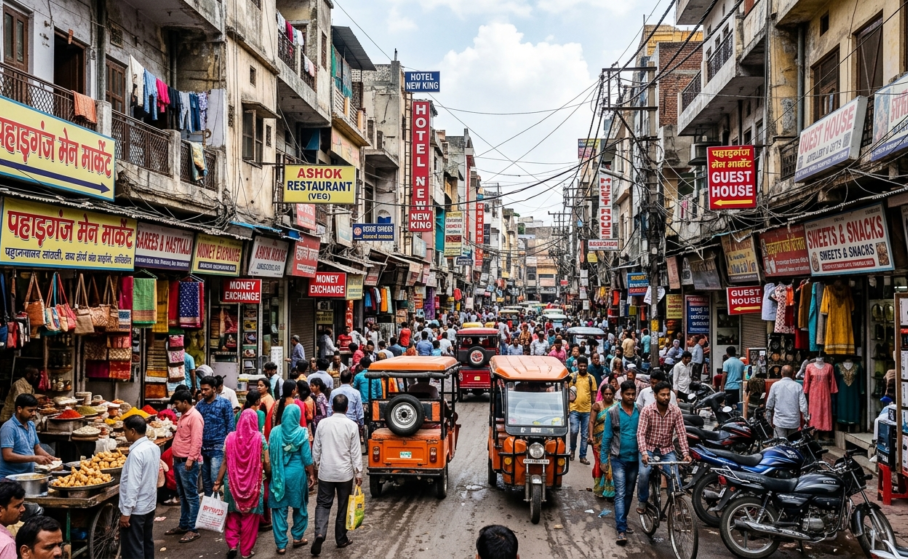
Paharganj, New Delhi :- The Mecca of Global Backpackers and the Capital’s Vibrant Historic Commercial Node
Situated directly across the prominent eastern gateway of the New Delhi Railway Station, Paharganj stands as one of the oldest, densest, and most structurally unique commercial expanses in the National Capital Region. Far more than a conventional street bazaar, Paharganj operates as a self-sustaining global village, accommodating budget travelers, international backpackers, and multi-state merchants within its high-velocity ecosystem. From its medieval origins through the colonial period to the contemporary era, the locality has preserved a deeply distinct identity. While its narrow alleyways, heritage masonry, and relentless kinetic energy evoke the raw spirit of old Delhi, its proliferation of eclectic rooftop cafes, budget transit lodges, and specialized boutique storefronts lend it an international reputation. To experience the unedited, resilient, and high-octane pulse of Central Delhi, executing a pedestrian exploration of the Paharganj Main Bazar is an absolute necessity.
Detailed History
The territorial and socio-economic evolution of Paharganj is intimately tethered to the urban topography of the Mughal Empire and the historical expansion of Delhi.
- The Imperial Genesis and Nomenclature :– The historical lineage of Paharganj spans over three and a half centuries. During the Mughal era, specifically coinciding with the engineering of Shahjahanabad (Old Delhi) in the mid-17th century, this territory sat as an elevated ridge formation just outside the defensive perimeter of the Ajmeri Gate. Due to this specific elevated topography, the locality was designated as ‘Paharganj,’ translating literally to the “Market on the Hill.”
- The Imperial Grain Repository :– Prior to the cataclysmic invasion of Nadir Shah in 1739, Paharganj functioned as the largest wholesale grain market (Grain Market) operating outside the fortified city walls, serving as the primary transshipment node for agricultural commodities arriving from northern and central India.
- The Hippie Trail and Backpacking Metamorphosis :– During the late 1960s and 1970s, as the transnational “Hippie Trail” reached its cultural zenith, Paharganj underwent a massive structural pivot. Its immediate proximity to both Connaught Place and the central railway terminal, combined with the availability of exceptionally low-cost transient accommodation, transformed the market into India’s premier overland backpacker junction—a demographic dominance it fiercely retains to this day.
Detailed Architecture
The architectural landscape of Paharganj is a complex, high-density manifestations of traditional vernacular Indian urbanism (High-Density Urban Fabric) overlaid with multi-tiered contemporary commercial signage.
- The Main Bazar Axis and Linear Framework :– The structural spine of the locality is the Main Bazar Road, a continuous commercial corridor stretching approximately 1 to 1.5 kilometers. This linear artery is flanked by tightly packed, multi-story masonry structures featuring a mixed-use framework: the ground levels are heavily optimized for retail store displays, while the upper structural tiers house dense configurations of traveler lodges, guest houses, and open-air rooftop cafes. Innumerable narrow, intersecting alleyways branch off this main axis, forming a labyrinthine interior network.
- Colonial-Mughal Vernacular Remnants :– Meticulous observation of the older structural facades reveals significant historic architectural components, including heavily carved timber window frames, decorative cast-iron balconies, and narrow cantilevered projections characteristic of late 19th-century design. Over these historic bases, modern plate glass, aluminum frame retrofits, and neon commercial light boxes have been installed, creating a highly textured, raw urban aesthetic.
- Visual Density and Spatial Dynamics :– The visual landscape is exceptionally saturated. The public airspace and shop frontages are completely filled with hanging leather apparel, arrays of ethnic jewelry, vertical columns of footwear, and complex multi-lingual signage in Hebrew, French, Japanese, and Russian, projecting a hyper-global street dynamic.
Travel Guide & Routes
To plan an exceptionally structured, efficient, and logistically sound navigation through the dense grid of Paharganj, refer to this detailed operational index.
- Market Timings :–
- The Main Bazar commercial zone remains comprehensively operational from 10:00 AM to 11:00 PM daily.
- Weekly Holiday :– The retail market officially observes its closed day on Mondays. While bulk wholesale warehouses, independent street vendors, and certain specialized craft stalls remain shut on Mondays, major transit hotels, money changers, and international rooftop cafes continue full uninterrupted operations.
- Entry Fee :–
- Admission to this public historic commercial district is entirely Free of Charge.
- How to Reach :–
- By Metro (The Absolute Premier Mode) :– The locality is bookended by two highly efficient mass transit nodes. At the eastern terminus lies the New Delhi Metro Station (serving the Yellow Line and the Airport Express Line); exiting this hub places commuters directly facing the immediate entry point of the Main Bazar. At the western terminus lies the R.K. Ashram Marg Metro Station (serving the Blue Line), providing direct linear access into the opposite end of the market grid.
- By Road/Bus :– Situated at the geographic core of Central Delhi, the destination is perfectly accessible via app-based cabs, local auto-rickshaws, and numerous arterial DTC buses terminating at the New Delhi Railway Station outer bays.
- Photography Spots :–
- The Rooftop Panorama :– Accessing any of the elevated rooftop cafes (such as Sam’s Cafe or Metropolis) provides an exceptional high-angle, deep-perspective frame of the kinetic movement, cascading signs, and packed street life below.
- Alleyway Murals and Graphiti Art :– The inner intersecting lanes feature striking, avant-garde wall murals and graffiti executed by international street artists, juxtaposed beautifully against aging brickwork.
- The Cross-Cultural Interface :– Capturing the candid, high-contrast interactions between nomadic global backpackers, local merchants, and traditional street vendors offers rich documentation of Delhi’s urban subcultures.
- Local Flavors (Must-Experience Dining) :– Paharganj is celebrated for offering a fascinating culinary dichotomy, ranging from historic North Indian street institutions to specialized continental cuisines:
- Sita Ram Diwan Chand :– The undisputed culinary institution of Paharganj. This legendary spot is nationally renowned for serving a highly precise, exceptionally soft, paneer-stuffed variant of Chole Bhature that draws food enthusiasts from across the country.
- The International Rooftop Cafes :– Venues like Sam’s Cafe and Khalsa Restaurant are highly sought after for serving extraordinarily authentic, budget-friendly Mediterranean and Middle Eastern platters (Falafel, Creamy Hummus, Shakshuka) alongside classic Italian pasta and English breakfast spreads.
- Banke Bihari Corner :– A classic outpost positioned inside the main lane, famous for delivering piping hot, ultra-crisp khasta kachoris and deep-fried bedmi puris paired with highly spiced potato curries.
- Famous Specialized Items to Shop :–
- Artisanal Leather Goods :– Genuine hand-stitched leather backpacks, vintage messenger bags, heavy riding boots, utility belts, and pressed-paper leather journals at deep wholesale rates.
- Bohemian-Chic & Hippie Apparel :– Flowing organic cotton tunics, classic harem pants, vibrant tie-and-dye shirts, pashmina stoles, and casual travel gear.
- Curated Accessories & Jewelry :– Extensive arrays of heavy oxidized metallic jewelry, natural stone beaded bracelets, artisanal wooden rings, and retro eyewear.
- Aromatic Extracts & Herbs :– High-grade traditional Indian attars (concentrated perfumes), organic herbal incense formulations, pure essential oils, and therapeutic Ayurvedic items.
Nearby Attractions
Given its highly centralized placement within the capital core, a journey through Paharganj can be effortlessly synthesized with these surrounding landmarks.
- Connaught Place (CP) :– Positioned barely 1.5 kilometers south, this iconic British Georgian-era circular commercial and financial hub is the premier destination for high-street shopping, upscale dining, and central park access.
- New Delhi Railway Station (NDLS) :– Anchored directly opposite the market’s eastern boundary, this massive infrastructure hub stands as one of the largest and most complex rail transit centers in India.
- Ancient Hanuman Temple (Connaught Place) :– Located 2 kilometers away, this historic worship site dates back centuries and is deeply revered for its towering deity structure and a traditional peripheral market specializing in intricate bangles and henna art.
- Sadar Bazar & Chandni Chowk :– Positioned approximately 2.5 kilometers north, these historic commercial districts of Old Delhi function as the largest wholesale trade hubs in Asia, presenting an unmatched spectacle of traditional mercantile culture.
Interesting Facts
- The Transnational Melting Pot :– Paharganj represents a rare urban space where tourists from the United States, Israel, Western Europe, and East Asia navigate the exact same pavement lanes daily. This continuous multi-decade exposure has enabled local merchants and street hawkers to comfortably converse in multiple foreign languages, including Hebrew, Spanish, Russian, and Japanese.
- The Cinematic Underbelly Conduit :– The raw, unfiltered texture, dense human traffic, and bohemian energy of Paharganj make it a premier location for realistic cinema. Celebrated filmmakers have shot crucial sequences here, including Danny Boyle’s Academy Award-winning Slumdog Millionaire, Anurag Kashyap’s gritty Dev.D, and the cult urban comedy Delhi Belly.
- The District That Never Sleeps :– Owing to its symbiotic structural link with the central railway terminal, Paharganj operates on a strict 24-hour kinetic cycle. It is one of the exceptionally rare zones in Delhi where transit ticketing agencies, foreign exchange counters, local tea stalls, and select diners remain active through the deep hours of the night.
Important Questions and Answer :-
Question 1:– Is navigating Paharganj safe for solo travelers and international backpackers?
Answer:– Yes, Paharganj maintains a consistent and solid safety baseline due to round-the-clock foot traffic, heavy civilian presence, and continuous local police patrolling. However, given its high density and crowded conditions, visitors must exercise standard urban vigilance: protect personal belongings from opportunistic pickpockets in crowded zones, and avoid exploring poorly lit, deep internal alleyways alone late at night.
Question 2:- Is aggressive price negotiation expected across the retail stores in Paharganj?
Answer:– Active bargaining is an absolute cultural norm across all open-air street stalls, garment racks, and accessory kiosks along the Main Bazar. Initial prices quoted to international tourists or new visitors are often significantly scaled up. Strategic buyers can comfortably negotiate final transactions down by 30% to 50%. Conversely, established leather showrooms and high-grade handicraft emporiums operate under strict fixed-price regimes.
Question 3:– What is the most practical transit mode and optimal time to explore the market?
Answer:– The absolute best way to experience Paharganj is via Pedestrian Walking, as the high density of foot traffic and structural narrowness make vehicular entry highly impractical. Scheduling your exploration between 03:00 PM and 08:00 PM ensures you experience the market at its highest cultural and visual vibrancy.
Author’s Thoughts
From an analytical and urban anthropological view, Paharganj is a fascinating, entirely unfiltered urban phenomenon that defies the sanitized uniformity of modern commercial malls. It is a space that deliberately forces you to engage with the raw, uncompromising realities of a living, breathing historic city. The true genius of Paharganj rests in its absolute cosmopolitan friction—where the pungent, rich aroma of frying North Indian spices directly collides with the scent of roasted Mediterranean coffee drifting from an elevated rooftop. It represents an urban crossroads where multi-generational Indian trading families and transient international nomads coexist seamlessly within the same narrow spatial grid. If you seek to experience New Delhi not merely as a collection of manicured monuments, but as a roaring, historic, and borderless human crucible, spending an afternoon walking the length of the Paharganj Main Bazar is an irreplaceable rite of passage.
“Where the historic grit of Old Delhi collides with the nomadic spirit of a borderless world, high above the bustling tracks—that is the raw, unforgettable pulse of Paharganj.”