
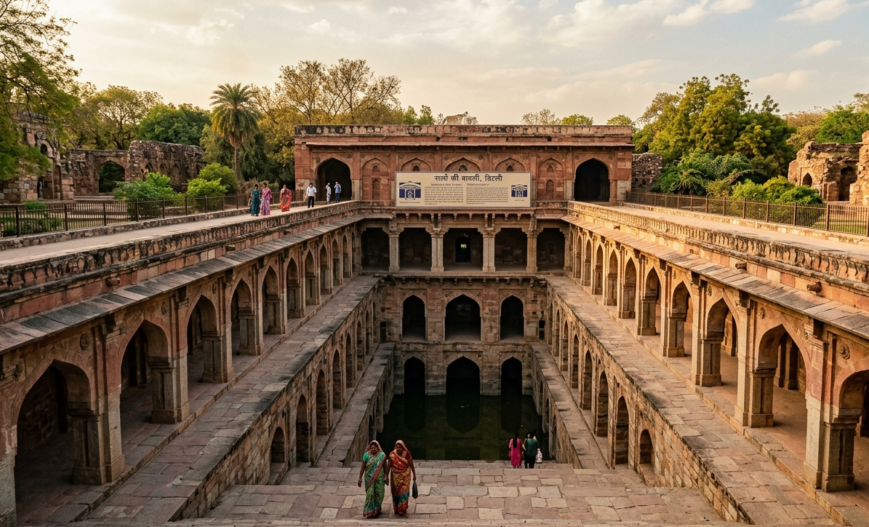
Rajon Ki Baoli, Delhi :- The Architectural Mastery of the Lodhi Era Stepwell
Detailed History
Rajon Ki Baoli, nestled deep within the verdant and historic expanse of the Mehrauli Archaeological Park in South Delhi, stands as one of the most magnificent, imposing, and remarkably preserved stepwells (Baolis) in the capital. Far beyond its rudimentary utility as an ancient subterranean water reservoir, it represents a supreme pinnacle of late 15th and early 16th-century Lodhi Dynasty architecture.
The operational foundation of this monumental stepwell dates back to the year 1506, commissioned during the illustrious reign of Sultan Sikandar Lodi. Historical archives state that the project was executed under the patronage of Daulat Khan, a highly influential nobleman and administrator of the era. The naming convention of ‘Rajon Ki Baoli‘ carries an intriguing etymological narrative; it does not derive from ‘Raja’ (Kings) or royal lineages, but rather from the Hindi term ‘Raj’ or ‘Rajmistry’ (Master Masons). During the early decades of the 20th century, the abandoned structure was temporarily occupied as a structural base and resting camp by a large contingent of local masons working across South Delhi. Consequently, the local populace began colloquially identifying the monument as Rajon Ki Baoli. The structure beautifully demonstrates the high-caliber hydro-engineering prowess of medieval India, providing an elite social sanctuary filled with chilled groundwater and structural shade during Delhi’s punishing summer seasons.
Detailed Architecture :-
The overall design architecture of Rajon Ki Baoli is a masterful display of the structural symmetry, clean lines, and geometric precision that characterized the architectural transition from the Tughlaq to the Lodhi style.
- Four-Tiered Subterranean Structure :– The stepwell is configured as an expansive four-story deep subterranean complex carved directly into the rocky terrain of the ridge. A grand, wide staircase descends from the northern platform, leading down systematically to the primary rectangular pool at the deepest base level. As visitors descend each vertical layer, the ambient temperature drops significantly, demonstrating the natural air-cooling capacity of the design.
- Symmetrical Arched Cloisters :– Each level of the stepwell is flanked on both lateral sides by continuous, highly symmetrical arcades featuring elegant pointed arches (piers). Tucked directly behind these arched corridors are compact multi-purpose chambers (rooms). Historically, these cool subterranean chambers served as resting inns (Seráis) for weary traders, sufi travelers, and nearby residents looking to escape the dry surface winds.
- Integrated Mosque and Twelve-Pillared Tomb :– The defining architectural attribute of the Rajon Ki Baoli complex is its seamless integration with an elevated stone mosque and a magnificent ‘Barakhamba’ (twelve-pillared) tomb pavilion positioned on the western edge at ground level. The fine plaster incised medallions, calligraphic motifs, and stone carvings adorning the mosque’s Mihrab display elite craftsmanship.
- Photography Spots :– For architects, heritage scholars, and conceptual street photographers, Rajon Ki Baoli operates as a premium sanctuary. Standing at the topmost northern landing and capturing the deep convergence of the steps vanishing into the lower tiers framed by the rhythmic repetition of the side arches creates an exceptional depth of field frame. The dramatic interaction of shifting sunlight passing through the deep stone arcades offers high-contrast lighting (chiaroscuro effects) perfectly optimized for fine-art heritage photography.
Travel Guide & Routes :-
- Ticket :– Because Rajon Ki Baoli is safely located within the protected state-managed boundary of the Mehrauli Archaeological Park, there is absolutely no entry fee or ticket fee mandated for national or international visitors. Commercial and amateur still photography is completely free.
- Visiting Time :– The gates of the heritage park remain open from 06:00 AM to 06:00 PM daily. To explore the architecture comfortably without harsh solar glare, the optimal hours are between 07:00 AM and 10:00 AM or post 04:00 PM in the golden evening light.
- How to Reach :–
- By Metro :– The most seamless transit gateway is via the Delhi Metro Yellow Line. The nearest transit points are Qutub Minar Metro Station and Chhattarpur Metro Station. The pedestrian entry gate of the Mehrauli Archaeological Park sits approximately 1.5 kilometers from the Qutub Minar metro platform, easily accessible via local auto-rickshaws or walking trails.
- By Bus :– The historical Mehrauli Bus Terminal serves as the closest localized bus station, linked smoothly via direct routes from Central, West, and South Delhi points.
- By Road :– Commuters can drive smoothly down Anuvrat Marg or the main Mehrauli-Gurugram Road (MG Road) to reach the park terminal. (Crucial Note: Private vehicles are strictly restricted inside the historical park zone. Visitors must undertake an incredibly scenic 500-to-700 meter nature walk along paved forest trails from the main entry checkpoint to reach the stepwell location).
- Nearby Attractions :– The historic Jamali Kamali Mosque and Tomb, the world-famous Qutub Minar Complex, the ancient fort walls of Lal Kot, the structural Tomb of Ghiyasuddin Balban, and Gandhak Ki Baoli (the sulfur stepwell).
- Local Flavors & Famous Markets :– The nearby historic lanes of old Mehrauli bazaar are deeply famous for traditional street delicacies including crispy khasta kachoris, Bedmi Poori, and localized samosas. For contemporary fine dining, the immediate periphery of Qutub Minar features a high-density cluster of luxury European-style cafes and premium rooftop lounges. Shopping enthusiasts can explore the centuries-old Mehrauli Market, heavily preferred for designer ethnic wear, boutique bridal trousseaus, and traditional craft materials.
Interesting Facts :-
- Rajon Ki Baoli represents one of the highly unique heritage layouts in India where an active religious mosque, a royal tomb pavilion, and a deep public water system coexist inside a single integrated structural platform.
- During the apex of the Lodhi era, the hydro-static equilibrium of the stepwell was so profound that water routinely submerged the entire lower tier of the arched chambers, which has contemporary receded to the lowest well shaft due to urban groundwater table variations.
- Owing to its heavily protected and secluded geographical position inside the dense green canopy of the Mehrauli forest, it remains rated as one of Delhi’s most tranquil, undisturbed, and ‘secret’ heritage sanctuaries.
Important Questions and Answer :-
Question 1:– Did Rajon Ki Baoli historically serve as a private luxury palace pool for medieval kings?
Answer:- No, the stepwell was constructed as a high-capacity public utility project by nobleman Daulat Khan during Sultan Sikandar Lodi’s rule. Its name references the local master masons (‘Raj’) who utilized its chambers as a collective seasonal camp centuries later.
Question 2:- Does the stepwell still contain water in the current period?
Answer:- Yes, the deep circular well shaft and the primary lower rectangular channel gather substantial amounts of freshwater during the peak monsoon season. However, during the height of the summer heatwaves, the water line drops substantially down to the lowest base levels.
Question 3:– Is the trail leading to Rajon Ki Baoli inside the Mehrauli Archaeological Park clearly demarcated for solo travelers?
Answer:- Yes, the Archaeological Survey of India (ASI) has placed highly strategic, multilingual directional signboards along all intersecting paved walking paths starting from the primary park gate, making navigation towards the stepwell completely straightforward.
Author’s Thoughts :-
Stepping out from the dense green forest canopy of Mehrauli and standing before the grand vertical drop of Rajon Ki Baoli is akin to stepping through a portal across centuries. The sheer silence inside these deep stone galleries, broken only by the occasional flutter of pigeons, forces an immediate sense of introspection. It stands as a silent monument to an era that perfectly balanced architectural grandeur with ecological survival through state-of-the-art rainwater harvesting. In an age dominated by glass-and-steel skyscrapers, a quiet afternoon spent sitting on the weathered sandstone steps of Rajon Ki Baoli is the ultimate antidote to urban exhaustion—a true pilgrimage for any history lover exploring the deep layers of old Delhi.
“Resting majestically beneath the green shadows of Mehrauli, Rajon Ki Baoli remains a brilliant subterranean testament to Lodhi architectural genius and the timeless science of ancient water conservation.”