
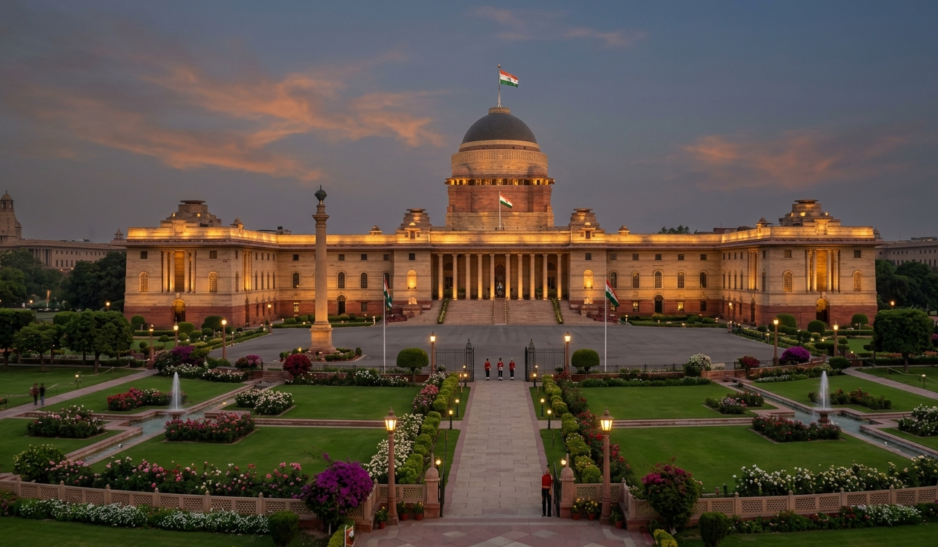
Rashtrapati Bhavan :- The Pride of Indian Democracy and Architectural Zenith
Proudly standing atop the Raisina Hill in the absolute center of New Delhi, the ‘Rashtrapati Bhavan’ (President’s House) is not just the official residence of the First Citizen of India; it is the ultimate symbol of national pride, democratic values, and unmatched architectural brilliance. Sprawling across an immense 130-hectare (330 acres) estate, this structural masterpiece stands as one of the largest official presidential residences in the world. In this comprehensive blog, we will take a deep dive into the illustrious history, cross-cultural architecture, and complete travel details of this iconic landmark.
Detailed History
The history of Rashtrapati Bhavan is deeply intertwined with the dawn of the 20th century. When the British Empire decreed the relocation of India’s capital from Calcutta (now Kolkata) to Delhi during the Delhi Durbar of 1911, a grand palace was envisioned for the British Viceroy, originally termed the ‘Viceroy’s House’.
The monumental task of designing this empire-defining estate was entrusted to the legendary British architect Sir Edwin Lutyens and his close associate Herbert Baker. The construction officially commenced in 1912 and spanned nearly 17 long years of meticulous craftsmanship. Finally completed in 1929, the palace welcomed its first British resident, Viceroy Lord Irwin, in 1931.
On January 26, 1950, when India transitioned into a sovereign Republic, this grand mansion was formally rechristened as ‘Rashtrapati Bhavan‘, welcoming Dr. Rajendra Prasad, India’s first President, into its hallowed halls. Since then, it has stood as a monumental witness to independent India’s history, major democratic milestones, and top-tier diplomatic receptions.
Detailed Architecture
The architectural grammar of Rashtrapati Bhavan is a spectacular fusion of classical Western proportions and traditional Indian motifs, leaving global structural engineers spellbound.
- Exterior Architecture :– The primary H-shaped mansion features four stories housing a total of 340 rooms. It was constructed using locally quarried grey quartzite along with millions of tons of red and pink Dholpur sandstones. The ultimate crown of the structure is its massive central dome, heavily inspired by the world-famous Buddhist Stupa of Sanchi. Additionally, the pillars are adorned with beautifully carved stone bells, famously called ‘Lutyens’ Bells’, which draw directly from classic Indian temple architecture.
- Interior Architecture :– The interiors present a visual symphony of regal elegance. The most prominent room is the ‘Darbar Hall’, positioned directly beneath the main dome, which hosts national award investitures and historic swearing-in ceremonies. Another breathtaking space is the ‘Ashoka Hall’, world-renowned for its hypnotic Persian-style ceiling paintings and majestic chandeliers. Additionally, the Marble Hall, the sprawling banquet spaces, and long state corridors house invaluable museum artifacts, historic paintings, and life-size oil portraits of past Indian presidents.
Travel Guide & Routes :-
For travelers wishing to witness this majestic bastion of the Indian Republic up close, the complete travel breakdown is arranged sequentially below.
- Ticket :– To tour the designated circuits of Rashtrapati Bhavan (Circuit 1, 2, and 3), a nominal registration fee of ₹50 per person is charged. Entry is completely free for children under 8 years of age. All bookings must be made online through the official Rashtrapati Bhavan web portal; no on-spot or counter ticket sales are available.
- Visiting Time :– The gates are opened for pre-booked tourist slots from 09:00 AM to 04:00 PM.
- Opening & Closing Time :– The mansion circuits are open to the general public on specific days of the week (typically Tuesday through Sunday, excluding gazetted government holidays). The world-renowned ‘Amrit Udyan’ (formerly Mughal Gardens) is opened to the public for a special seasonal window during the peak of spring (February to March).
- How to Reach :–
- By Metro :– The absolute closest transit station is ‘Central Secretariat’, which serves as an intersection for both the Yellow and Violet Lines. From there, the entry gates (Gate No. 2 or Gate No. 37) are just a short walk or quick auto-rickshaw ride away.
- By Bus :– Multiple DTC buses connecting to ‘Central Secretariat’ or ‘Krishi Bhavan’ stop directly in the vicinity of the Raisina Hill complex.
- By Road/Cab :– You can easily navigate via a private vehicle or an app-based cab setting the destination to ‘Rashtrapati Bhavan, New Delhi’. It rests perfectly on the western edge of the Kartavya Path (formerly Rajpath). Due to highest-level security protocols, private passenger vehicles are not permitted inside the gates and must utilize designated external parking bays.
Photography Spots, Local Flavors, and Famous Markets
- Photography Spots :–
- The majestic front courtyard (Forecourt) facing the monumental ‘Jaipur Column’.
- The perfectly symmetrical, sweeping view of Rashtrapati Bhavan framed from the central axis of Kartavya Path.
- The spectacular color canvas of exotic tulips, roses, and fountains during the spring opening of the Amrit Udyan.
- (Crucial Note :– Due to strict security mandates, cameras, mobile phones, and general photography are strictly forbidden inside the main historical rooms of the mansion. Photography is only permitted in the outdoor gardens and the external forecourt within designated guidelines).
- Local Flavors :– There are no commercial food stalls or markets operating within the high-security perimeter of the estate. However, stepping outside onto ‘Kartavya Path’, you can enjoy Delhi’s legendary street food culture, including iconic ice cream vendors, golgappas, and bhel puri. For a premium sit-down culinary experience, head over to nearby Connaught Place (CP) or Khan Market to explore exceptional North Indian, Mughlai, and global cuisines.
- Famous Market :– The most iconic shopping hubs located nearby are ‘Connaught Place’ and the vibrant ‘Janpath Market’. Janpath is globally celebrated for affordable handloom garments, ethnic jewelry, brass artifacts, and rare curios. Additionally, the premium ‘Khan Market’, known as one of Delhi’s trendiest lifestyle hubs, is just a 10-minute drive away.
Nearby Attractions :-
You can effortlessly expand your travel itinerary by visiting these globally famous monuments located right next to the presidential estate.
- Kartavya Path & India Gate :– The monumental triumphal arch and the National War Memorial resting at the eastern end of the central avenue.
- The National Museum :– Holding one of the world’s largest collections of ancient Indian art, antiquities, and historic treasures, situated just down the road.
- The New Parliament House :– India’s striking new triangular architectural icon of governance, located right adjacent to the estate.
- Gurudwara Bangla Sahib :– One of the most sacred, serene, and culturally active Sikh shrines in the capital, located roughly 2.5 km away.
Interesting Facts :-
- The mega-structure consists of 340 palatial rooms, 74 corridors, 18 grand staircases, and 37 ornamental fountains. Uniquely, over 700 million bricks and 3 million cubic feet of heavy stone were used in its creation without utilizing a single piece of structural steel.
- The pristine ‘Amrit Udyan’ situated at the back of the mansion flawlessly integrates both English and Mughal landscaping concepts, boasting over 159 celebrated varieties of roses and rare botanical herbs.
- The Rashtrapati Bhavan operates like a self-sustaining miniature city, featuring its own domestic staff, medical facilities, and dedicated artistic preservers working round-the-clock to maintain the estate’s glory.
Important Questions and Answer :-
Question 1:– Can I explore Rashtrapati Bhavan directly via a walk-in entry without an online pass?
Answer:- No, due to state-level security guidelines, direct walk-in entry is absolutely prohibited. Every visitor must secure a formal online booking confirmation along with a valid government ID before arriving at the gates.
Question 2:– When does the famous ‘Amrit Udyan’ open for general public tours?
Answer:- The Amrit Udyan opens to the public exclusively for a limited spring window every year, typically from the first week of February through mid-March. Online pre-registration is mandatory for this garden tour as well.
Question 3:– Are mobile phones and bags allowed inside the main palace tour?
Answer:- No, visitors are strictly prohibited from carrying mobile phones, bags, cameras, or any electronic equipment inside the core palace rooms (Circuit 1). Visitors must store all personal belongings safely at the official clockroom facilities located at the entry gates. However, mobile phones are generally permitted during the seasonal Amrit Udyan garden walk.
Author’s Perspective :-
In my view, Rashtrapati Bhavan is much more than a stunning display of stone and symmetry; it is the living, breathing heart of the Indian Republic. As you walk up the historic incline of Raisina Hill, the sheer scale of the palace commands absolute awe and leaves you with an overwhelming sense of national pride. While Sir Edwin Lutyens originally created this monument to display the unyielding authority of the British Empire, history has beautifully reclaimed it, and today every single pillar echoes the voice of Indian sovereignty and secular democracy. It is a journey through history and statehood that every Indian must experience at least once in their lifetime.
S“Seated majestically atop the heights of Raisina Hill, this grand monument sings an eternal saga of India’s democratic power, heritage, and sovereign pride.”