
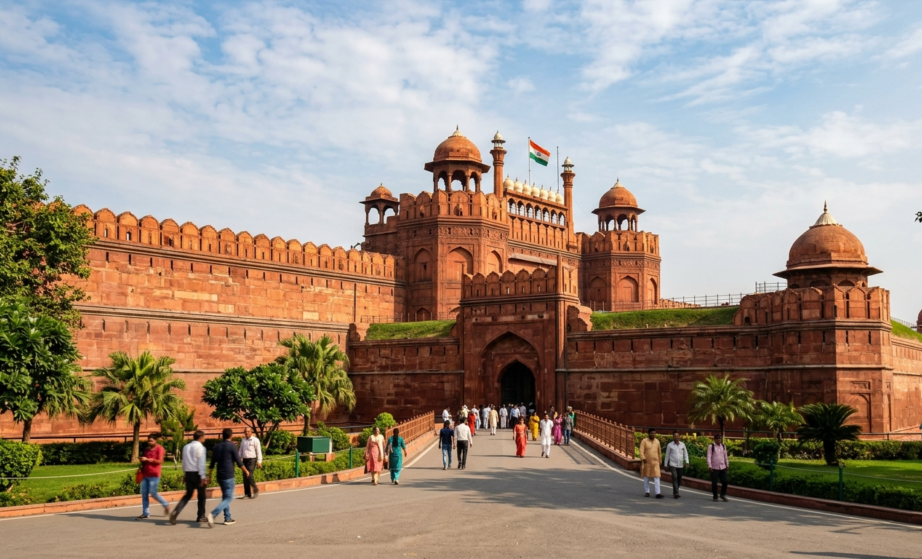
Red Fort, Delhi
Following the historic fort of Gwalior, let us return to the capital city of Delhi, where the majestic Red Fort (Lal Qila) stands along the banks of the Yamuna River as the ultimate national symbol of India’s sovereignty, freedom, and historical pride. Representing the absolute zenith of Mughal architecture, this grand fortress is not merely a palace of the past but a living witness to centuries of imperial transitions and India’s struggle for independence. Declared a UNESCO World Heritage Site in 2007, it serves as the historic stage from which the Prime Minister of India unfurls the national flag every Independence Day.
Detailed History :-
The construction of the Red Fort was commissioned in the 17th century by the fifth Mughal Emperor, Shah Jahan. When Shah Jahan decided to shift his imperial capital from Agra to Delhi, he laid the foundation stone of this fort on May 13, 1638. Designed by the master architect Ustad Ahmad Lahori (who also conceptualized the Taj Mahal), the construction took a decade and was successfully completed in 1648. The newly fortified city surrounding the palace was named ‘Shahjahanabad‘ (modern-day Old Delhi).
Initially christened as ‘Qila-e-Mubarak‘ (The Blessed Fort), the fortress witnessed major geopolitical shifts over the centuries. Following the devastating raid by Persian invader Nadir Shah (1739) and subsequent Maratha control, the fort became the nerve center of the First War of Indian Independence in 1857, when the revolutionaries rallied around the last Mughal Emperor, Bahadur Shah Zafar. After suppressing the uprising, the British forces seized the fort, systematically dismantled a majority of its inner residential pavilions, and repurposed it into a military garrison. Upon India’s independence on August 15, 1947, the first Prime Minister, Pandit Jawaharlal Nehru, hoisted the tricolor at the Lahori Gate, signaling the dawn of a sovereign nation.
Detailed Architecture :-
Spanning across an expansive 254 acres of land, the structural layout of the Red Fort is crafted in an innovative octagonal design. It is enclosed by 2.4 kilometers of defensive perimeter walls built of massive blocks of red sandstone, rising up to 33 meters on the city-facing side. Its interior architecture is a brilliant synthesis of Persian, Timurid, and traditional Hindu structural vocabularies.
- The Main Gateways :– The fort features two primary gateways. The iconic ‘Lahori Gate’ facing west serves as the main public entrance and the focal point of national celebrations. Conversely, the ‘Delhi Gate’ facing south was designed for formal imperial processions and remains secure.
- Chhatta Chowk and Naubat Khana :– Stepping through the Lahori Gate, visitors enter ‘Chhatta Chowk‘ (The Covered Bazaar), a vaulted arcade that housed luxury silk and jewelry merchants during the Mughal era. This leads directly to the ‘Naubat Khana’ (Drum House), from where musicians heralded the arrival of the Emperor and visiting royals.
- Diwan-i-Am (Hall of Public Audience) :– A massive red sandstone pavilion featuring a grand colonnade where the Emperor addressed public grievances. At its heart lies an exquisitely carved white marble balcony throne where Shah Jahan sat in state.
- Diwan-i-Khas (Hall of Private Audience) :– Constructed entirely of premium white marble, this elite pavilion was reserved for high-level ministerial councils and foreign emissaries. Inscribed upon its walls is the famous Persian couplet: “Gar firdaus bar rue zamin ast, hami ast o hami ast o hami ast” (Meaning: If there is a paradise on earth, it is this, it is this, it is this). This very hall once housed the legendary Peacock Throne (Takht-e-Taus) embedded with the priceless Koh-i-Noor diamond.
- Rang Mahal and Mumtaz Mahal :– These served as the luxurious residential quarters (Harem) for the royal consorts. The Rang Mahal features a central marble lotus fountain fed by an intricate network of water channels known as ‘Nahr-i-Bihisht’ (Stream of Paradise) that cooled the royal chambers.
Travel Guide & Routes :-
Tickets & Entry :–
- For Indian Citizens :– ₹35 per individual (Cash) or ₹50 (Digital/Online booking).
- For Foreign Nationals :– ₹500 per individual (Cash) or ₹550 (Digital booking).
- Children below 15 years :– Entry is completely free of charge.
- Camera Fee :– Standard photography using smartphones or digital cameras is completely free. Videography using professional video equipment incurs a nominal charge of ₹25.
Timings :–
- Visiting Hours :– Open from 09:30 AM to 04:30 PM.
- Weekly Closure :– The Red Fort remains strictly closed to the public on Mondays. It operates normally from Tuesday through Sunday.
How to Reach :–
- By Metro :– The absolute fastest transit option is the Delhi Metro network. The ‘Lal Qila’ Metro Station on the Violet Line is located directly adjacent to the fort, with the fort walls visible immediately upon exiting. Alternatively, the ‘Chandni Chowk’ Metro Station on the Yellow Line is just a brisk 10-minute walk away.
- By Road/E-rikshaw :– Commuters traveling from New Delhi, Noida, or Gurgaon can easily take app-based cabs or DTC buses heading towards Old Delhi Railway Station or Kodai Pul. Local e-rickshaws are readily available at the metro station exits to shuttle visitors straight to the main ticket complex.
Photography Spots :–
- The Facade of Lahori Gate :– Capturing the symmetry of the red sandstone battlements flanked by the unfurled National Flag.
- The Arches of Diwan-i-Am :– The perspective created by the rows of multi-foliated sandstone pillars offers an incredible frame for portrait shots.
- The Inlay Work at Diwan-i-Khas :– The marble screens adorned with intricate Pietra Dura (stone inlay) floral works provide highly textured architectural backdrops.
Local Food & Shopping :–
- Local Cuisines :– Positioned directly opposite the fort gates is Chandni Chowk, the gastronomic capital of Delhi. No trip is complete without sampling the varieties of deep-fried breads at the historic Paranthe Wali Gali, the soft lentil dumplings at Natraj Dahi Bhalle, massive crisp Jalebis, and spiced Kachoris.
- Famous Markets :– The lively street markets of Meena Bazar (located right inside the entrance path), the historic Chandni Chowk market lines, and the wholesale corridors of Dariba Kalan are excellent for lifestyle shopping. Visitors can buy traditional ethnic wear, silver jewelry, handicrafts, and authentic Indian attars (perfumes).
Interesting Facts :-
- The White Fort Mystery :– Scientific restoration analyses by the Archaeological Survey of India (ASI) revealed that several inner structures of the fort were originally built using white limestone plaster. When the plaster began peeling over time, the British authorities sandblasted and painted the entire complex red for uniform preservation.
- The Plunder of the Peacock Throne :– During his brutal sack of Delhi in 1739, Persian ruler Nadir Shah completely looted the imperial treasury within the fort, taking Shah Jahan’s gem-encrusted Peacock Throne and the legendary Koh-i-Noor diamond back to Persia.
- The Historic INA Trials :– In 1945, the fort’s barracks served as the historic courtroom where the British administration court-martialed three top officers of Netaji Subhas Chandra Bose’s Indian National Army (INA)-Colonel Sehgal, Colonel Dhillon, and Major Shah Nawaz Khan-igniting widespread national fervor.
Important Questions and Answer :-
Question 1:- Why is Delhi’s iconic fortress called the ‘Red Fort’?
Answer:- The fortress derived its popular name from the monumental, high-rising defensive ramparts constructed entirely out of deep red sandstone blocks, giving the entire exterior a distinct crimson hue.
Question 2:– Are there active museums open inside the Red Fort complex?
Answer:- Yes, the fort houses multiple world-class interactive museums, including the ‘Azaadi ke Diwane’ museum, the 1857 Uprising Gallery, and the Dr drashay kala Museum showcasing rare artifacts, weapons, and historical records relating to Netaji Subhas Chandra Bose and the INA.
Question 3:- How much time should a traveler allocate to fully tour the Red Fort?
Answer:- Due to its expansive layout, vast garden courtyards, detailed architectural pavilions, and numerous multi-story museum installations, it takes roughly 2 to 3 hours to comprehensively explore the site.
“Carved out of crimson sandstone along the historical banks of the Yamuna, the Red Fort stands as a majestic citadel anchoring the imperial opulence of the Mughals and the proud democratic dawn of modern India.”